
Level Gauge Installation: Depth, Dead Zone and Bypass Clearance
The same rod measures piston stroke on a cylinder and liquid level in a tank, but the installation rules are different. A cylinder cares about concentricity and pressure; a tank cares about insertion depth and dead zones. Get the depth wrong and the low end of the range never reads correctly.
Insertion depth: the rod must cover the range you actually measure
Useful range is the span between the lower and upper dead zones, not the full rod length. There are several tens of millimetres of dead zone at the electronics end and a shorter one at the tip. A 3 m tank where you need 0 to 2.5 m does not call for a 3 m range: it calls for a range that covers 2.5 m with both dead zones outside the region you care about.
Sizing by tank height is the classic mistake. Pick a 3 m range for a 3 m tank and the upper dead zone lands right at the full level, so the reading freezes exactly when the tank fills.
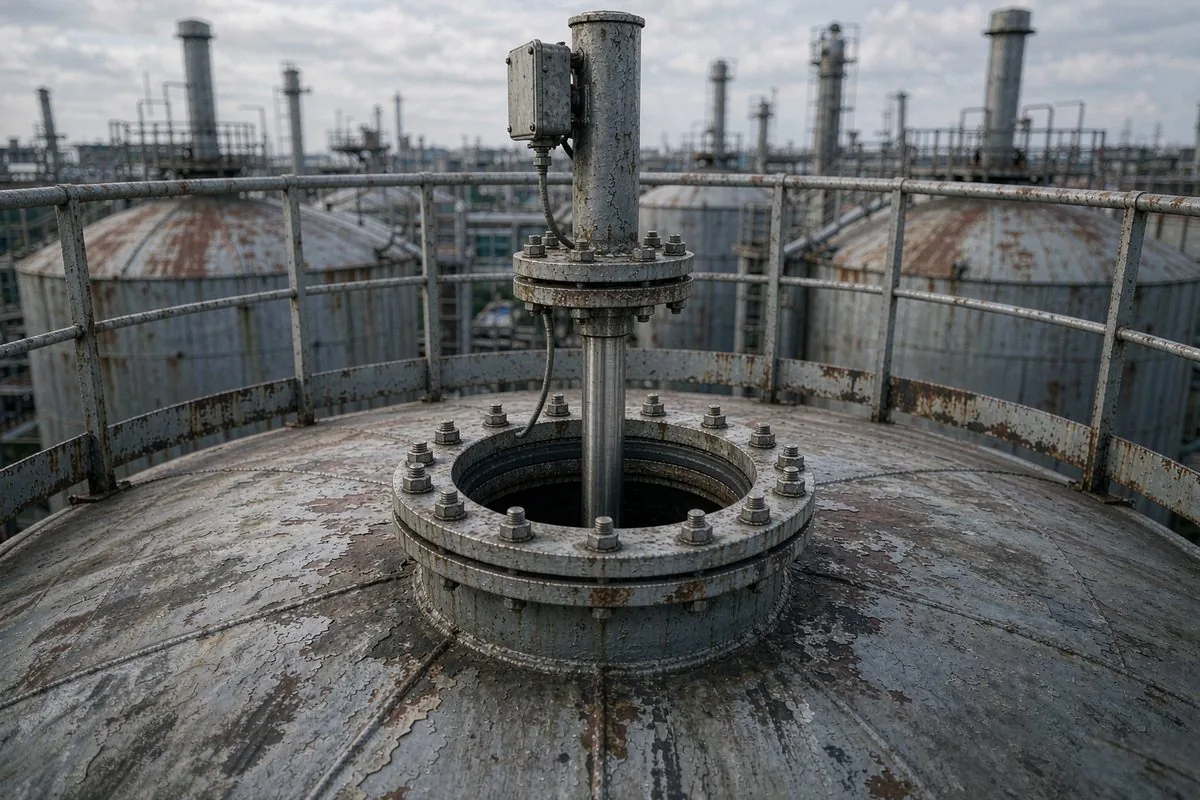
Dead zone position follows mounting direction
Rod entering from the top with the electronics head up puts the long dead zone at the full-level end. Mount it upside down and the dead zones swap ends, which also changes the calibration logic. Confirm head orientation before modifying an existing installation.
Side mounting adds a second problem: a horizontal or tilted rod lets the float rest against the lower wall, so part of its buoyancy is carried by the tube. Beyond 15 degrees of tilt, a float type is the wrong choice; use a submersible pressure transmitter instead.
Bypass chamber and flange: three dimensions must agree
Nozzle position, flange spacing and insertion depth have to match the drawing. Bypass chambers add one more: the chamber bore should be at least 1.2 times the float diameter. A 52 mm float in a 60 mm bore leaves 4 mm per side, and anything viscous or particulate will jam it.
Flange rating follows tank design pressure, not the experience you have with atmospheric tanks. Gasket material has to suit the medium as well; rubber swells in aromatics, so use PTFE or a spiral-wound gasket.
Keep clear of agitators and inlets
A rod directly above an impeller sees a vortex, and the float rides up and down with it. A rod under the inlet sees the incoming stream push the float down. Both look like instrument faults but are flow problems. Stop the agitator and the inlet, wait ten minutes, and read again: a stable reading proves it is flow, not electronics.
Where the rod must sit inside the mixing zone, fit a stilling tube with balance holes. Total hole area should be at least 1.5 times the tube cross-section, otherwise the level inside lags behind the tank.
Two checks after installation
Empty and full point check first. An empty tank should read just above the lower dead zone; a full tank just below the upper one. If both points are off in the same direction, shift the zero; if they are off in opposite directions, correct the span factor.
Then a static stability check: with the level steady, log readings for ten minutes. The spread should stay under 0.2% of range. Anything larger points to earthing, shielding or a coated float.
Finally, run a dynamic check at normal fill and drain rates and plot both curves. The difference at the same level is the hysteresis; more than 0.5% of range means the float is catching somewhere in the chamber.
One line
Installing a level gauge is not pushing a rod into a tank. It is aligning the range to the level band you actually measure. Get insertion depth, dead zone position or bypass clearance wrong, and no amount of calibration will fix it.
Frequently Asked Questions
Q: A 3 m tank where I need 0 to 2.5 m. What range?
Choose a range covering 2.5 m with both dead zones outside the region you measure, not a 3 m range. A 3 m range puts the long dead zone at full level.
Q: The reading keeps jumping. Is the sensor faulty?
Stop the agitator and the inlet, wait ten minutes and read again. A stable reading means it is flow, so move the rod. If it still jumps, check earthing, shielding and float coating.
Level Gauge Installation comes down to stroke, mounting style and output interface.magnetostrictive displacement sensorThe product range lists every series by stroke, mounting style and output interface, and is the practical starting point for selection.
← Back to News