
Oil-Water Interface: Float Density Between Two Media
Two liquids in one tank, separated into layers, means the interface height matters rather than the top surface. A magnetostrictive gauge can measure it, but only if the float density sits between the two liquids. Otherwise it floats on the top layer or sinks to the bottom, and you are back to measuring surface or tank floor.
Interface sensing differs from level sensing by float density alone
For plain level, the float is lighter than the medium and rides the surface. For interface, the float density is set between the light and heavy media: the upper layer cannot support it, the lower layer can, so it settles at the interface.
Example: oil at 0.85 over water at 1.0 calls for a float between 0.9 and 0.95. The standard 0.7 float cannot do interface work at all; it rides straight to the oil surface.
Float density is not a free parameter. Standard parts come at fixed densities, so interface work means matching a float to the density gap. If nothing matches, the measurement principle is wrong for that tank, not the setting.
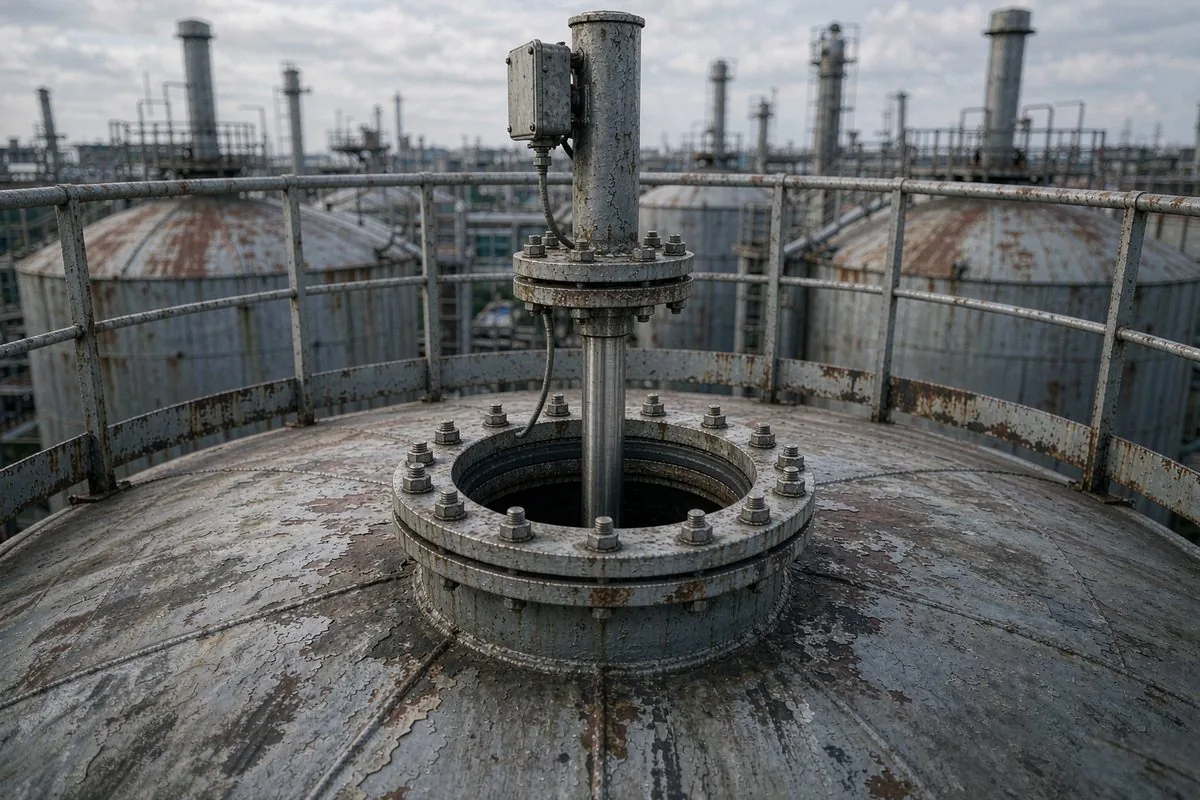
Three conditions that defeat float-based interface sensing
A thick emulsion band. Oil and water rarely meet at a clean line; there is usually a transition layer tens of millimetres deep. The float settles somewhere inside it and the reading drifts by that amount. Where emulsification is severe, float-based interface sensing should not be used.
Too small a density difference. Below 0.05 between the two media, the usable float window is 0.05 wide and temperature shifts push it out of range. Use differential pressure or RF admittance instead.
Coating from the upper layer. A viscous top layer wraps the float and changes its effective density. Weigh the float periodically; more than 5% gain means clean or replace it.
A fourth case is rarely mentioned but decisive: the two media may dissolve into each other or react. Some solvents shift the interface continuously in one direction, which looks like drift but is the process itself moving.
Stoppers matter more here than in level sensing
Interface work usually cares about a narrow band, not the whole rod. Stoppers limit float travel to the range where the interface can appear, keeping it out of the upper layer and off the bottom sludge. With a 10 mm bore and 20 mm outside diameter, place them 50 mm beyond each end of the expected interface band.
Record the current interface height and reading before moving a stopper. Any change invalidates the existing calibration, and that pair of numbers lets you recompute instead of running a full calibration again.
Calibration differs from level calibration
Level zero is set against a known liquid surface. Interface zero is set against a known interface height, usually an existing sample point or a gauge tap on the tank. Without that reference you are back-calculating from lab samples, and the error grows by an order of magnitude.
Take at least two points, one low and one high. Compare the reading difference against the measured height difference; a ratio more than 2% away from 1 means the float is not actually sitting at the interface, but in the emulsion band or a coating layer.
Maintenance runs more often than for level
Both media can coat the float, and it sits permanently in the dirtiest layer. Halve the cleaning interval compared with level service, and inspect the equator of the sphere, which is the part permanently at the interface.
After cleaning, test the float in clean water before refitting. It should sit upright with its upper half above the surface. A float that lists or half-sinks has liquid inside or coating left on, and will read off permanently.
One line
Interface sensing succeeds or fails on float density against the density gap. Below 0.05 difference, or with an emulsion band over 30 mm, do not use a float type.
Frequently Asked Questions
Q: How many gauges does interface sensing need?
One, provided the float density sits between the two media. Measuring surface and interface together needs two: one float lighter than the upper medium, one between the media.
Q: How thick an emulsion band rules out a float?
Beyond 30 mm stability starts to suffer; beyond 50 mm the reading drifts continuously and is no longer usable. Move to differential pressure or RF admittance.
Oil-Water Interface comes down to stroke, mounting style and output interface.magnetostrictive displacement sensorThe product range lists every series by stroke, mounting style and output interface, and is the practical starting point for selection.
← Back to News