Series 17EX intrinsically safe explosion-proof magnetostrictive displacement sensor
CNEX certified intrinsically safe (Ex ia IIB T4 Ga)
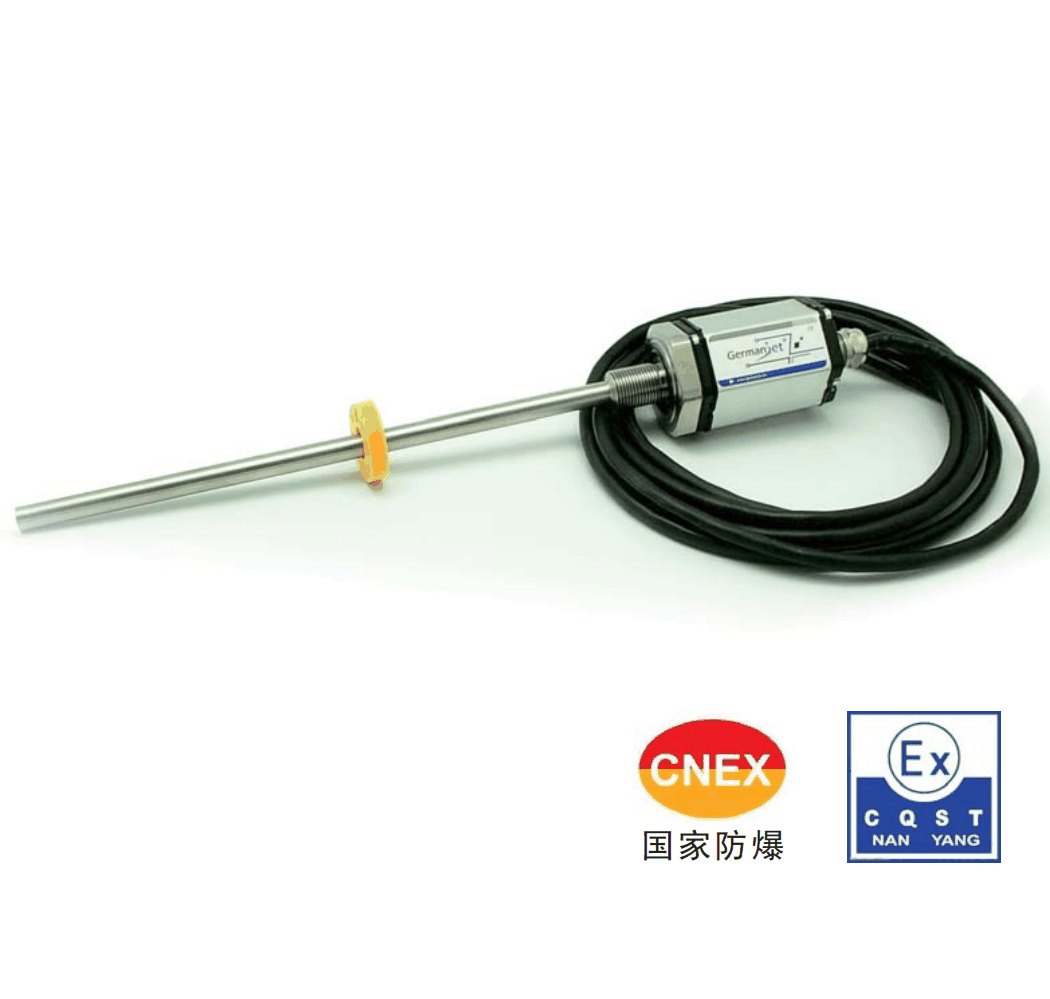
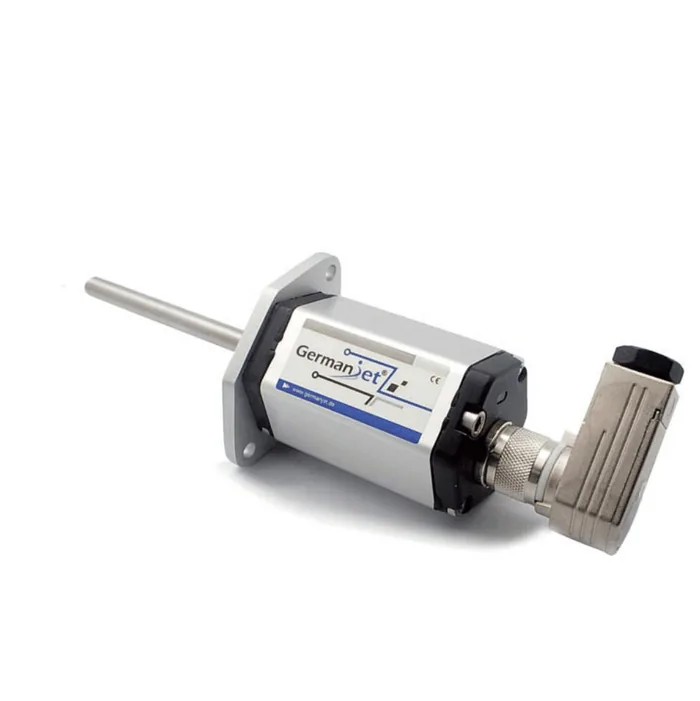
The Series 17EX intrinsically safe explosion-proof magnetostrictive displacement sensor is certified by CNEX (national explosion protection), marking Ex ia IIB T4 Ga (certificate no. CNEx26.3453X), with intrinsically safe (Ex ia) design. It suits position detection in hazardous environments such as oil extraction and refining, chemical production, pharmaceuticals and paint spraying. The explosion-proof design builds on the Series 17 modular architecture: an extended flying-lead cable avoids on-site wiring spark risk, and all circuit parameters are strictly limited to permitted energy levels. Multiple bus signal outputs are supported (0-10 V, 4-20 mA, SSI, CANBus, Profibus, Profinet, EtherCAT). Models 174Ex-179Ex.
Product Overview
The Series 17EX intrinsically safe explosion-proof version is a professional variant of the Series 17 flagship line with added Ex certification, holding CNEx national explosion protection certification, marking Ex ia IIB T4 Ga (certificate no. CNEx26.3453X, valid to 2031-09-08).
The intrinsically safe (Ex ia) design allows use in Zone 0/1/2 explosive gas atmospheres - oil extraction platforms, refineries, chemical plants, pharmaceutical workshops and spray booths. The certificate states that in Zone 0, precautions must be taken against ignition caused by impact or friction.
The extended direct cable outlet is an important safety detail: it avoids the spark risk that can arise from field wiring work. All circuit parameters are strictly designed to intrinsic safety energy limits, ensuring that even a fault cannot become an ignition source. The same wide choice of signal interfaces as Series 17 is supported.
Operating Principle
Series 17EX uses the same non-contact magnetostrictive measurement principle and modular architecture as Series 17. The key difference is that the electronics module has passed stringent intrinsic safety (Ex i) certification. Intrinsic safety design ensures that even under fault conditions the spark energy and surface temperature generated by the circuit stay below the ignition threshold of the hazardous gas - achieved by limiting capacitance, inductance and operating current/voltage. The extended flying-lead cable avoids the spark risk that field wiring operations can create, further improving safety.
Typical Applications
Technical Specifications
| Measuring Range | 100 ~ 4000 mm (same mechanical interface as Series 17) |
|---|---|
| Resolution | 0.0015% (min. ±5 µm) |
| Non-Linearity | < ±0.02% FS (min. ±90 μm) |
| Repeatability | < ±0.001% FS |
| Update Time | 0.5 ~ 2.0 ms (depending on stroke) |
| Supply Voltage | Intrinsically safe loop DC 12 V (Ui=12VDC, Ii=200mA, Pi=0.6W, Ci=8uF, Li=0.05mH) |
| Explosion Protection Certification | CNEx national explosion protection / Ex ia IIB T4 Ga (cert. no. CNEx26.3453X) |
| Protection Class | IP67 |
| Operating Temperature | -40 °C to +75 °C |
| Pressure Rating | 350 bar working / 600 bar peak (same as Series 17) |
| Piston-rod bore | ≥12.7 mm; cap M18×1.5 / through-hole Ø13 mm |
| Cable Outlet | Extended direct cable outlet (avoids sparks from field wiring) |
Models and Output Signals
Dimensions and Wiring Diagrams
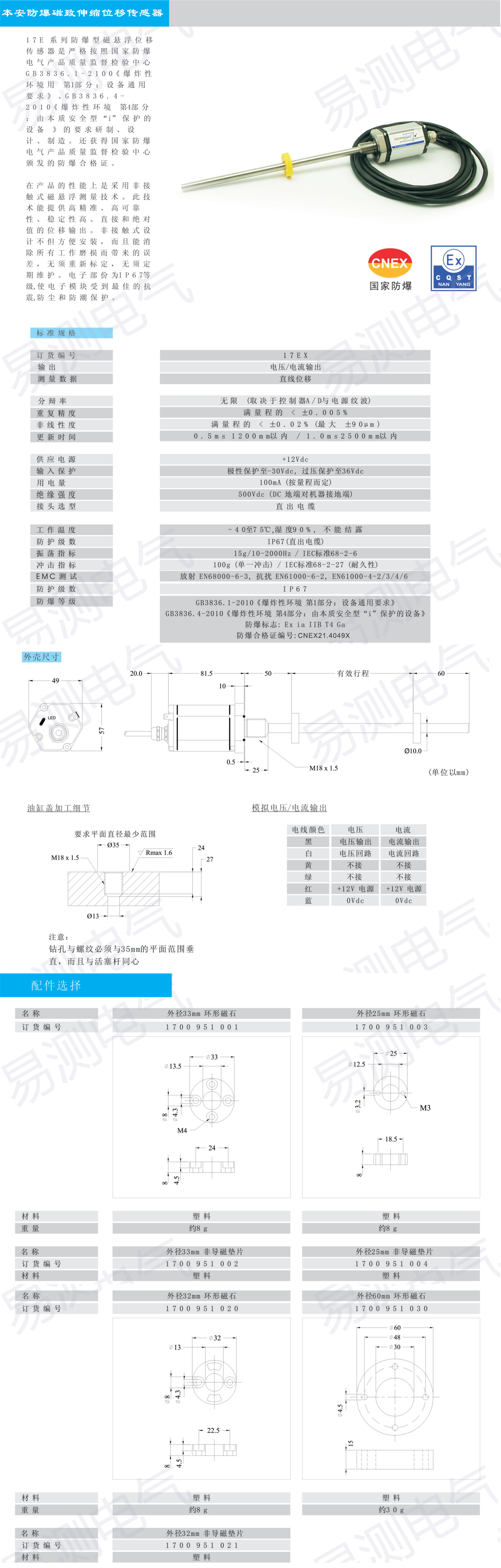
17EX Series - Intrinsically Safe Explosion-proof
Installation Precautions
- 17EX is an intrinsically safe version and must be used together with a certified isolating safety barrier; only the complete system may be used in explosive atmospheres.
- Installation, wiring and maintenance must comply with CNEx zone classification and GB 3836 explosion protection standards. Only qualified personnel may dismantle the unit.
- Never open the cover or mate/unmate connectors while energised in hazardous areas.
- The cable entry must use a certified explosion-proof gland and be sealed reliably.
- Mechanical installation same as Series 17: piston-rod bore ≥12.7 mm, cap M18×1.5, 350 / 600 bar.
Pricing Notes
17EX is an intrinsically safe certified product (CNEx, Ex ia IIB T4 Ga). In addition to measuring range and output signal, the price must also cover explosion protection certification, the matching safety barrier and compliance documentation, so it is normally higher than for standard models. Please provide the zone classification and gas group so we can select and quote accurately.
Technical Articles
SIL Is the Whole Loop for a Magnetostrictive Displacement Sensor: Sensor, Logic Unit and Actuator Together
Read More
Hazardous-Area Wiring of a Magnetostrictive Displacement Sensor: The Three Elements of an Intrinsically Safe Loop
Read More
Chemical Reactor Agitator Travel: Intrinsically Safe Displacement Monitoring by Zone
Read More
Oil Drilling Tool Position: Choosing an Explosion-Proof Displacement Sensor by Zone
Read More
Pick a Hazardous-Area Magnetostrictive Displacement Sensor by Zone 0, 1 or 2
Read More