
Magnetostrictive Level Gauge Calibration: Zero and Span
Calibrating a level gauge differs from zeroing a displacement sensor in one sentence: the datum is the liquid surface, not a mechanical face. A displacement sensor can zero against a cylinder end cap. A level gauge must zero against a known liquid level. Define the datum wrongly and every downstream calculation inherits the error.
Three checks before starting
Range and mounting position agree. The measuring span covers the section between the lower and upper flanges, while total tank height usually exceeds it. Confirm bore position, insertion depth and flange spacing; insufficient insertion depth loses the low-level section.
Float density matches the medium. The float must ride with an appropriate immersed fraction. Density changes, for example with temperature, alter immersion depth, and that is an inherent error of the method rather than something calibration removes.
Medium is stable. Close inlet and outlet valves and stop agitation during calibration. A rippled surface yields an average reading, so the zero you set is itself a moving value.
Choosing the datum: three options
Empty tank. Drain the tank so the float rests at the bottom and the reading is zero. The datum is unambiguous and repeatable, but many tanks cannot be emptied, and a float resting on sediment is not a true zero.
Full tank. Fill to the overflow or a calibration port and set the reading to span. Suits tanks with an overflow structure, but at full level the float may enter the upper dead band where response is no longer linear.
Arbitrary datum. Pick a reproducible level on site, measure it by manual dipping or another instrument, and calibrate the reading to that value. This is the most common industrial approach because it needs no shutdown and imposes no constraint on tank state.
All three share one requirement: the datum must be reproducible. If the zero was set against a dipped 1250 mm today, that same 1250 mm must be reachable next time. A datum that cannot be reproduced makes the calibration untraceable, and when a problem appears nobody can say what it was set against.
The two-point procedure
Record the raw reading. With the datum established, log the sensor's raw output before any conversion. This is the audit trail.
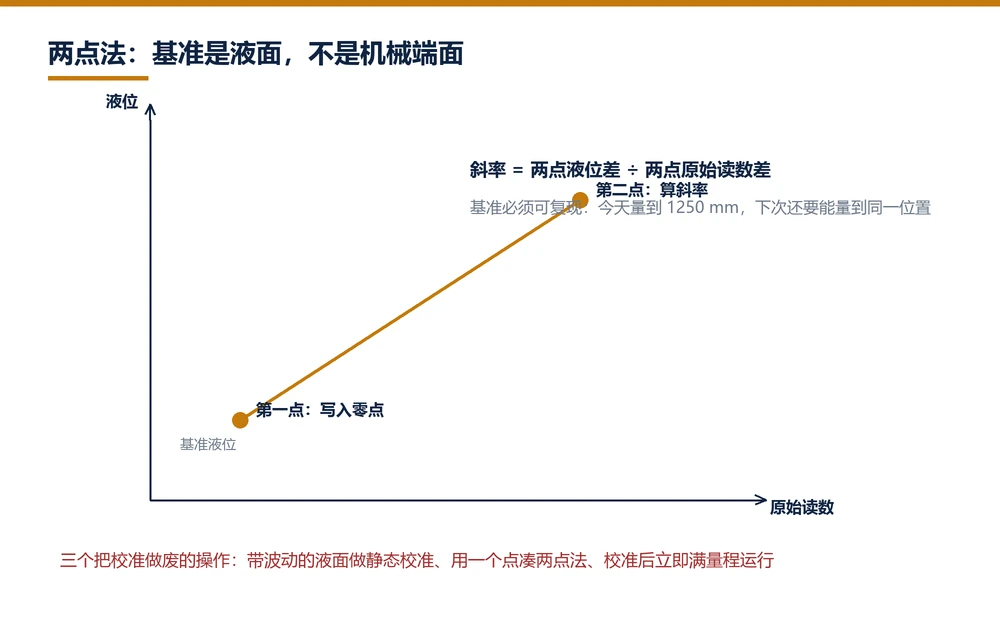
Write the zero. Define that raw value as the current level and enter it as the zero parameter. The displayed value should now match the manual measurement.
Change level and record a second point. Move to between 60 and 80 percent of span, staying clear of the upper dead band, allow it to settle, and record both the raw reading and the manual measurement.
Calculate and write the slope. Slope equals the level difference divided by the raw reading difference. After writing it, the second point should agree with the manual value.
Verify at mid-span. Set the level to mid-span and compare. Deviation should be below rated accuracy times span. A larger deviation means the two points were poorly chosen, or float immersion differed between them.
Four-point review. Compare at 20, 40, 60 and 80 percent and record the deviations. That record is the only basis for judging drift later.
Three practices that void the result
Calibrating on a moving surface. With ripples the reading oscillates, and a human reading taken at one instant may catch a crest. Once the surface settles the error appears, and it gets attributed to sensor accuracy.
Using one point for a two-point method. Recording a single set of data and inventing the second point from a default slope produces a "calibrated but inaccurate everywhere" curve. The value of the method lies in two genuinely different physical states.
Running the tank immediately after calibration. Rapid level change leaves the float lagging, the reading looks wrong, and the calibration is repeated, each pass adding confusion. Allow the float to settle before verification.
How often to review
By medium: 12 months for clean liquids, 3 to 6 for solids-bearing or scaling media, 1 to 2 for viscous media. A review is not a recalibration; perform the four-point comparison only and leave parameters alone if deviations are within tolerance.
One distinction matters. Level gauge drift has two sources: electronic thermal drift, which recalibration can compensate, and float immersion changing with medium density, which is a principle-level error that calibration cannot fix and which requires density compensation or a different float. Confusing the two leads to ever more frequent calibration and ever worse results.
Frequently Asked Questions
Q: How is a magnetostrictive level gauge calibrated
With a two-point method: log the raw reading at the datum and write it as zero; move to 60 to 80 percent of span, allow settling, record the second raw reading and manual value, calculate and write the slope; then verify at mid-span and review at four points.
Q: Should the datum be an empty tank or a full tank
Depends on site conditions. An empty tank is unambiguous but often impossible, and a float on sediment is not a true zero. A full tank suits overflow structures but the float may enter the upper dead band. Where shutdown is not possible, use an arbitrary datum with manual dipping.
Q: Why is accuracy still poor after calibration
Three possibilities: an unreproducible datum, so the zero itself is wrong; a poorly chosen second point too near the upper dead band; or float immersion differing between the two calibration states, which is a density-driven principle error that recalibration cannot remove.
Q: How often should a level gauge be reviewed
12 months for clean media, 3 to 6 months for solids-bearing or scaling media, 1 to 2 months for viscous media. A review repeats only the four-point comparison without rewriting parameters, and logs zero readings before and after cleaning.
Related Products
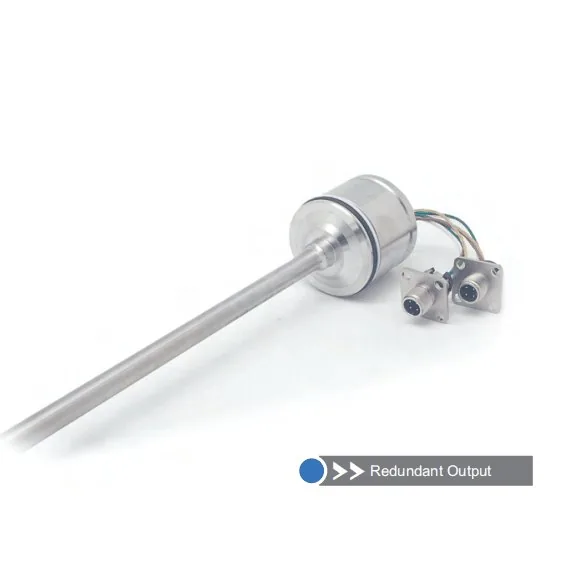
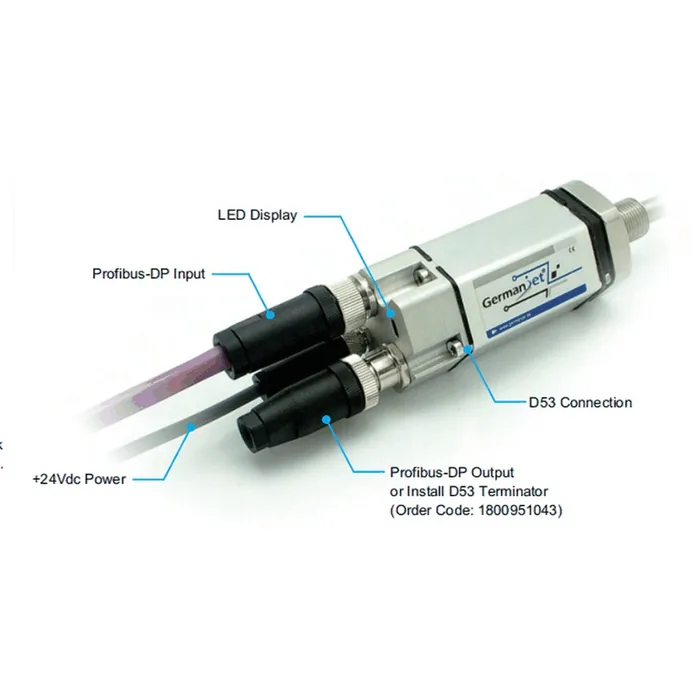


Whatever the question above, it comes back to the same device.magnetostrictive displacement sensorThe product range lists every series by stroke, mounting style and output interface, which is the quickest way into a selection.
← Back to News