
How a Magnetostrictive Level Sensor Reads Liquid Level: A Float Instead of a Magnet, and a Zero Set by the Mounting Datum
The tank is installed, the wiring is right, and the reading comes up the moment power is applied, yet the number does not match the actual level, or it drifts after a few weeks. In most of these cases the instrument is not the problem. A level reading is a relative quantity: shift the datum by a millimetre and the whole range is off by a millimetre.
1. The Level Version and the Displacement Version Differ by One Part
The magnetostrictive level sensor uses the same measuring principle as the magnetostrictive displacement sensor. The electronics head sends a current pulse, the pulse creates a circular magnetic field in the waveguide, that field interacts with the field of the magnet carried by the slider, and a torsional wave is generated at the point of interaction and detected on its way back. Position follows from the travel time.
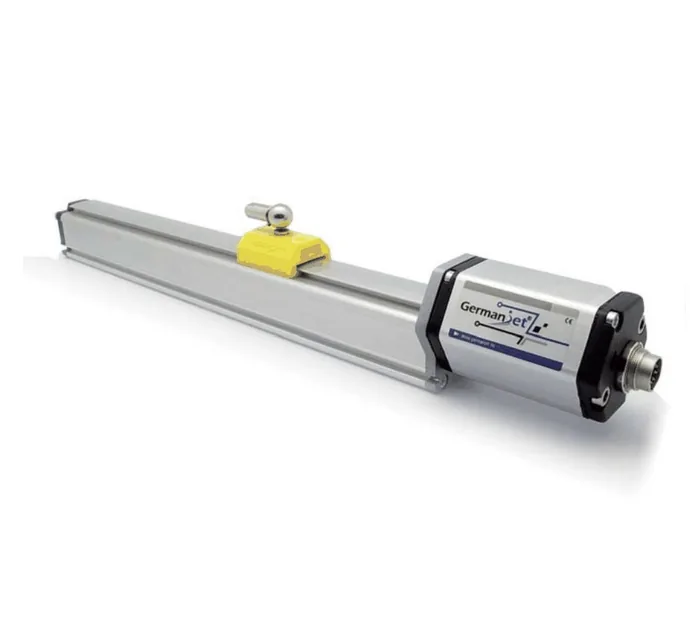
The structural difference comes down to one part: the slider on the probe. In the displacement version it is a magnet ring fixed to a piston or a moving machine part. In the level version it is a float that rides on the liquid surface by itself.
What changes is the object being measured. The displacement version reports where a machine part has reached, so the reading maps to stroke. The level version reports where the surface has settled, so the reading maps to stored volume. Decide by asking whether you are watching a mechanical motion or an inventory of liquid. One probe does not serve both.
2. Three Mounting Forms, Three Kinds of Tank
Tank roof, flange-mounted insertion
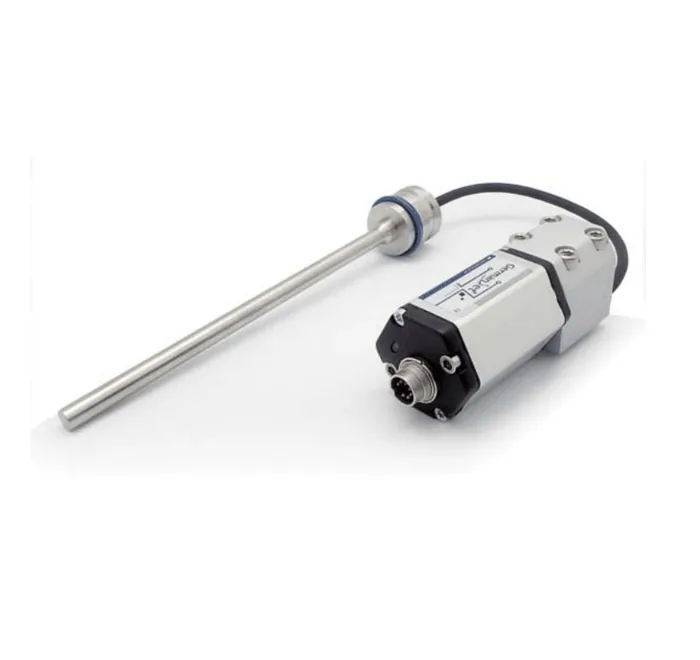
The probe enters vertically through the centre port of a roof flange, and the junction box is fixed on the roof. This suits small and medium vertical tanks, and any site where there is room to work on the roof and a roof penetration is acceptable. Two details decide the outcome. The sealing face must be clean before the flange is tightened, or the joint will weep. The probe must be vertical, or the float will rub against the wall as it travels. The roof-flange footage in our video library focuses on exactly these two steps.
Flexible level gauge
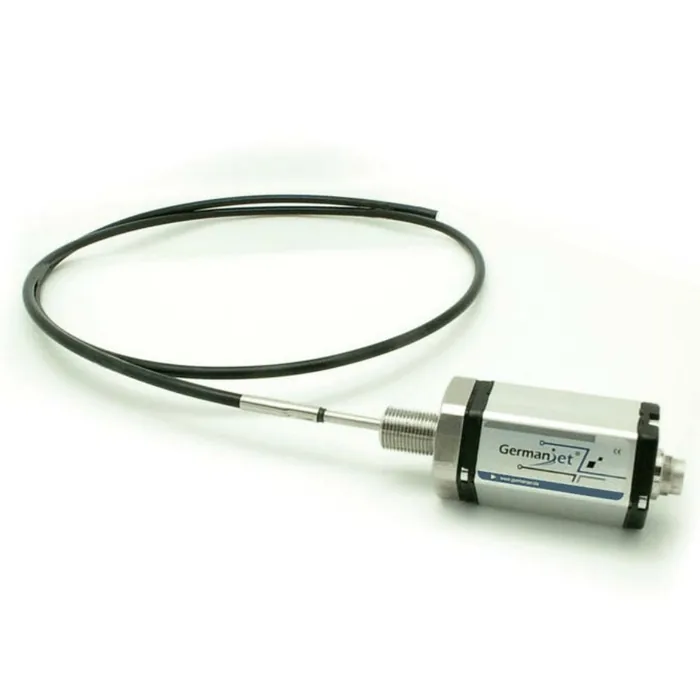
A rigid probe cannot be made long enough for deep tanks, and it cannot be transported at that length either. This is the case for a flexible gauge: coiled on a reel at the factory, then uncoiled, straightened and fixed on site. Our level measurement videos show the full sequence, from uncoiling to carrying the reel through the tank farm and up the side ladder to the roof. The difficulty is entirely in what happens after uncoiling. If the residual curvature is not taken out before the gauge is fixed, the float will hug the wall along its travel and the zero will be wrong from the start.
Side mounting
The probe enters through the tank wall, usually low on the shell or through the upper side. This suits horizontal tanks, underground tanks, and sites where a roof penetration is not allowed or the roof cannot be accessed. The datum becomes the centre height of the side flange, and the relationship between that height and the tank bottom must be confirmed against the drawing, or the reading will be right while the converted volume is wrong.

3. The Zero Comes From the Mounting Datum, Not From the Instrument
A level reading is the current float position minus the height of the mounting datum. What the instrument is calibrated to at the factory is the absolute scale along the probe. It has no way of knowing how far the flange face sits above the tank bottom once your probe is in the tank.
Each of the three forms has its own datum and its own failure mode:
- Roof flange: the datum is the sealing face. Debris on that face, or a gasket that seats unevenly, will leak. Uneven tightening torque warps the face slightly, and the probe tilts with it.
- Flexible gauge: the datum is set by how the gauge is straightened and fixed. Curvature from the reel has to be removed, and the fixing points have to be made in one pass after the gauge is straight. Moving them afterwards undoes the work.
- Side mounting: the datum is the centreline height of the side flange. That height has to agree with the level-to-volume table, or the reading will be correct and the conversion will not.
A level installation therefore has to be calibrated in place: measure the actual level by manual dipping or another confirmed method, and write that value into the current reading. Two-point calibration is not available here, because there is no way to drive the surface to two known heights inside a tank. That is a fundamental difference from the displacement case.
4. Media Properties That Do Not Enter the Reading
Magnetostrictive measurement follows the physical position of the float. There is no echo, no differential pressure, no capacitance change involved. The dielectric constant of the medium, fluctuations in density, and variations in vapour-space pressure do not enter the reading directly.
This is where it parts company with neighbouring methods. Radar relies on an echo, and a low dielectric constant or a thick foam layer weakens that echo. Differential-pressure and hydrostatic instruments rely on the pressure generated by the liquid column, so a change in density changes the pressure produced by the same level. The question is not which method is more accurate, but which parameters each one is sensitive to. Choose according to which parameter is unstable in your tank.
The float cares about exactly three things. The medium must be dense enough to float it. The medium must not coat the float and the probe. The medium must not glue the float in place or hold it at one height. None of these involve dielectric constant; all of them involve cleanliness, viscosity and whether the medium crystallises.
5. When the Level Version Is the Wrong Choice
- A distinct layered interface. The float only knows which layer it is floating on. It cannot report the position of an oil-water interface or an emulsion band. Interface measurement needs a different method.
- Viscous, crystallising or coating media. Coating wraps the float or builds up on the probe, and the reading becomes slow and dull before it stops changing altogether. On media like this, the maintenance interval deserves to be calculated before the accuracy specification.
- Heavy agitation and a continuously churning surface. The float follows the surface, so the reading follows the churn. Interlocks start to trip falsely. Either add a stilling arrangement or move to a non-contact method.
- Very short range in a small tank. Below a certain stroke the advantage of the magnetostrictive principle disappears, and other methods cost less.
6. Two Things Tank Farms Get Backwards
Treating "level steady, reading moving" as instrument drift
Check the float first. Is it coated? Is it blocked by an internal fitting such as a heating coil, a baffle or an inlet nozzle? Is it sitting in the region where the surface moves most? If the actual level is steady and the reading is not, the float is not moving freely. The electronics head is rarely the cause.
Calibrating the level version the way the displacement version is calibrated
The displacement version can be driven to both ends and back for a two-point calibration. The level version cannot, because the surface inside a tank cannot be placed at two known heights on demand. Calibration is a single point at whatever the current level happens to be. Getting a second point requires production to schedule the tank at another level, which is a process commitment rather than an instrument task.
7. Questions to Settle Before Selection
- Tank shape and height: vertical or horizontal, and how tall. This decides rigid probe versus flexible gauge.
- Whether a roof penetration is allowed. This decides insertion versus side mounting.
- Whether the medium is dense enough to float the float. This is the precondition for using the level principle at all.
- Whether the medium coats, and whether the tank is agitated. This sets the maintenance interval and may rule the principle out.
- Whether a layered interface exists. If it does, the level version should not enter the shortlist.
Output interface, supply and ingress protection come after these five. Germanjet magnetostrictive level sensors draw on the same output options as the displacement range, analogue and fieldbus both included, so the interface decision follows the same logic set out in our five-step selection article.
Frequently Asked Questions
Q: Can a magnetostrictive level sensor and a displacement sensor be swapped?
Not directly. The probe, waveguide and electronics head are shared, but the slider is not. The displacement version uses a magnet ring fixed to a machine part; the level version uses a float that follows the surface. One reports stroke, the other reports level, and the readings mean different things.
Q: What is the difference between a float and a magnet ring?
A magnet ring is passive. It is carried by external mechanics and its position is set by the machine. A float is self-following. It rests on the liquid surface under its own buoyancy and its position is set by the surface. The float carries a magnet inside, so the active element is the same.
Q: How is the zero of a level sensor calibrated?
Measure the actual level by manual dipping or another confirmed method, then write that value into the current reading as the datum. Two-point calibration is not possible, because the surface inside a tank cannot be driven to two known heights.
Q: Does foam in the tank affect the reading?
A thin foam layer usually does not. The float passes through it and rests on the liquid. A thick, stable or load-bearing foam layer can lift the float and push the reading high. In that duty, deal with the foam first or move to a non-contact method.
Related Products

Related Applications


Whatever the question above, it comes back to the same device.magnetostrictive displacement sensorThe product range lists every series by stroke, mounting style and output interface, which is the quickest way into a selection.
← Back to News