
Magnetostrictive Displacement Sensor Connectors: DIN 43650, D60, D70, M12 by Output
The connector on a magnetostrictive displacement sensor is fixed by its output code; match pins and coding before ordering a cable. A wrong mating connector shows up as “no data” or “dead on first power-up”. Lock the output first, then straight/angled and cable metres. Full pin maps and female parts go with the model; they are not dumped on this page.
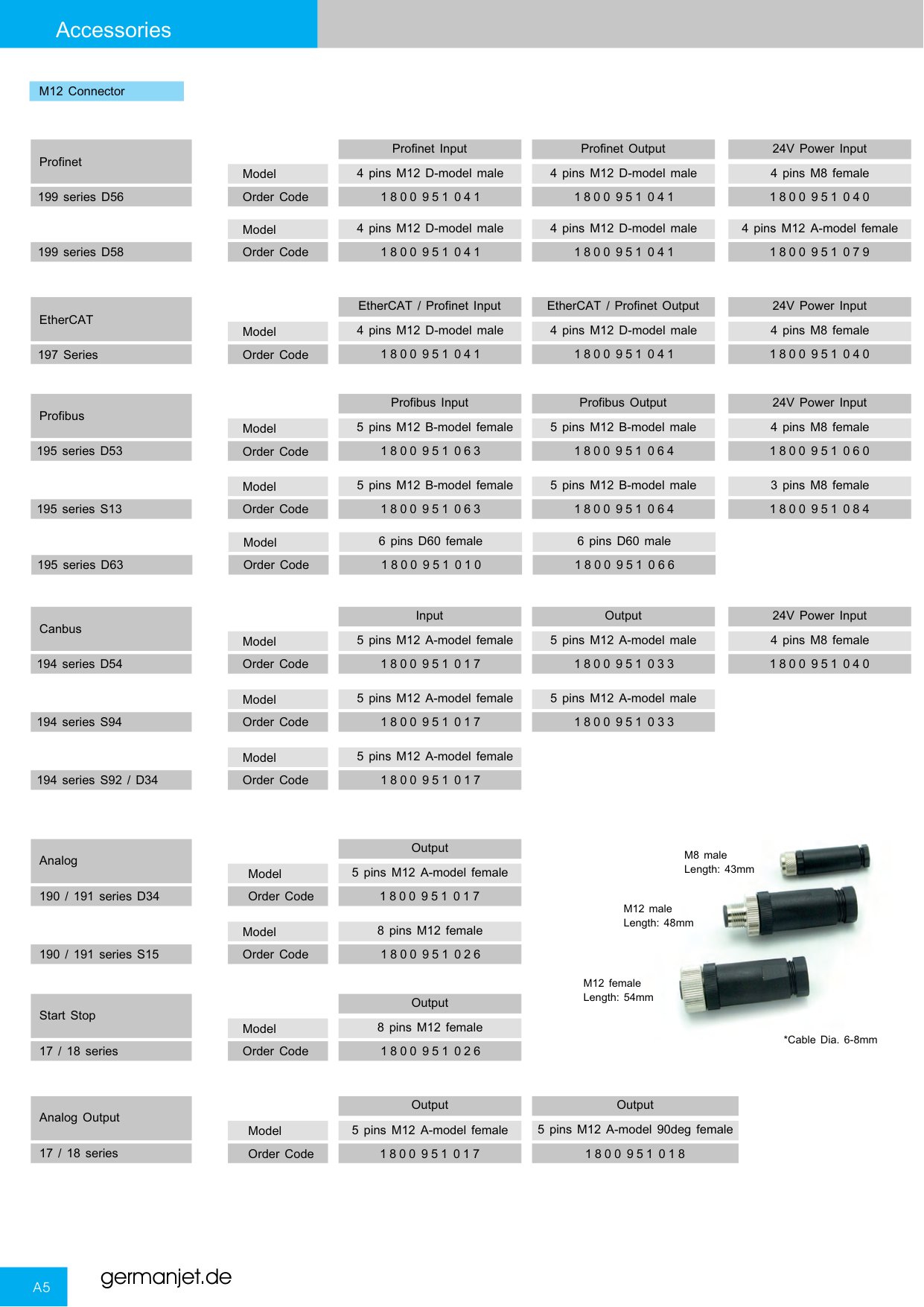
Connector family by output
| Output | Typical connector | If you mix them |
|---|---|---|
| Series 12 120 / 121 | DIN 43650 | Forcing an M12 damages pins |
| Series 16 160 / 161 | Internal terminals | Buying a D70 for the analogue head will not fit |
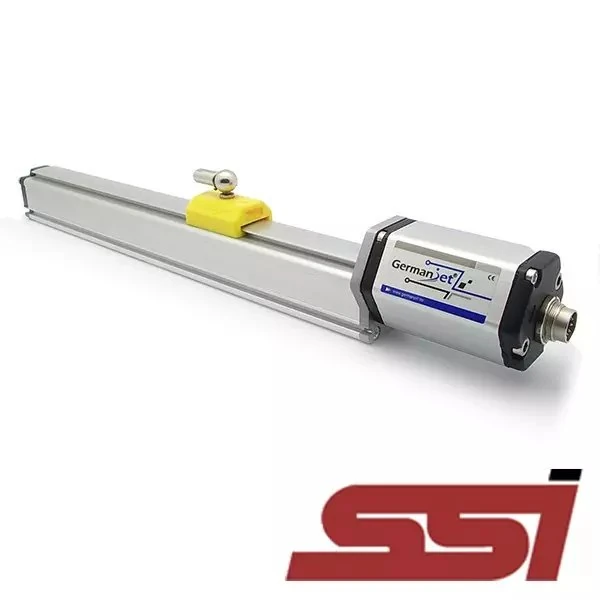
| 162 / 192 SSI | 7-pin D70 | A 6-pin D60 drops clock/data; master sees no frame |
| 190 / 191 analogue, 194 CANopen | 6-pin D60 | A D70 leaves pins unused; analogue supply/signal swap burns the head |
| 197 / 198 EtherCAT, Series 13 | M12 (198 is single M12) | A-code vs D-code: no Ethernet link |
A 6-pin D60 on a 7-pin SSI drops clock or data, so the master sees no frame; an A-coded M12 on EtherCAT has no Ethernet link. 162 vs 192: 162 and 192. 191 D60 colours: 191 wiring. M12 sealing: waterproof connectors.
How you already got it wrong
- The plug turns but will not lock: stop — pin count or keying differs.
- SSI master has no clock reply: count seven pins on D70, then baud vs length.
- Analogue dies or runs hot at power-up: supply and signal pins swapped — Series 18 four-pin voltage is unforgiving.
- EtherCAT port dark: wire map and M12 D-coding for that type.
Straight / 90°, cable length and the mating female: confirm against the model. A terminating resistor (e.g. CANopen 1800 951 044) is not the sensor connector — do not order it as a D70.
Frequently Asked Questions
Q: Can D60 and D70 mate?
No. D60 is six-pin, D70 seven-pin, different keying. SSI uses D70; analogue and CANopen often use D60.
Q: Does Series 16 analogue also use D70?
160 / 161 use internal terminals. D70 is the 162 SSI connector.
Q: Will any fieldbus take M12?
No. 198 single-M12 EtherCAT and Series 13 often use M12. Series 19 Profibus / CANopen often stay in the D60 family.
Q: Typical result of the wrong female?
It will not lock, or pins sit in the wrong holes. Analogue supply/signal swap can destroy the head; SSI simply never talks.
Related Products
Related Applications
Multi-Industry Application Cases for Magnetostrictive Displacement Sensors
View Details
Series 12 General-Purpose Magnetostrictive Displacement Sensor Application Cases
View Details
Series 16 Hydraulic Rod Magnetostrictive Displacement Sensor Application Cases
View Details