Cleanroom Non-Contact: Wear-Particle-Free Displacement Sensor
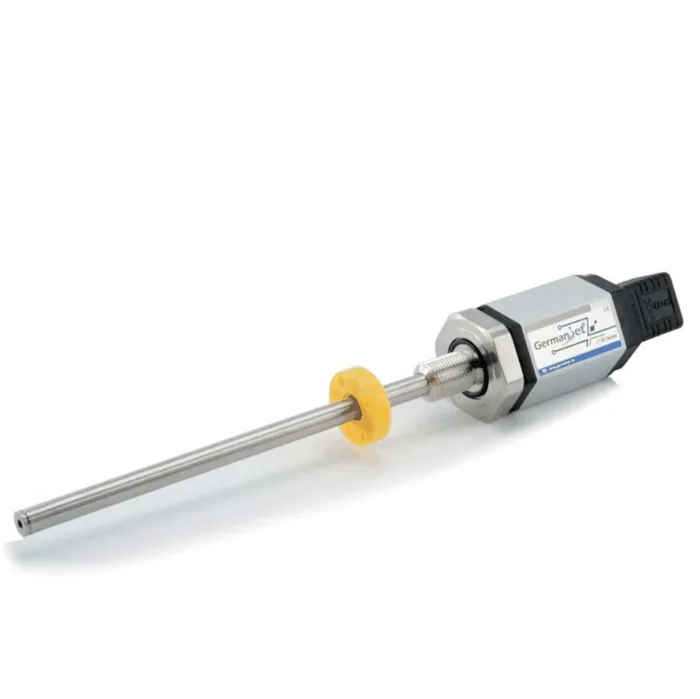
A magnetostrictive displacement sensor in a semiconductor cleanroom is non-contacting and sheds no wear particles. Constraints run opposite to heavy industry: there is no slurry impact and no high-pressure cylinder, but instead cleanliness requirements, particle-contamination control, long continuous running and an extremely small maintenance window. There is no mechanical friction between the magnet and the rod, so no wear particles are generated and no lubrication is required, which some contacting schemes cannot satisfy.

Three requirements that a clean environment places on displacement measurement
The first is no particle generation: any measuring method with a friction pair produces particles. The wire and rewind mechanism of a long-stroke cable-extension encoder, and the wiper of a contact-based sensor, both fall into this class. Non-contact measurement avoids the problem at the principle level. The second is materials and surfaces: exposed parts should be easy to wipe, should not shed debris, and should withstand cleaning agents; connectors and cable jackets need to be considered for cleanroom suitability. The third is long-term stability: equipment typically runs 24 hours a day, and unplanned downtime is costly, so the ability of repeatability to hold over time matters more than the factory-rated figure.
Typical measuring points: lift, transfer and chamber mechanisms
Common measuring points include the linear axes of wafer-transfer mechanisms, stage lift mechanisms, chamber-door and valve-plate stroke, and various adjustment mechanisms. Strokes at these points are mostly short to medium; resolution is typically taken in the 1-10 μm grade. For mechanisms that only need in-position confirmation, a 20-50 μm grade is sufficient; resolution too fine amplifies noise into jitter, so there is no need to chase a high figure blindly. Note that excessive resolution also amplifies system noise, so the reading appears to “jitter”, which is unhelpful for a stable criterion; this is explained in the three accuracy terms. Refresh rate should be checked against the motion-control cycle; the method is given in matching response time to the control cycle.
Comparison with other measuring schemes
| Scheme | Contacting? | Particle risk | Position retained on power loss | Clean-environment fit |
|---|---|---|---|---|
| Magnetostrictive displacement sensor | Non-contact | Low | Absolute position, retained | Good |
| Contact-based sensor | Contacting (wiper) | High | Retained | Poor |
| Cable-extension encoder (long stroke) | Contacting (wire) | Medium to high | Mostly incremental | Poor |
| Incremental encoder + ballscrew | Indirect | Depends on the transmission | Homing required | Medium |
Protection rating and cleaning maintenance
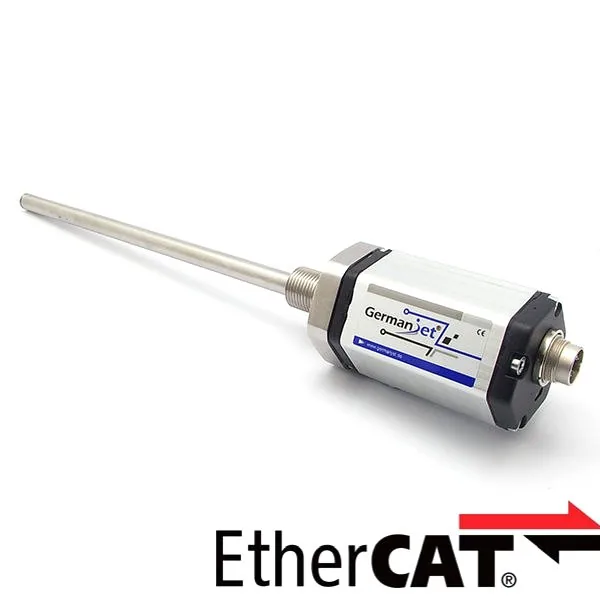
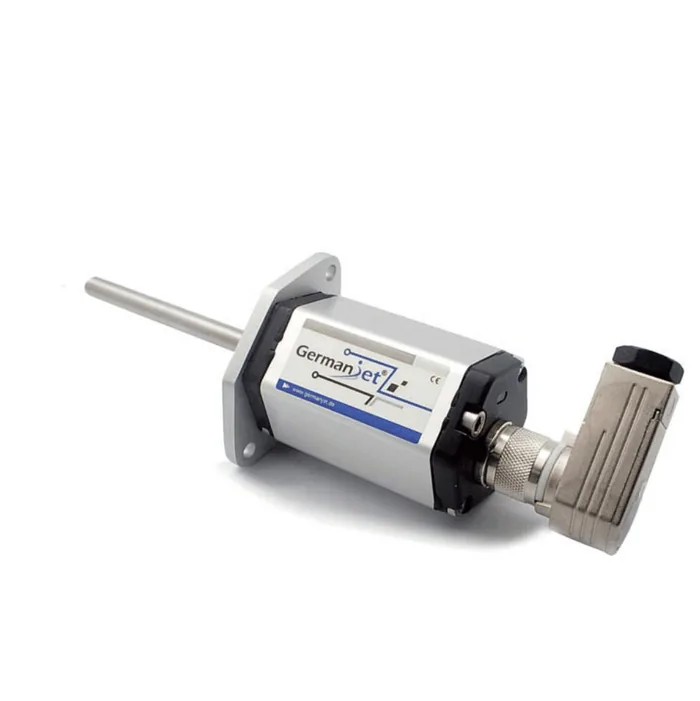
A cleanroom has no slurry, but equipment cleaning and chemical wipe-down are routine, so connectors should still reach IP65 or better. Some wet-process areas (clean, develop) have liquids and chemical mist; in those cases select IP67/IP68 according to the actual medium. For what each rating means in practice see what IP65/67/68/69K really mean. For a general-purpose product see Series 12 general-purpose; for short, compact mounting consider the single-M12 Series 198 single-M12 EtherCAT — fewer connectors mean fewer contamination and leak points.
Interfaces and equipment networking
Semiconductor equipment commonly uses high-determinism fieldbuses. EtherCAT distributed clocks keep multi-axis data sampled synchronously. If the equipment already has an IO-Link or Modbus architecture, selection can follow the existing system. Fieldbus wiring and termination are covered in the practical fieldbus guide. Position data can also be brought into the equipment condition-monitoring system to analyse mechanism-degradation trends. Medical equipment has similar requirements for cleanliness, low noise and position safety; see medical equipment: radiotherapy couch and operating-table position. The general selection framework for hydraulically driven mechanisms is given in hydraulic cylinder position-control schemes.
Frequently Asked Questions
Q: Can magnetostrictive sensors be used in a cleanroom?
Yes. Non-contact measurement means no wear and few particles; Series 12 general-purpose profile types can be adapted. The emphasis is on clean routing, sealing and connector protection.
Q: How is low noise assured?
Use screened cable with single-end earthing, keep away from high-current cables, and follow EMC practice; on fieldbus types pay attention to terminating resistors and topology.
Q: Does a semiconductor line need homing?
With an absolute-position sensor, homing can be omitted: position is read on power-up, which helps restore cycle time quickly.
Related Products
Related Applications
Multi-Industry Application Cases for Magnetostrictive Displacement Sensors
View Details
Series 12 General-Purpose Magnetostrictive Displacement Sensor Application Cases
View Details
Series 17 Hydraulic Cylinder Integrated Magnetostrictive Displacement Sensor Application Cases
View Details