Matching Response Time and Refresh Rate to the Control Cycle of a Magnetostrictive Displacement Sensor
Response time and refresh rate decide whether a displacement sensor can keep up with the control loop. Response time is the sensor's reaction delay to a change of position; refresh rate is how many times per unit time a position value is output. Choose either wrongly and the closed loop lags at best, and low-frequency oscillation appears at worst. When specifying, refresh rate should at least match the loop frequency, with margin.
Response time: from change to reflection
Response time comprises the propagation time of the torsional wave in the waveguide and the circuit processing time. Because propagation time is proportional to measuring range, the inherent response time of a long-stroke sensor is usually longer — this is not a performance defect, but a consequence of physical path length. For example, the response time of a several-metre range is clearly greater than that of a short stroke.
Refresh rate and the control cycle
The control loop computes at a fixed cycle (for example 1 ms = 1 kHz). Sensor refresh rate must be ≥ several times the control frequency so that the controller obtains a valid new value every cycle. If refresh rate is below the control frequency, position feedback is equivalent to "dropped frames" and the loop lags or even becomes unstable.
Refresh-rate needs by application (guide)
| Application type | Typical control cycle | Suggested refresh rate |
|---|---|---|
| Hydraulic servo pressing | 0.5–1 ms | ≥ 1 kHz |
| Injection molding clamp | 1–2 ms | ≥ 0.5–1 kHz |
| General proportional control | 5–10 ms | ≥ 100–200 Hz |
| Slow position monitoring | ≥ 50 ms | ≥ 20 Hz |
Analogue update time by stroke
| Stroke | Update time |
|---|---|
| ≤ 1200 mm | 0.5 ms |
| ≤ 2400 mm | 1.0 ms |
| ≤ 4800 mm | 2.0 ms |
| ≤ 7600 mm | 5.0 ms |
Series 12 voltage type (120) stays at 0.2 ms — do not use the bands above. 162 / 192 SSI lists update rate vs stroke (3.7 kHz at 300 mm … 0.5 kHz at 5000 mm); see Series 16 and 162 vs 192.
Particularities of bus-type refresh
- CANopen: actual refresh is set by transmission type + Event Timer or a synchronous mode;
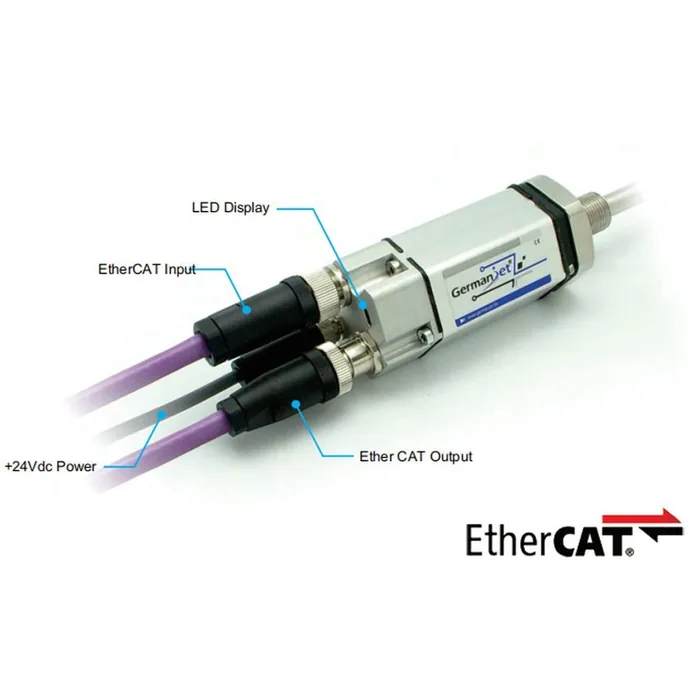
- EtherCAT: synchronised by distributed clocks (DC); refresh rate is affected by bus cycle and load;
- Several axes sharing a bus: more axes dilute per-axis refresh bandwidth; total load must be calculated.
Bus synchronisation is covered in bus-type power-down hold and synchronous refresh; EtherCAT real-time behaviour is in EtherCAT real-time behaviour explained. Overall output-type selection is in analog vs. fieldbus; for robot applications that are sensitive to response speed see robot displacement sensing.
Frequently Asked Questions
Q: What is the difference between response time and refresh rate?
Response time is the reaction delay to a change of position; refresh rate is how many times per unit time a position value is output.
Q: Is response slower on a long stroke?
Yes. Torsional-wave propagation time is proportional to measuring range, so a long stroke has a longer inherent response time.
Q: How high a refresh rate is needed for a 1 ms control cycle?
At least 1 kHz or higher; prefer high rather than low, so that every cycle obtains a valid new value.
Q: Why is analogue update time sometimes 0.5 ms and sometimes 5.0 ms?
It is banded by stroke: ≤1200 / 2400 / 4800 / 7600 mm → 0.5 / 1.0 / 2.0 / 5.0 ms. Series 12 type 120 stays at 0.2 ms. SSI (162 / 192) uses a kHz update rate — do not mix it with the analogue millisecond bands.
Related Products
Related Applications
Multi-Industry Application Cases for Magnetostrictive Displacement Sensors
View Details
Series 17 Hydraulic Cylinder Integrated Magnetostrictive Displacement Sensor Application Cases
View Details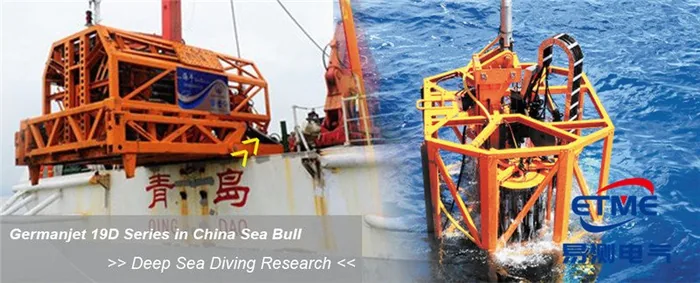
Series 19D Split-Type Process Displacement Sensor Application Cases
View Details