
Absolute vs. Incremental Position: Why Magnetostrictive Sensors Never Lose Zero on Power Loss
Absolute position and incremental position are two fundamentally different ways of representing position in displacement measurement. A magnetostrictive displacement sensor outputs an absolute position value and, after power loss, recovers the correct reading without homing; an incremental encoder loses its position datum on power-down and must home after power is restored. This difference directly decides how the machine behaves after a power loss or unplanned stop, and is one of the first technical points to confirm when specifying.
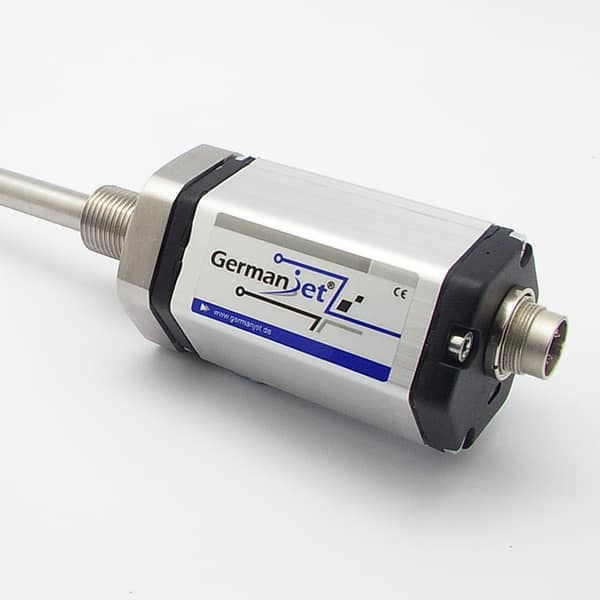
What absolute position is
Absolute position encoding uniquely determines the physical position of the measured object at any moment, independent of the history of motion. A magnetostrictive sensor obtains absolute position by measuring the distance from the position magnet to the fixed end — that distance is set by the propagation time of the torsional wave in the waveguide, with a physical timing reference that does not rely on accumulated counts. Therefore, no matter how many cycles the machine has run, as long as the magnet is at a given spatial position, that is the position the sensor reads.
How incremental position works, and why homing is needed
An incremental encoder records pulse counts of relative displacement; position = starting datum + accumulated pulses. Once power is lost, the accumulated value is cleared; on power-up the controller does not know the current mechanical position and must "home" (hit a mechanical limit, find a reference point) to rebuild the datum. On multi-axis machines or long-stroke mechanisms, homing often occupies a full motion cycle.
Why magnetostrictive sensors do not lose zero on power-down
Magnetostrictive position is essentially the spatial position of the magnet on the waveguide, determined by the physical location of the permanent magnet, not by electronic counting. Wherever the magnet sits during a power loss, after power-up the electronics launches one current pulse, measures one torsional-wave flight time, and obtains the same position. The whole process therefore needs neither homing nor a reference-point switch.
Absolute vs. incremental position
| Criterion | Absolute position (magnetostrictive) | Incremental position (encoder) |
|---|---|---|
| Recovery after power loss | Direct reading, no homing | Must home to rebuild the datum |
| Position datum | Physical position of the magnet | Accumulated pulses + starting datum |
| Immunity to disturbance power loss | Strong | Weak (lost as soon as power is lost) |
| Reference-point switch | Not required | Required |
| Typical use | Hydraulic presses, multi-axis synchronisation, long stroke | Short stroke, applications that can home frequently |
Engineering meaning and limits
- Resuming a press after power loss: no homing; the pressing process can resume directly, saving a cycle;
- Multi-axis synchronisation: after power is restored, each axis position can be confirmed independently at once, avoiding interlocking confusion;
- Safety after an unplanned stop: the machine resumes from a known position, so it cannot mis-act on an unknown coordinate after an unexpected power cut;
- Not "calibration-free": absolute position solves "position not lost on power-down", but the mechanical zero offset still has to be set once at installation and then held stable.
For the overall framework of output-type selection, see analog vs. fieldbus selection; power-down hold and synchronous refresh on bus types are covered in bus-type power-down hold and synchronous refresh. The measuring principle itself is in the magnetostrictive effect and the Wiedemann effect. Related products such as the Series 191 analog and the Series 17 hydraulic-cylinder integrated type both output absolute position. Incremental units still need a reference switch; absolute units do away with it entirely.
Practical tips for engineers
- Analog outputs are factory-calibrated slightly wider than the nominal stroke; after installation the machine must be recalibrated.
- Two-point method: Slope = actual displacement ÷ (stroke-end reading − zero reading); Datum = Slope × zero reading; machine position = (Slope × current reading) − Datum.
- Example: zero reading 0.2 V, reading after moving 98 mm is 9.5 V → Slope = 98÷(9.5−0.2) = 10.537, Datum = 10.537×0.2 = 2.106.
Frequently Asked Questions
Q: Is it true that a magnetostrictive sensor does not need to home after power-down?
Yes. Position is determined by the physical location of the magnet on the waveguide; after power-up, one measurement of torsional-wave flight time yields the original position, with no homing or reference-point search.
Q: Can absolute position drift?
The mechanical zero offset must be set once at installation and then held stable. Drift comes mainly from temperature and similar effects, not from lost position.
Q: What has to change when converting an incremental encoder to absolute position?
Both the sensor and the controller interface must support absolute position, and the homing action must be removed; assess the effect on the control cycle.
Q: After a multi-axis power loss, are the axis positions consistent?
Each axis is read independently in absolute terms; after recovery, positions can be confirmed at once, with no interlocking homing and no confusion.
Related Products

Related Applications

Multi-Industry Application Cases for Magnetostrictive Displacement Sensors
View Details
Series 17 Hydraulic Cylinder Integrated Magnetostrictive Displacement Sensor Application Cases
View Details
Series 19D Split-Type Process Displacement Sensor Application Cases
View Details