Cold and Warm Readings Differ: Thermal Expansion or Magnetostrictive Displacement Sensor Drift
A hydraulic machine reads one value at start-up and a different value at noon, and the gap is not small. Range, zero and wiring have all been checked. Fit a new unit and the same pattern comes back.
At this point the direction of the investigation has to change: the reading is changing, which does not mean the measuring device is changing. What is being measured is moving. Two sources feed into it, and they differ in magnitude by a lot.

Two sources — keep them apart
Source one: the measured structure is expanding. Cylinder, piston rod, machine frame and workpiece all change length as they heat. The measuring device is not wrong; it is faithfully recording that the datum moved.
Source two: the magnetostrictive displacement sensor drifts with temperature. Sound velocity in the waveguide changes with temperature, and the timing reference in the electronics head does as well. Factory calibration is done at a controlled temperature; move away from that point and the output moves a little.
On site the two look almost identical: both move the reading slowly and monotonically with temperature, neither produces a jump, and refitting does not make either go away. The difference is magnitude — on most hydraulic machines the structural expansion is an order of magnitude larger than the unit's own drift, or more.
That is why the first reaction should not be to replace the part. Replacing addresses source two, and source two is often not the main term.
How large is structural thermal expansion
Steel expands at roughly 11–12 μm per metre per degree Celsius, and that number is enough to estimate with.
A two-metre cylinder body, heated by 30 °C, changes length by 2000 × 30 × 11.5 ÷ 1000 — about 0.69 mm. On equipment that needs sub-millimetre accuracy, that has to be handled.
The key point is that not all of the heated length enters the reading. It depends on how the datum is arranged:
- If the unit is fixed to the frame and the magnet follows the cylinder, the cylinder's change enters the reading.
- If the unit and the measured part are fixed to the same heated structure, part of the expansion cancels out.
- Where the workpiece itself expands — die casting, forging, vulcanising — that is separate from structural expansion and has to be treated on its own.
So the same situation can measure 0.5 mm on one site and 0.1 mm on another, and both can be right. Estimation is the starting point; field measurement settles it.
Where the unit's own thermal drift comes from
The position is derived from a time measurement: an excitation pulse travels the waveguide, and the return timing converts to magnet position. Two parts of that timing chain shift with temperature — sound velocity in the waveguide, and the timing circuit in the electronics head.
The manufacturer handles this by calibration: every unit is calibrated at a controlled temperature and the compensation coefficients are written into the head. The accuracy figures in a datasheet are therefore referenced to a point within a specified temperature range, usually near 25 °C.
Two consequences follow. The further the temperature sits from that reference, the larger the deviation, and the direction is monotonic. And the deviation is a known design quantity, not a fault. Its magnitude is generally below structural expansion, but it is never zero. How to read the temperature figures is covered in operating and storage temperature: how to read both without tripping up.
There is also a transient effect: for the first twenty to thirty minutes after power-up the electronics head warms itself, and the reading creeps in one direction before settling. That is separate from thermal drift. Do zero calibration and acceptance after it has passed; the sizing of that interval is in warm-up and thermal equilibrium.
Three field tests that separate the two
| Test | How to run it | What it shows |
|---|---|---|
| Unloaded thermal cycle | Run the machine unloaded at its normal cycle so it heats up, and log the reading at one fixed mechanical position | The movement comes mainly from structural expansion and mounting position |
| Heat the unit alone | With the machine cold, warm only the area around the electronics head and watch how far the reading moves | That portion approximates the unit's own drift |
| Split-head comparison | Move the electronics head to a temperature-stable area with the rod left in place, and repeat the thermal cycle | If the movement narrows noticeably, drift contributed substantially in the original arrangement |
None of the three needs precision instruments — an infrared thermometer and a period of continuous logging will do. When they are done, which source dominates is obvious, and so is where to adjust next.
If the tests show that temperatures are already near the device limit, the problem is selection rather than drift. The handling order is in four steps to keep heat out and oil temperature and ambient temperature as two independent boundaries.
Two routes to handle it
Route one: align the datum with the process. If the process datum is itself in the hot state, recalibrate the zero while hot so the reading matches the working condition, and accept the offset when cold. This costs the least, provided the machine spends most of its time hot.
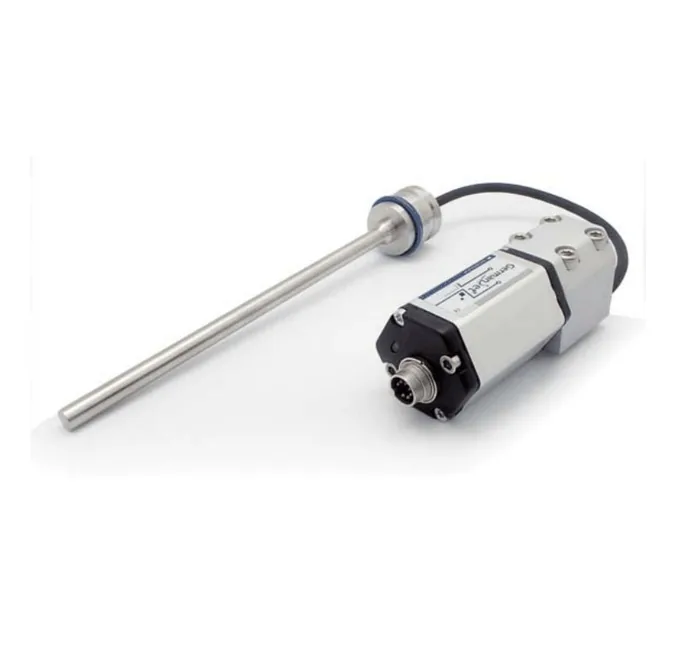
Route two: take temperature out of the measurement chain. Use a split-head arrangement to move the electronics into a stable area while the rod stays in place. It cannot do anything about structural expansion, but it removes the unit's own contribution.
The two are not exclusive. What must be avoided is the third case: calibrated cold, running hot, never aligned in either state. The reading then appears to drift all day, when in fact it was never aligned with the process datum to begin with.
Field notes for engineers
- A quick way to test whether temperature is behind it: park the machine at one mechanical position, log the reading and the ambient temperature for an hour, and plot both. Following temperature with a lag points to temperature; not following it but jumping occasionally points somewhere else.
- Point the infrared thermometer at the electronics head casing — not at the rod, not at the frame beside it. Rod temperature is media temperature and frame temperature is ambient, and neither is what the electronics actually sees.
- On precision equipment, structural expansion sometimes matters more than the accuracy class chosen. Before a retrofit, measure how far the datum moves once the machine is hot, not just the accuracy spec.
- Do acceptance and calibration after thermal equilibrium. Calibrating cold and running hot is a combination that recurs on the same site and often costs several rounds of adjustment without ever settling.
Frequently Asked Questions
Q: Cold and warm readings differ. Is the unit faulty?
Do not go there first. Fit a new unit and if the same pattern returns, the part is not the cause. Once the machine is hot, cylinder, frame and workpiece have all grown, and that movement is being measured faithfully. Run an unloaded thermal cycle and log the reading at one fixed mechanical position to see how large it actually is.
Q: Which is larger, thermal drift or structural expansion?
On most hydraulic machines structural expansion is an order of magnitude larger, because the heated length is measured in metres and the temperature change in tens of degrees, which readily produces a few tenths of a millimetre. The drift of the unit itself is usually much smaller but never zero; take the datasheet figure as the reference. An unloaded thermal cycle tells you which one dominates.
Q: Should zero calibration be done cold or hot?
Whichever state the machine spends most of its time in. Where the process datum is hot, recalibrate the zero while hot so the reading matches the working condition and accept the cold deviation. Wait for thermal equilibrium before starting either way — for the first twenty to thirty minutes the reading is still creeping and the zero will not hold.
Q: Does moving the electronics head solve the temperature problem completely?
It solves half of it. A split-head arrangement removes the drift of the unit itself by moving the electronics into a stable area, but the structural expansion of the measured parts remains and depends on the machine. Solving that means working on the process datum — calibrating hot, or adding temperature compensation to the critical structure.
Related Products
Related Applications
Series 16 Hydraulic Rod Magnetostrictive Displacement Sensor Application Cases
View Details
Series 19D Split-Type Process Displacement Sensor Application Cases
View Details
Series 19H Cylinder-Integrated Process Displacement Sensor Application Cases
View Details