What's Inside the Electronics Head of a Magnetostrictive Displacement Sensor: Pulse, Echo, Output
The electronics head is the core of a magnetostrictive displacement sensor that turns a "mechanical torsional wave" into a "digital position value". It contains pulse drive, echo detection, signal processing and the output interface. Understanding each module's role helps you locate quickly, when faced with no output or jumping values, whether the fault is in the waveguide, the position magnet or the electronics head itself.
Pulse-drive circuit
Responsible for producing a standard current pulse along the waveguide. Pulse amplitude and edge quality directly affect echo strength. If the drive is abnormal, the echo is weak or missing, appearing as no output or an intermittent reading.
Echo detection
Captures the instant the torsional wave returns to the electronics head and times it to nanosecond-class accuracy. Timing accuracy directly decides resolution and repeatability — this is the core of "timing yields position". The detection circuit is affected by temperature and noise, and is the main object of temperature-drift compensation.
Signal processing
Applies temperature compensation, linearisation, filtering and zero-offset calculation to the raw time, producing a stable engineering position value. This is done in firmware; the compensation parameters written at factory calibration (see factory calibration and linearisation) act here.
Output interface
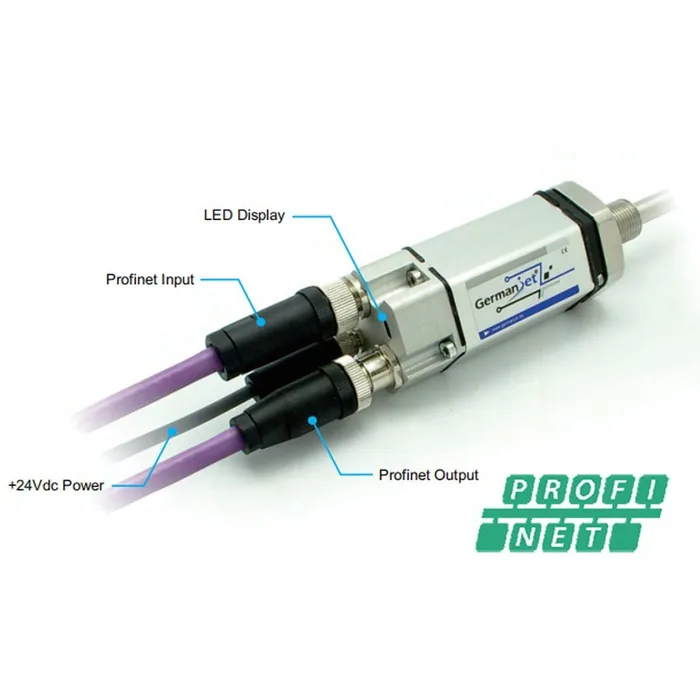
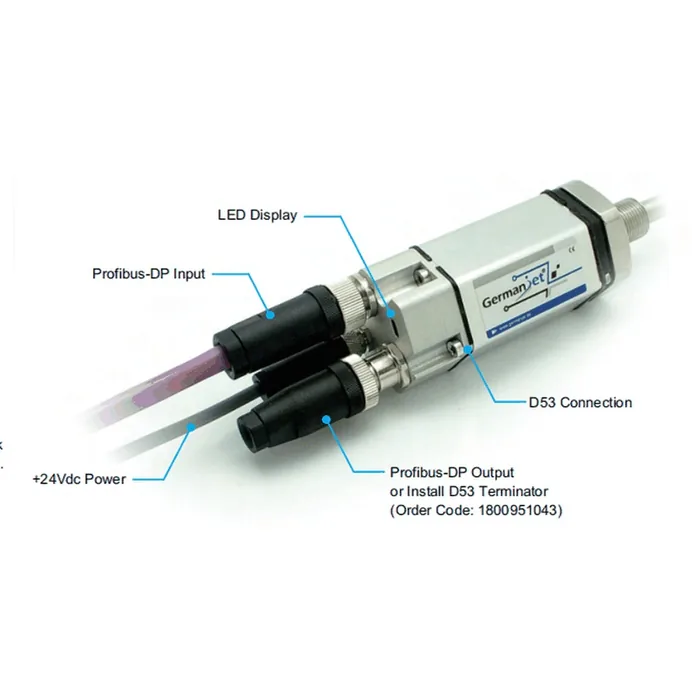
Converts the position value to analog (4-20 mA / 0-10 V) or a fieldbus telegram (CANopen / Profibus / EtherCAT / PROFINET and similar). Interface type decides how you connect to the PLC; wiring differs too, with analog signal pairs single-end earthed and bus lines bonded at both ends. Selection is in analog vs. fieldbus.
Responsibilities of each electronics-head module
| Module | Responsibility | Abnormal behaviour |
|---|---|---|
| Pulse drive | Generate the current pulse | No echo, intermittent |
| Echo detection | Nanosecond-class timing | Poor resolution/repeatability |
| Signal processing | Compensation, linearisation | Temperature drift, non-linearity |
| Output interface | Analog/fieldbus | No output, communications drop-out |
For a recap of the measuring principle see the magnetostrictive effect and the Wiedemann effect; common fault symptoms and actions are in troubleshooting. On models with a modular design, the electronics head can be replaced independently; confirm this in model selection before condemning the whole unit.
Frequently Asked Questions
Q: If the electronics head fails, is the sensor scrap?
On some models the electronics head can be replaced independently; first confirm whether the design is modular.
Q: What does echo-detection accuracy decide?
It directly decides resolution and repeatability; it is the core of the timing chain.
Q: Why keep the electronics head away from high temperature?
Internal electronics usually have a lower temperature rating than the rod; over-temperature causes failure.
Related Products
Related Applications
Series 19D Split-Type Process Displacement Sensor Application Cases
View Details
Series 19F Flexible Process Displacement Sensor Application Cases
View Details
Series 19H Cylinder-Integrated Process Displacement Sensor Application Cases
View Details