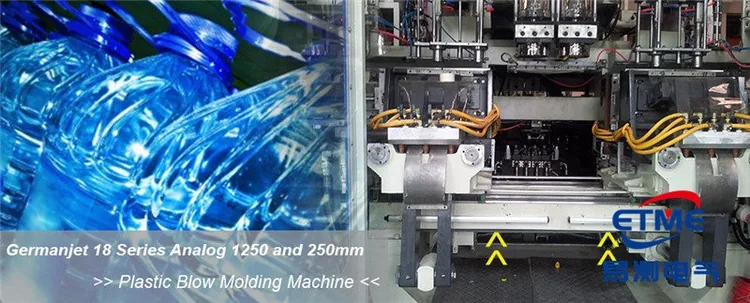
Die-Casting Feedback: Displacement Sensor on Clamp and Shot Plunger
A magnetostrictive displacement sensor gives stable clamp-position feedback on a die-casting machine that must work for long periods in an environment of high-temperature radiation, oil mist, mould-release vapour and severe shock together. Clamp position determines mould seating and the build-up of clamping force; shot-side displacement is used to calculate the plunger speed curve and the intensification switch point. Magnetostrictive displacement sensors, with absolute-position output and non-contact measurement, are a common replacement on die-casting machines for external long-stroke contact-based feedback; the key is to distinguish mounting form and protection class by measuring point, not to use one model throughout.
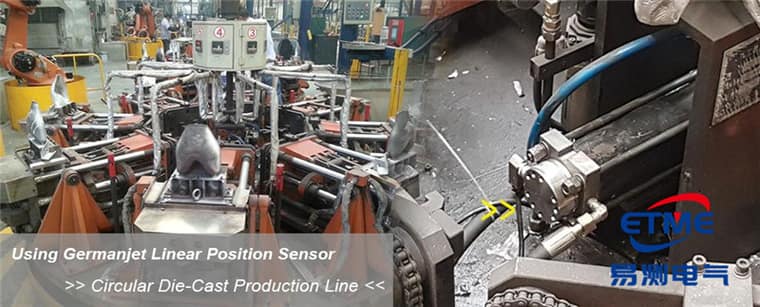
Two classes of position measuring point on a die-casting machine
The first is clamp open/close stroke: the moving platen travels a long stroke, and the end position determines mould seating and clamping-force build-up; absolute position with retention on power loss is required, so that homing is not repeated at every power-up. The second is shot-plunger stroke: the stroke is shorter but the speed is extremely high; the controller needs the plunger speed curve by differentiating displacement, to judge the slow-shot to fast-shot switch and the intensification point. The second class demands a far higher update rate than the first; The injection stage needs far higher refresh than clamp; sampling too slowly smooths out the speed-curve corner. If the sample period cannot keep up, the speed curve is smoothed through the critical inflections and process analysis loses meaning.
Site constraints on clamp-position feedback
The reality of a die-casting shop: high mould-surface temperature, continuous radiant heat on nearby parts; vapour and oil mist driven onto the machine when mould-release is sprayed; continuous vibration from clamp shock and shot recoil. The corresponding selection constraints are three — ambient temperature must be checked against the sensor’s operating-temperature range, not storage temperature (the distinction is in Operating Temperature vs. Storage Temperature); protection class at least IP67, with IP69K recommended near the spray zone; vibration and shock ratings must cover shot recoil. Temperature also introduces zero and span drift through change of waveguide sonic velocity; compensation logic for high-temperature duty is in Do Sensors Need Warm-Up? Self-Heating, Thermal Equilibrium and the Real Magnitude of Temperature Effects.
Measuring-point selection comparison
| Measuring point | Core need | Recommended mounting | Resolution step | Protection suggestion |
|---|---|---|---|---|
| Clamp open/close stroke | Absolute positioning, retained on power loss | In-cylinder or machine-frame external | 10–20 μm | IP67 and above |
| Shot plunger | High update rate, reconstruction of the speed curve | In the shot cylinder | 5–10 μm | IP67, tolerant of high-temperature radiation |
| Ejector | Short stroke, collision protection | In-cylinder | 10–20 μm | IP67 |
| Core-pull | In-position confirmation | External | 20–50 μm | IP67/IP69K (spray zone) |
Choosing in-cylinder versus external
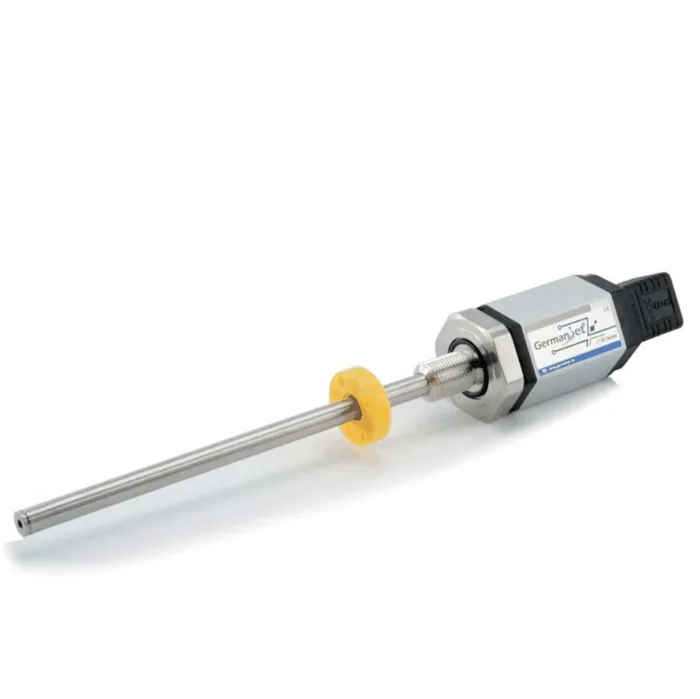
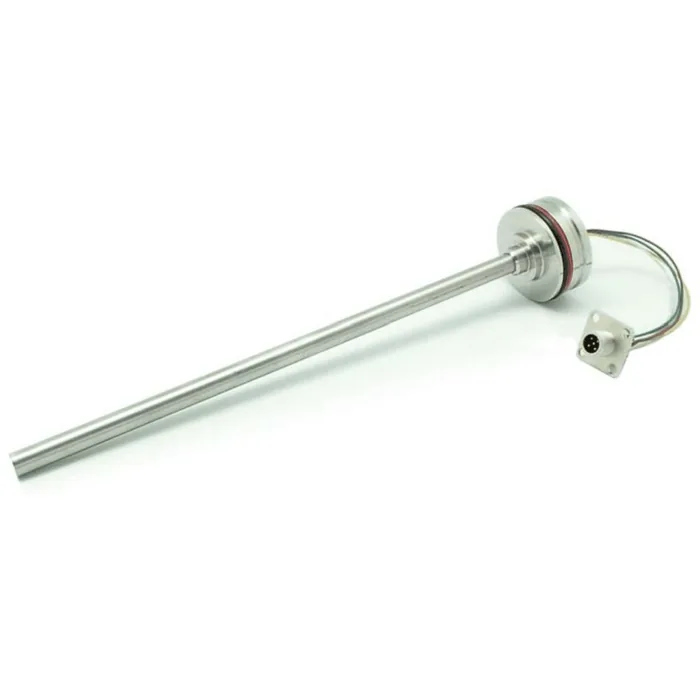
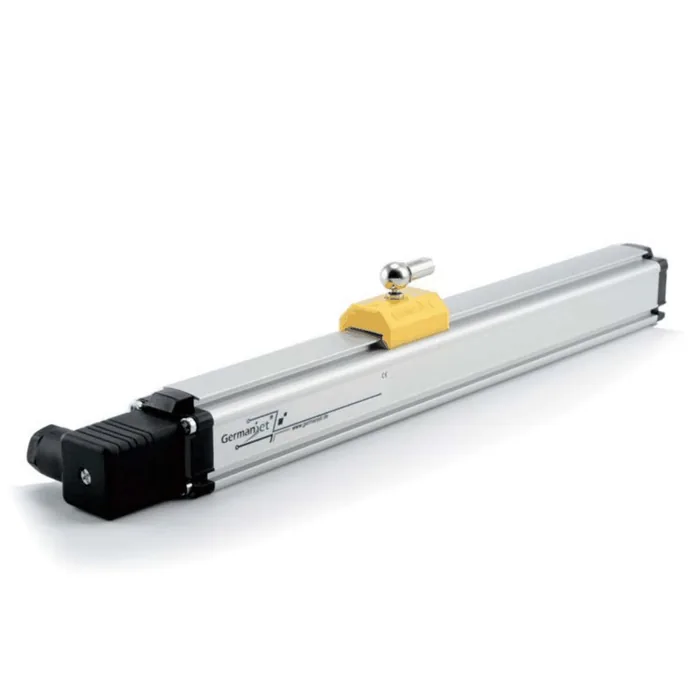
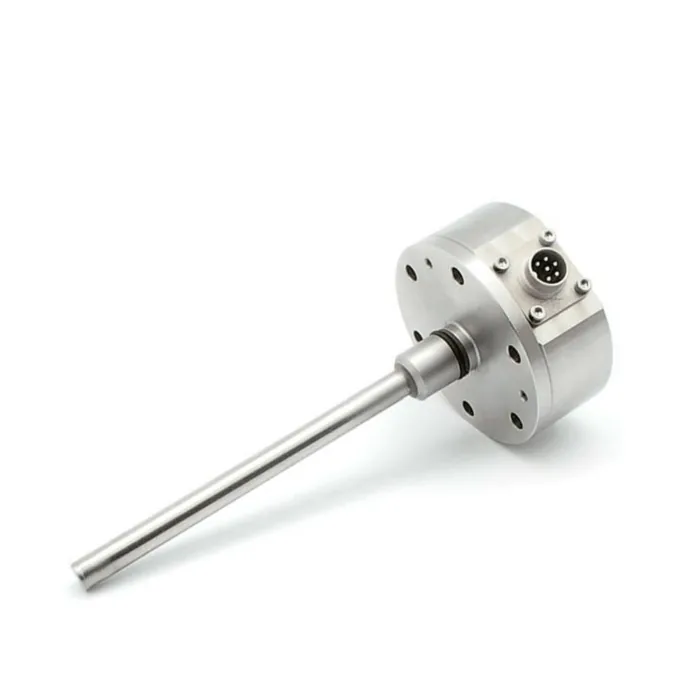
Clamp and shot cylinders on die-casting machines are mostly high-pressure systems. An in-cylinder type puts the rod in the piston-rod bore, so the rod is not exposed to spray and flying metal, with better life and reliability; the cost is that the piston rod must be deep-bored to specification (minimum bore generally ≥12.7 mm) and the pressure rating must cover system peak pressure (by series: Series 16/16R is 350 bar working / 530 bar peak, Series 17/17EX is 350/600 bar, Series 19 in-cylinder is 300/600 bar). An external type is convenient to retrofit without touching the cylinder, suited to in-service machines, but the rod needs a guard and must be kept off the spray and splash path. In-cylinder products include Series 16 cylinder-integrated and Series 17 hydraulic-cylinder integrated; the overall hydraulic closed-loop selection approach is in Why Choose Magnetostrictive Sensing for Hydraulic Cylinder Position Control. Another scene of clamp-position coordination with temperature control (rubber vulcanising presses) is in Rubber Vulcanising Presses: Coordinating Clamping Position with Temperature Control.
Signals and process-data acquisition
Shot-curve analysis needs displacement, speed and pressure aligned on the same time axis. If the controller uses analog acquisition, match A/D sample rate to sensor update rate; the slower of the two sets the curve resolving power. With a fieldbus type (for example CANopen, EtherCAT), distributed clocks can be used for multi-axis synchronous sampling, reducing inter-channel time offset; configuration points are in How to Connect Magnetostrictive Displacement Sensors to a Fieldbus. A fieldbus with distributed clock synchronises multi-axis sampling; injection spikes usually trace back to shield grounding. If the reading jumps at the instant of the shot, it is often related to strong electromagnetic interference or incorrect shield earthing; the troubleshooting order is in Troubleshooting Magnetostrictive Displacement Sensors.
Practical tips for engineers
- For in-cylinder mounting, piston-rod bore lower limit is ≥12.7 mm (Ø10 rod). Series 17 also has a Ø13 mm through-hole + M18×1.5 on the cylinder cap; Series 16 uses Ø18G7. Do not mix pressure ratings: Series 16/16R is 350 bar working / 530 bar peak, Series 17/17EX is 350/600 bar, Series 19 in-cylinder is 300/600 bar.
- The sensor rod should be protected against wear inside the cylinder.
- Series 19 in-cylinder types are rated 300 bar with a 600 bar peak; use these figures for selection and pressure testing.
Frequently Asked Questions
Q: Why does die-casting clamp displacement need real-time feedback?
Clamping force is determined by the closed position of the clamp cylinder; insufficient position flashes the mould, excessive position damages it. Real-time displacement feedback is used for combined force-position control and mould protection.
Q: Does shot position have a large effect on quality?
Yes. The shot stroke and speed curve determine whether filling is complete and whether air is trapped. Displacement update rate must keep up with the shot cycle; on long ranges, response time must also be checked.
Q: How should I select for the high-temperature die-casting environment?
Keep the electronics head away from the molten-aluminium hot zone; if necessary choose a split type and move the electronics head out. Check the dual constraint of operating temperature and oil temperature; see Series 17 integrated and Series 19D split type.
Related Products
Related Applications
Multi-Industry Application Cases for Magnetostrictive Displacement Sensors
View Details
Series 16 Hydraulic Rod Magnetostrictive Displacement Sensor Application Cases
View Details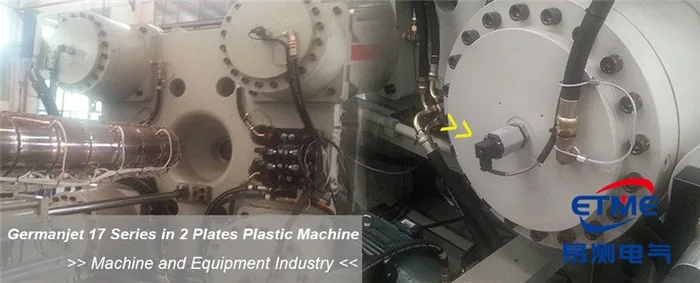
Series 17 Hydraulic Cylinder Integrated Magnetostrictive Displacement Sensor Application Cases
View Details