Two Positions from One Waveguide: Multi-Magnet Sensing on a Magnetostrictive Displacement Sensor
Disclaimer: Germanjet supplies only magnetostrictive linear displacement/position sensors; descriptions of other displacement-measurement technologies below are for technical comparison only.
A standard magnetostrictive displacement sensor uses one position magnet to read one position. By placing several permanent magnets (position magnets) on the same waveguide, a single sensor can measure several independent positions at once, cutting hardware cost and cabling where multi-position feedback is needed. This is one of magnetostriction's structural advantages over most single-point displacement transducers.
How multi-magnet measurement works
The current pulse from the electronics head travels along the waveguide; each time it meets a magnet's axial field, a torsional-wave echo is launched at the superposition. The electronics receives the echoes in time order; the flight time of each echo corresponds to the distance of that magnet from the fixed end. That is one excitation, several positions, with the magnets independent of one another.
How many magnets one rod can carry
Limited by the echo time window and resolving ability, common models support 2–4 independent magnets (the exact number depends on model and measuring range). The key is that magnets must keep a minimum spacing — if two magnets are too close, their echoes overlap in time and the electronics cannot separate them. In the Series 19 analogue (190 / 191) dual-magnet minimum spacing is 76 mm; closer than that, the two echoes cannot be separated. Do not lay out to the old 78 mm figure. For other series, take the minimum spacing from that series catalogue and confirm against the ordered model, leaving a margin for installation error, and exclude layouts where the two magnets would cross over each other.
Typical applications
- Dual-carriage / dual-fixture mechanisms: two moving parts on the same linear guide are positioned independently, sharing one sensor;
- Gantry beam, both sides in sync: the two carriages are read separately for synchronisation correction;
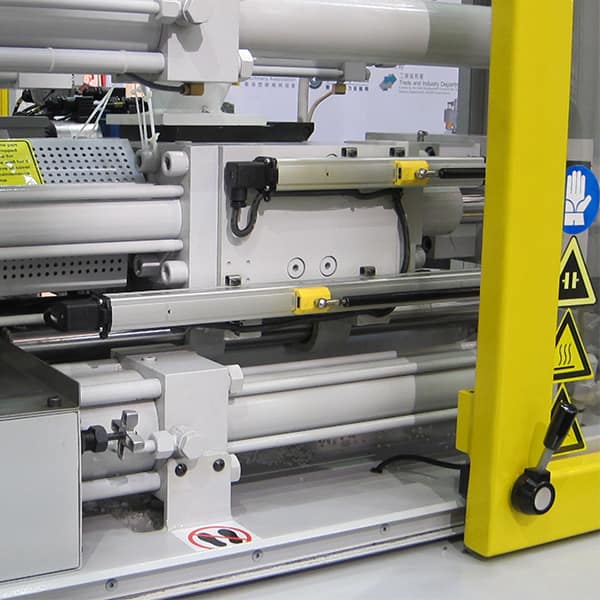
- Injection molding machines: screw position and platen position can be fed back together, simplifying the construction.
The common prerequisite is that all measured parts move along the same linear axis, and that the sensor rod can span the whole measuring interval. Mechanisms that do not meet this cannot use multi-magnet measurement.
Unsuitable: multi-stage (telescopic) cylinders
A common misunderstanding needs to be cleared up: multi-stage hydraulic cylinders (telescopic cylinders) cannot use magnetostrictive displacement sensors, whether single- or multi-magnet. The reasons are structural:
- The stages nest and extend; there is no through-cavity spanning the full stroke inside the cylinder, so there is nowhere to fit the rod;
- The pistons move in bores of different diameters and cannot share one waveguide, nor can magnets be fixed on every stage piston;
- Even if only the last stage is measured, the rod length cannot change as the cylinder telescopes.
Stroke feedback on multi-stage cylinders should use an externally mounted magnetostrictive displacement sensor, or measure the last stage alone. At the selection stage, first confirm whether the cylinder is single- or multi-stage, to avoid choosing the wrong scheme.
Single-magnet vs. multi-magnet
| Criterion | Single magnet | Multi-magnet |
|---|---|---|
| Number of positions | 1 | 2–4 (by model) |
| Hardware cost | One set per position | Several positions share one set |
| Cabling | Increases linearly with number of positions | Essentially unchanged |
| Magnet-spacing constraint | None | 19 analogue: 76 mm minimum; other series per catalogue |
Configuration points
- Bus mapping: bus types map each magnet position separately through the object dictionary (for example CANopen multi-magnet reading);
- Independent zeros: the zero offset of each magnet must be set separately;
- Spacing check: lay out to the model's minimum spacing so that echoes do not overlap.
The underlying principle of multi-magnet measurement is in the magnetostrictive measuring principle; CANopen multi-magnet configuration is in CANopen multi-magnet reading configuration; in-cylinder layout is covered in in-cylinder drilling requirements. Overall output-type selection is in analog vs. fieldbus.
Practical tips for engineers
- The position magnet must not touch the measuring rod; the designed clearance between them must be maintained.
- Fix the magnet with screws, spacers and similar parts made of non-magnetic material, so that ferromagnetic parts do not disturb the measurement.
- An M6 hexagon-socket set screw is recommended for locking the magnet — this screw is not supplied with the sensor and must be provided by the user.
Frequently Asked Questions
Q: How many positions can one rod read?
Typically 2–4 independent magnets are supported; the exact number depends on model and measuring range.
Q: Do multiple magnets interfere with one another?
They do not interfere magnetically. Each magnet launches its own echo; the electronics solves each position from its time difference. The hard constraint is adjacent-magnet spacing: Series 19 analogue dual-magnet minimum is 76 mm — do not order or install to the old 78 mm figure. Once spacing meets that model’s specified value, the two echoes are separable on the time axis; if they are too close they overlap, appearing as position jumps or a no-position report. Layout must also avoid the measuring dead zones at both ends of the waveguide.
Q: How are several magnet positions read from the bus?
Map each magnet position separately through the object dictionary, for example CANopen multi-magnet reading.
Q: Can multi-stage (telescopic) cylinders use multi-magnet measurement?
No. In a multi-stage (telescopic) hydraulic cylinder the stages nest and extend; there is no through-cavity spanning the full stroke, so a magnetostrictive rod cannot be installed; nor can the stage pistons move along the same waveguide and carry magnets. Magnetostrictive displacement sensors (single- or multi-magnet) are therefore not suitable for multi-stage/telescopic cylinders. Stroke feedback on multi-stage cylinders usually uses an external magnetostrictive sensor (Series 18 / 19P floating type or rail type), or measurement of the last stage alone. Multi-magnet measurement truly applies to single-stage cylinders, linear guides and similar cases with continuous linear mounting space and several parts moving independently along the same axis.
Related Products
Related Applications
Multi-Industry Application Cases for Magnetostrictive Displacement Sensors
View Details
Series 17 Hydraulic Cylinder Integrated Magnetostrictive Displacement Sensor Application Cases
View Details
Series 18 Profile Magnetostrictive Displacement Sensor Application Cases
View Details