Position Data for a Digital Twin from a Magnetostrictive Displacement Sensor: The Basis of the Physical Mapping
A digital twin is only useful when it is in the same state as the cylinder at the same moment; the magnetostrictive displacement sensor supplies that absolute position. For a digital twin to hold, the virtual model and the physical machine must be in the same state at the same instant. For most mechanical equipment, the first variable that describes that state is position — how far the hydraulic cylinder has extended, at what height the carriage sits, how far the roll gap is open. Position data is therefore not "one optional data source among others" for a digital twin; it is the base coordinate of the physical mapping. The trend is that twins fail not because modelling ability is lacking, but because the position data falls short in three respects: no absolute reference, no reliable timestamp, and accuracy that does not match the model's resolving power. These output absolute position and do not lose zero on power-down, which solves the most basic of those three.
Why it must be absolute position
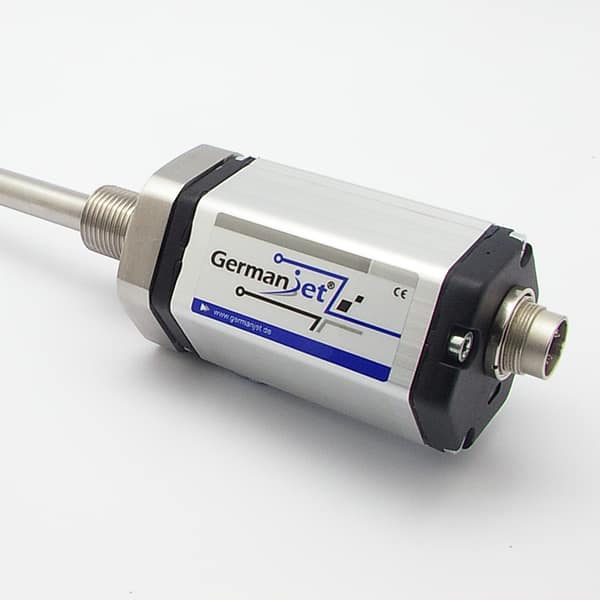
A digital twin must be able to answer "where is the machine now" at any instant. Incremental measurement needs homing to rebuild the reference after a power loss or a communications break. That "position-unknown interval" is fatal to the twin model — the model either freezes or shows a wrong pose. Magnetostrictive position is determined by the physical location of the position magnet on the waveguide; it is read on power-up with no homing, so the twin model can realign at the instant of recovery. Use a non-contact absolute sensor rather than an incremental encoder, so the twin needs no homing after every restart. Principle and differences are in magnetostriction and the Wiedemann effect and absolute vs. incremental position; the power-loss retention mechanism on fieldbus types is in power-loss retention and synchronous refresh on fieldbus types.
Four requirements a twin model places on position data
| Requirement | Meaning | Consequence of falling short | Corresponding technical means |
|---|---|---|---|
| Absolute reference | Position can be uniquely determined at any instant | Model pose fails after power/network loss | Absolute-position output, no homing |
| Time comparability | Timestamps of all sources share a common origin and can be aligned | Multi-axis motion timing is scrambled; cause and effect are misjudged | EtherCAT DC / PROFINET IRT |
| Accuracy matching | Measurement error is far smaller than the deformation the model cares about | What the model "sees" is measurement noise | Convert %FS into absolute error for the actual range |
| Update-rate matching | The sampling beat covers the dynamic process being simulated | Fast-motion sections are skipped by sampling | Align update rate with the control cycle |
"Accuracy matching" is the one most often overlooked. Non-linearity is stated as %FS; the same <0.02%FS figure corresponds to very different absolute errors on a short range and a long range, and must be calculated together with the range. See the three accuracy terms: resolution, repeatability and non-linearity and how to read a datasheet: parameter traps. The resolution step (1/2/5/10/20/50/100 μm selectable) should also be chosen for the smallest increment the model needs to resolve, not always the highest step.
Three twin applications place different emphasis on the data
- Visual twin: only the position value and an acceptable refresh rate are needed, for remote monitoring and training. Accuracy demand is relatively modest; continuity demand is high — there must be no long data gaps.
- Behavioural twin: the model must reproduce the machine's motion, for process tuning and virtual commissioning. Timestamp quality and update rate then become the main constraints; see matching response time / refresh rate to the control cycle.
- Predictive twin: on top of a behavioural twin, historical baselines are compared to judge a degradation trend. Long-term consistency of the data then matters most — the measuring chain on the same machine must not change its calibration method mid-stream. The method is in predictive maintenance: spotting equipment degradation in position data.
A typical scene: twin mapping of a hydraulic machine
Take a hydraulic press as an example. The twin model needs at least three position channels: main-cylinder stroke, ejector-cylinder stroke and mould-height position. Those three absolute positions, plus pressure and temperature, can reconstruct a complete process cycle on the virtual side for comparing shot-to-shot consistency. The technical logic of choosing a displacement sensor for hydraulics is in why choose magnetostrictive sensing for hydraulic-cylinder position control; the configuration idea for a high-accuracy closed loop is in high-accuracy applications: specifying sensors for μm-level closed loops. If positions among axes are to be strictly aligned in the twin, synchronisation must be solved first; see multi-axis synchronisation: how many axes can one fieldbus carry reliably.
Data path and deployment form
| Deployment form | Data source | Typical latency | Suitable twin type |
|---|---|---|---|
| Local twin (HMI / industrial PC) | Read the control layer directly | Low | Behavioural twin, virtual commissioning |
| Edge twin (gateway side) | Fieldbus bypass acquisition | Lower | Behavioural twin + local prediction |
| Cloud twin (platform side) | Features and curves uploaded from the edge | Higher | Visualisation, cross-machine prediction |
Duty boundaries of the layered architecture and paths to the cloud are in IIoT and edge computing: an architecture for getting position data to the cloud; field-layer access methods are in how to network displacement sensors under Industry 4.0.
Product correspondence
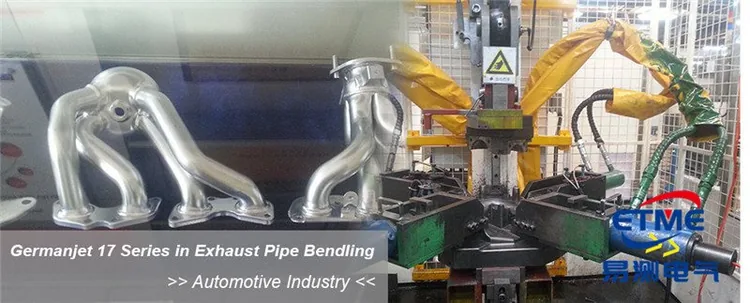
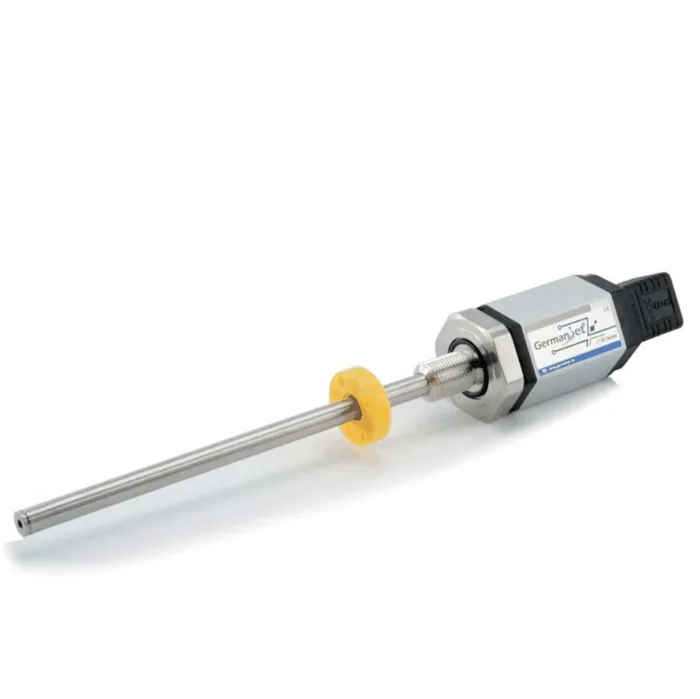
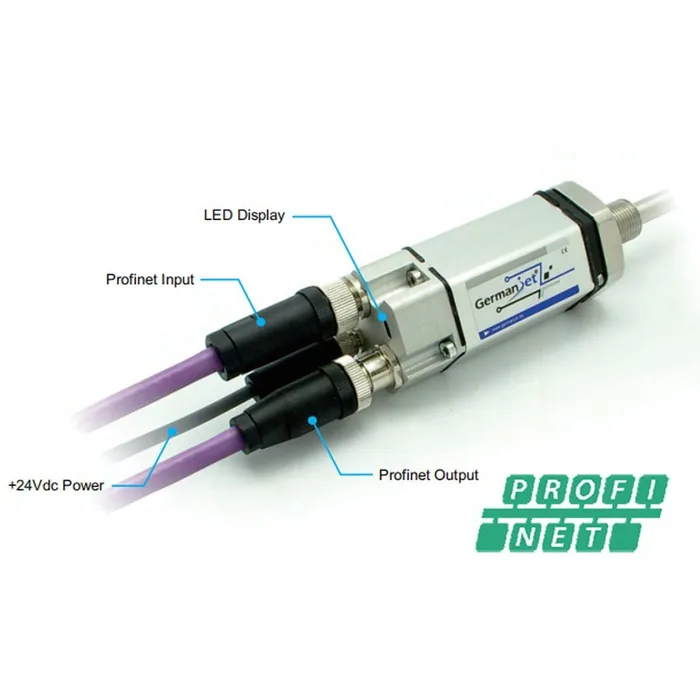
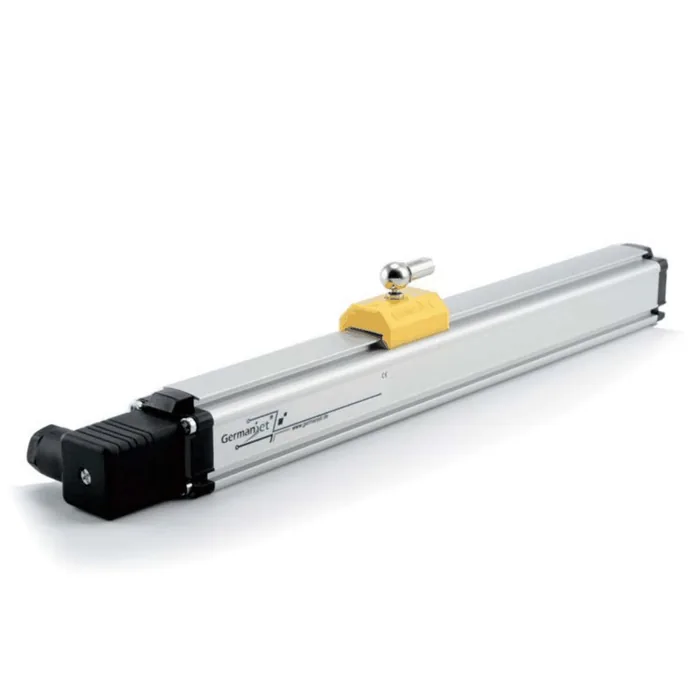
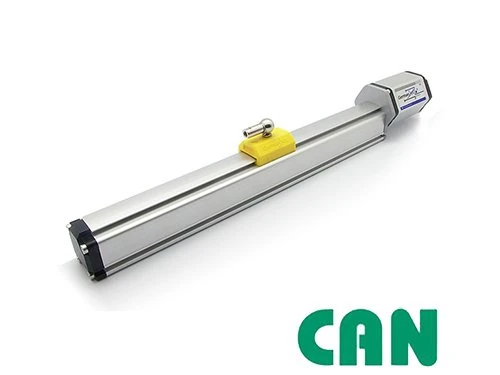
For behavioural/predictive twins that need high time-base quality, prefer the Series 197 EtherCAT (distributed clocks) or the 199PROFINET series (IRT); cylinder-integrated mounting on hydraulic machines commonly uses the Series 17 hydraulic-cylinder integrated and the Series 16 cylinder-integrated; existing machines where the cylinder is not to be modified can add the Series 18 external in parallel; multi-axis distributed stations can use the Series 194 CANopen. Technical matching in China is provided by Shenzhen Yice Electric Co., Ltd. (authorised distributor).
Frequently Asked Questions
Q: Why must a digital twin use an absolute-position sensor?
A twin must be able to determine where the machine is at any instant. Incremental measurement needs homing to rebuild the reference after a power or network loss; that position-unknown interval freezes the model or shows a wrong pose. Magnetostrictive reading is determined by the physical location of the position magnet, is read on power-up with no homing, and can realign at the instant of recovery.
Q: Can a twin model's accuracy be higher than the sensor's accuracy?
No. If measured repeatability is of the order of ±0.002 mm and the model displays to 0.001 mm, the extra digits are false confidence. Non-linearity is stated as %FS and must be converted to absolute error for the actual range before the model's resolving power is set.
Q: Does a digital twin always require EtherCAT or PROFINET?
It depends on the twin type. A visual twin is relatively relaxed about the time base; a behavioural twin and a predictive twin need to reproduce the motion and compare historical curves, where a fieldbus that supports distributed clocks or isochronous synchronisation has a clear advantage.
Q: What must be made explicit before twin modelling?
At least the definition of zero: the offset relationship among mechanical zero, sensor zero and the model coordinate origin must be written down, and reset to the same definition after a replacement. Every calibration and replacement event should also be recorded, so that a baseline jump in a historical curve is not misread as a machine abnormality.
Related Products
Related Applications
Multi-Industry Application Cases for Magnetostrictive Displacement Sensors
View Details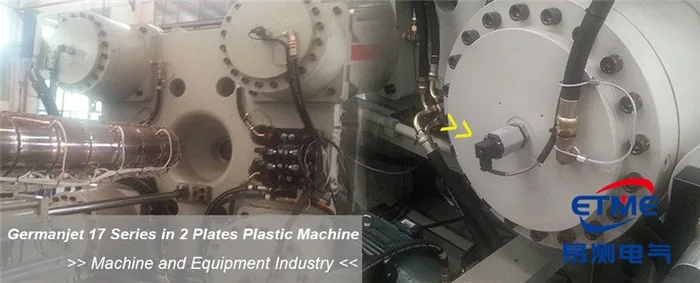
Series 17 Hydraulic Cylinder Integrated Magnetostrictive Displacement Sensor Application Cases
View Details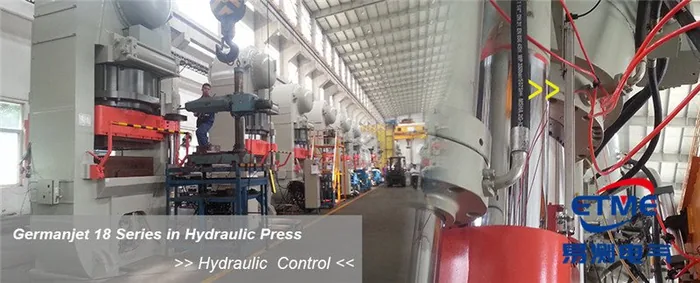
Series 18 Profile Magnetostrictive Displacement Sensor Application Cases
View Details