Four-Layer Cloud Path for a Magnetostrictive Displacement Sensor: Field, Control, Edge and Platform
Taking a magnetostrictive displacement sensor to the cloud works best in layers: field produces, control uses, edge filters, platform stores. The mainstream architecture for taking position data to the cloud is layered; it is not a direct connection of the sensor to the internet. A sound division of labour is: the field layer produces data, the control layer uses data, the edge layer filters data, the platform layer analyses data. The reason is direct — a displacement sensor's raw update rate is usually of the order of milliseconds. Uploading every sample unchanged quickly makes bandwidth and storage costs unmanageable, and the cloud cannot meet the determinism of a real-time closed loop. The trend is therefore that edge computing is not the opposite of the cloud; it is the necessary middle layer that lets position data "get up, be affordable to compute, and be usable".
A four-layer architecture and the duty boundary
| Layer | Typical components | Data handled | Real-time requirement | What it should not do |
|---|---|---|---|---|
| Field layer | Displacement sensors, pressure/temperature sensors | Raw position value + device status word | Millisecond order (with range and protocol) | No business logic |
| Control layer | PLC / motion controller | Closed-loop feedback, alarms, process sequencing | Deterministic cycle (within the scan cycle) | No long-term data archive |
| Edge layer | Edge gateway / industrial PC | Feature extraction, down-sampling, buffering, protocol conversion | Near-real-time (hundreds of milliseconds to seconds) | No participation in safety interlocks |
| Platform layer | Cloud platform / data hub | Trends, cross-machine comparison, reports | Non-real-time (minutes to hours) | No real-time control |
The boundary most often crossed is "the edge layer does not participate in safety interlocks". Any judgement that involves functional safety should stay in the control layer and the hard-wired safety loop. Keep safety limits and fast control on the PLC; the cloud path is for trends and alarms, not for the closed loop. Related integrity-level concepts are in standards and certification: how to read functional safety SIL.
Where the data comes from: field-layer access choices
The first hop of position data into an IIoT path determines what can be obtained later. Analog can only give a value, which must be timestamped again at the control layer; a digital fieldbus can provide value, parameters and diagnostics together; IO-Link is suited to gathering distributed sensors at a master and then going onto the network. Access capability and the evolution path are compared in how to network displacement sensors under Industry 4.0; the IO-Link mechanism is in IO-Link: the last hundred metres to the cloud. If the existing system is PLC-centred, reading the position value over Modbus RTU/TCP is often the shortest path; mixed-protocol sites can refer to multi-protocol gateway schemes.
What the edge layer should actually compute
The value of the edge is "local compute in exchange for uplink bandwidth". For position data, common and cost-controllable processing includes:
- Event-triggered storage: in normal running, only conventional totals go up; when a motion is abnormal or an alarm occurs, that section of the complete high-rate curve is sent back;
- Feature extraction: from one motion, pull a few numbers such as time to target, steady-state error and pressure-hold drift; data volume can fall by several orders of magnitude;
- Down-sampling and compression: for trend-type monitoring, aggregate at second level, keeping extrema and the mean rather than every sample;
- Time alignment: pack position, pressure and temperature on a common time base so that they can still be related after they reach the cloud;
- Offline buffering: continue storing locally when the network is down, and catch up after recovery so that the trend curve does not break.
These processed results are the input to predictive-maintenance analysis. The judgement method is in predictive maintenance: spotting equipment degradation in position data.
Timestamp quality: the most underestimated link in a cloud architecture
Cross-machine, cross-system data analysis depends, in essence, on time being comparable. If node timestamps come from different clocks and are not synchronised, the "cause and effect" seen in the cloud may be entirely an artefact of sampling skew. EtherCAT with distributed clocks and PROFINET IRT with isochronous synchronisation have a structural advantage here. The mechanisms are in EtherCAT DC synchronisation and jitter and PROFINET basics: IRT and device-name assignment. Synchronisation choices in multi-axis applications are also in multi-axis synchronisation selection.
Comparing typical paths to the cloud
| Path | Data link | Advantages | Limitations |
|---|---|---|---|
| PLC forwarding | Sensor → PLC → gateway → cloud | Reuses existing programs; small retrofit | Limited by the scan cycle; PLC load rises |
| Gateway bypass acquisition | Sensor → fieldbus → edge gateway → cloud | Does not occupy control resource; high-rate sampling possible | The gateway must support the protocol |
| IO-Link master aggregation | Sensor → IO-Link master → Ethernet → cloud | Unified parameterisation and events; automatic write-back at replacement | The field layer must be converted to IO-Link |
| Independent acquisition unit | Analog → acquisition card → edge → cloud | Monitoring can be added to a legacy machine with zero change | Timestamp quality and accuracy are limited |
Product and implementation correspondence
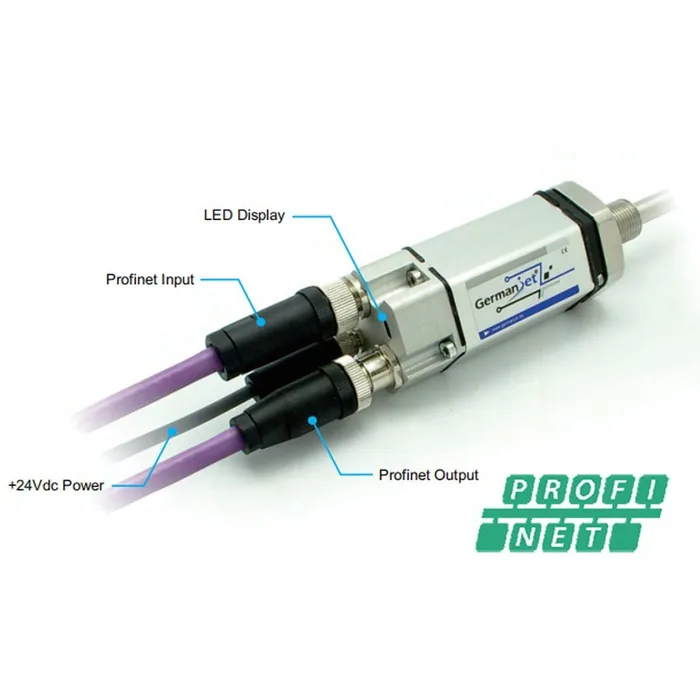
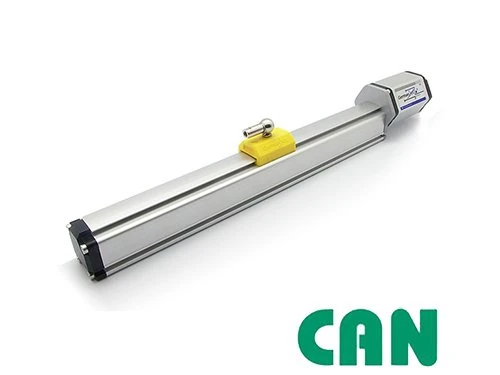
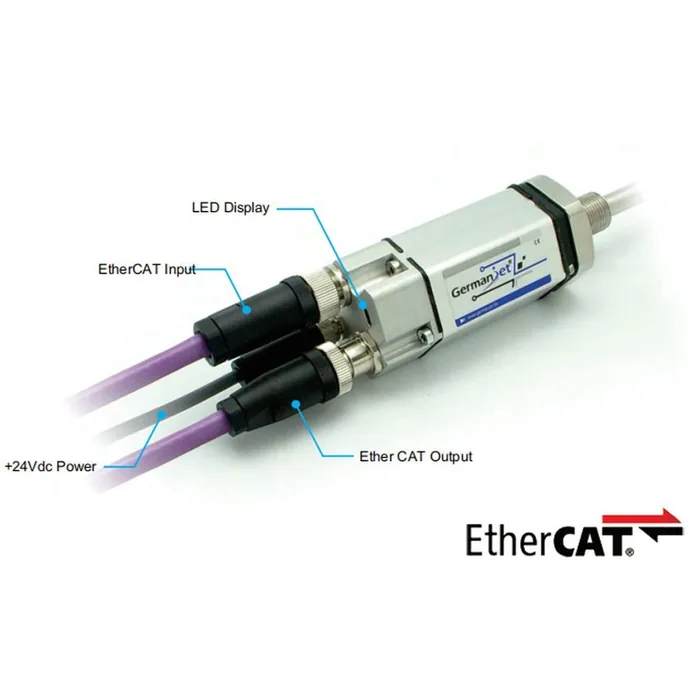
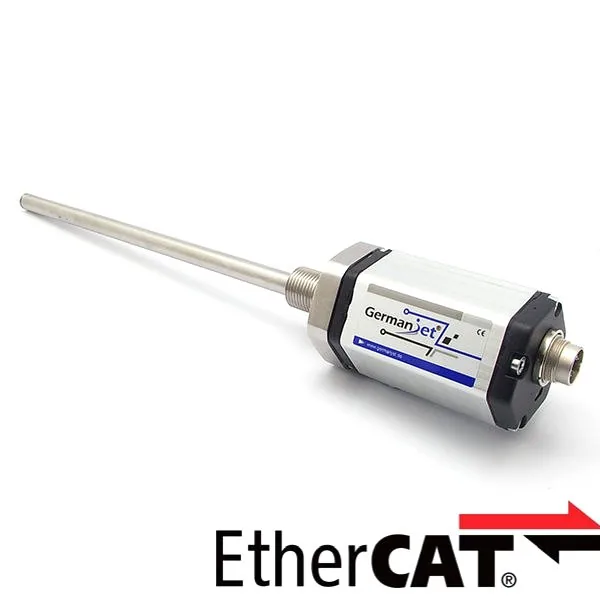
When high-rate sampling and a stable time base are needed, the Series 197 EtherCAT or the compact-wiring 198 single-M12 EtherCAT is often chosen; for a whole line with a PROFINET backbone, the 199PROFINET series; mobile equipment and distributed stations commonly use the Series 194 CANopen; for a legacy retrofit that only needs the value to go up, the Series 191 analog with an acquisition unit can also suffice. Architecture matching and selection support in China is provided by Shenzhen Yice Electric Co., Ltd. (authorised distributor).
Frequently Asked Questions
Q: Can a displacement sensor connect directly to a cloud platform?
Not recommended. A displacement sensor's raw update rate is often of the order of milliseconds. Uploading everything makes bandwidth and storage costs unmanageable, and the cloud cannot meet the determinism of a real-time closed loop. The sound practice is layered processing through the control layer and the edge layer, with feature extraction and down-sampling at the edge before the uplink.
Q: Can the edge layer take on a safety-interlock function?
No. Any judgement that involves functional safety should stay in the control layer and the hard-wired safety loop. The edge layer's role is near-real-time data processing and protocol conversion; its latency and availability do not meet the determinism of a safety function.
Q: Why does a cloud architecture emphasise timestamps?
Cross-machine, cross-system analysis depends on time being comparable. If node clocks are not synchronised, the cause and effect seen in the cloud may be only an artefact of sampling skew. EtherCAT with distributed clocks and PROFINET IRT with isochronous synchronisation have a structural advantage in time-base quality.
Q: Can a legacy machine send data to the cloud without being retrofitted?
The independent-acquisition-unit path can be used: analog output into an acquisition card and then an edge gateway, with zero change to the machine itself. The cost is limited timestamp quality and data accuracy. It suits trend-type monitoring, not applications that need high-rate curve comparison.
Related Products
Related Applications
Series 19D Split-Type Process Displacement Sensor Application Cases
View Details
Series 19F Flexible Process Displacement Sensor Application Cases
View Details
Series 19H Cylinder-Integrated Process Displacement Sensor Application Cases
View Details