Magnetostrictive vs. Laser Displacement Sensors: Environmental Robustness Compared
A magnetostrictive displacement sensor measures inside a stainless-steel sensing rod; a laser, by contrast, relies on light travelling out and back in air and being reflected by the measured surface. Choosing between them is essentially a contest of “measuring medium”: a laser relies on light travelling out and back in air and being reflected by the measured surface. Anything that affects the optical path and the reflection — dust, oil mist, water vapour, cutting fluid, smoke, colour and roughness of the measured surface, specular reflection, strong ambient light — directly affects the reading or even causes a lost echo. For the magnetostrictive rod the outside world need only ensure that the magnet ring can move along it, with no requirement on the medium. Therefore in clean, non-contact duty that needs to measure the surface of a moving part, prefer laser; inside a hydraulic cylinder, in oil mist and dust, water wash-down and high vibration, choose magnetostrictive. The overall comparison framework is in Magnetostrictive vs. LVDT vs. external magnetostrictive (long stroke).
Measuring mechanism and the “premises that must hold”
A laser displacement sensor (triangulation or time-of-flight) projects a spot onto the measured surface, receives the reflected light and resolves distance from spot position or transit time. It has three premises that must hold: the optical path must be clear, the measured surface must provide a stable echo, and the receiver must not be saturated by ambient light. If any one is not met, the output will jump or fail.
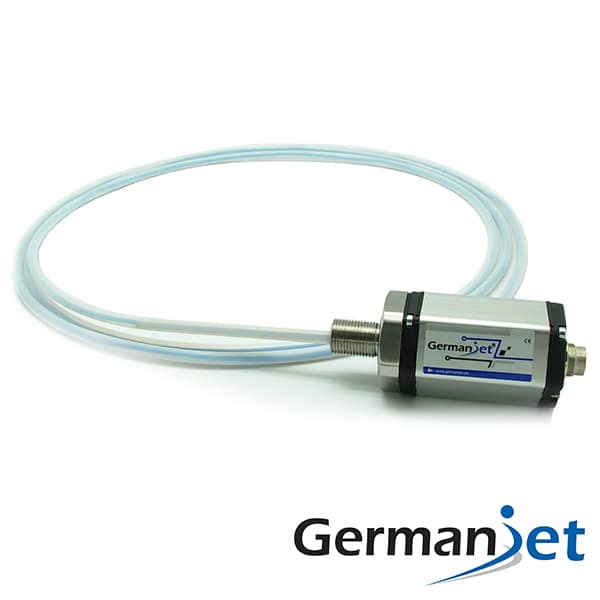
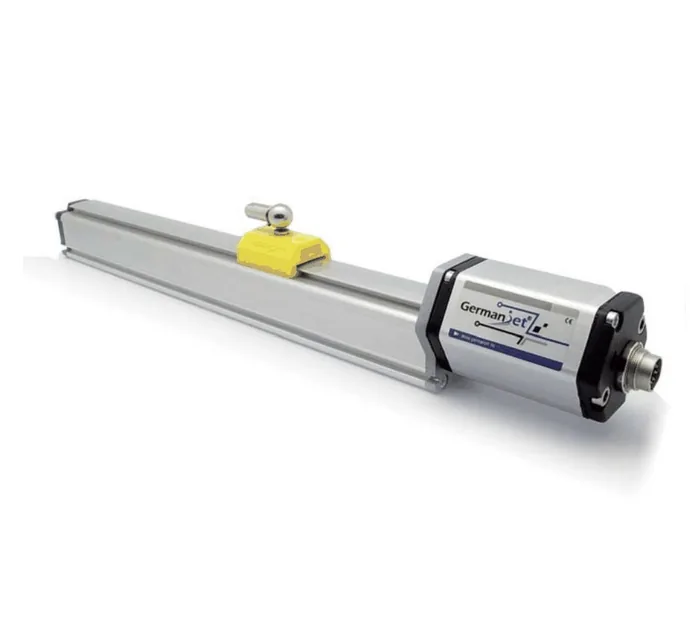
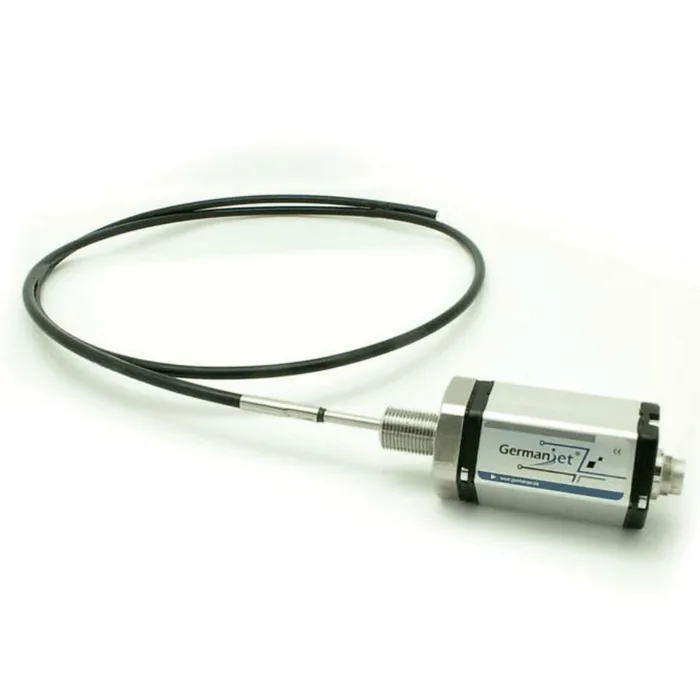
A magnetostrictive displacement sensor launches a current pulse from the electronics head into the waveguide wire; interaction with the magnet-ring field produces a torsion stress wave, and measuring its return time gives the magnet-ring position. There is only one premise that must hold: the magnet ring and sensing rod keep the specified coaxiality and gap. The measuring process is completely independent of air, illumination and the colour of the measured object. The principle is set out in Magnetostriction and the Wiedemann effect.
Environmental endurance item by item
The three most common “laser not suitable” situations in the field: first, oil mist in a hydraulic power unit and a die-casting zone forms a film on the lens, readings drift slowly, and frequent wiping is needed; second, dust and smoke in metallurgy, woodworking and cement weaken echo strength and cause intermittent lost readings; third, high-pressure hot-water wash-down on food and chemical lines directly damages the optical window. The corresponding magnetostrictive capability in these three duties is: Germanjet provides IP65 / IP67 / IP68 / IP69K protection in several grades, of which the Series 13 mobile hydraulic type reaches IP69K and is rated 25 g vibration, 100 g shock; what protection classes actually mean in testing is in IP65/67/68/69K are not a numbers game. Trial a laser on a full-load, heaviest-dust shift and count dropped readings, not a clean stopped-machine trial.
Conversely, magnetostrictive has its own hard constraint: a magnet ring must be fitted on the moving part. If the measured object is a high-temperature billet, a rotating roll face, a flexible strip or another object to which a magnet ring cannot be attached, laser is the only feasible option; the focus should then be on a guard, positive-pressure purge and lens maintenance.
Range, accuracy and installation-constraint comparison
| Dimension | Magnetostrictive displacement sensor | Laser displacement sensor |
|---|---|---|
| Measuring medium | Stress wave in the waveguide wire, enclosed | Optical path in air, open |
| Measured-surface requirement | Only a magnet ring need be fitted | Depends on reflectance, roughness, colour, inclination |
| Dust / oil mist / water vapour | Does not affect measurement | Significant effect; echo may be lost |
| High-pressure wash-down | IP69K models can withstand it | Needs an extra guard and purge |
| Strong ambient light / arc | Unaffected | May saturate the receiver |
| Contact and wear | Non-contact, no wear | Non-contact, no wear |
| Need to touch the measured part | Magnet ring must be fixed on the moving part | Completely non-contact with the measured part |
| Resolution | 1 / 2 / 5 / 10 / 20 / 50 / 100 μm optional | Can be very high, depending on model and range |
| Repeatability | Of the order of ±0.002 mm | High at short range, falls at long range, depending on model |
| Non-linearity | Typical <0.02% FS | Depends on model and measured-surface state |
| Long-stroke capability | Can cover several metres, including flexible long-stroke models | Accuracy of long-range models falls markedly with distance |
| Cylinder-integrated | Can be cylinder-integrated; pressure rating by series: Series 16/16R is 350 bar working / 530 bar peak, Series 17/17EX is 350/600 bar, Series 19 in-cylinder is 300/600 bar | No |
| Maintenance items | Essentially maintenance-free | Lens cleaning is a routine maintenance item |
| Typical application | Hydraulic cylinders, presses, metallurgy, mobile machinery, underwater | Clean assembly lines, inspection stands, objects that cannot take a magnet ring |
Where each applies
- Choose magnetostrictive: the measured part is a hydraulic-cylinder piston, rail type, cross-beam or other mechanism that can take a magnet ring; the site has oil, water, dust or vibration; long-term maintenance-free operation is needed; absolute position with no homing after power-down is needed; it must be placed inside a pressure-containing oil cavity.
- Choose laser: the measured object cannot have any part attached (high-temperature billet, finished-product surface, soft material); a profile or multi-point thickness must be measured; the stroke is very short and the environment is clean; the measured-object specification is changed frequently.
- Use both: some lines use magnetostrictive for closed-loop position feedback of the actuator and laser for sample inspection of workpiece size. The two chains have different duties and need not be an either/or.
If the site already uses laser but is continuously troubled by contamination, a conversion usually need not change the cylinder: an external type can be mounted in parallel outside the cylinder. The path is in Selecting for retrofit of existing plant: adding displacement sensing without touching the cylinder; products include the Series 18 external type or 19P external type. If a laser keeps failing on dirty fluid, add an external 18 or 19P magnetostrictive displacement sensor beside the cylinder. The output-interface trade-off is in 4-20 mA analog or CANopen fieldbus.
Frequently Asked Questions
Q: Can a laser displacement sensor still be used where there is oil mist and dust?
The risk is high. Oil mist forms a film on the lens and readings drift slowly; dust and smoke weaken echo strength and cause intermittent lost readings. Assessment must sample continuously for a full working shift at full production, in the heaviest contamination period, and observe the lost-reading rate — not a trial in a stopped, clean state.
Q: What is the output state when a laser loses a reading?
A common practice is to hold the last valid value, so the controller cannot see an abnormality from the number. The sensor’s echo-quality bit or validity flag must therefore be checked, or the closed loop will keep running on wrong data.
Q: When can only laser, not magnetostrictive, be used?
When a magnet ring cannot be attached to the measured object — for example a high-temperature billet, a rotating roll face, a flexible strip, or finished-product surface profile measurement. Magnetostrictive sensing must have a magnet ring fitted on the moving part; that is its hard constraint.
Q: What protection level can magnetostrictive reach?
IP65, IP67, IP68 and IP69K grades are available. The Series 13 aimed at mobile hydraulics reaches IP69K and is rated 25 g vibration and 100 g shock, able to withstand high-pressure hot-water wash-down. IP68 requires a separate confirmation of immersion depth and medium compatibility.
Related Products
Related Applications
Multi-Industry Application Cases for Magnetostrictive Displacement Sensors
View Details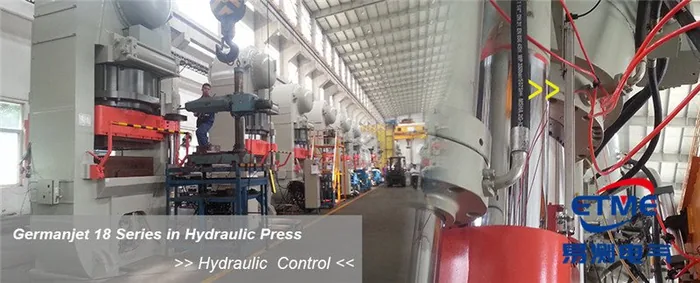
Series 18 Profile Magnetostrictive Displacement Sensor Application Cases
View Details
Series 19F Flexible Process Displacement Sensor Application Cases
View Details