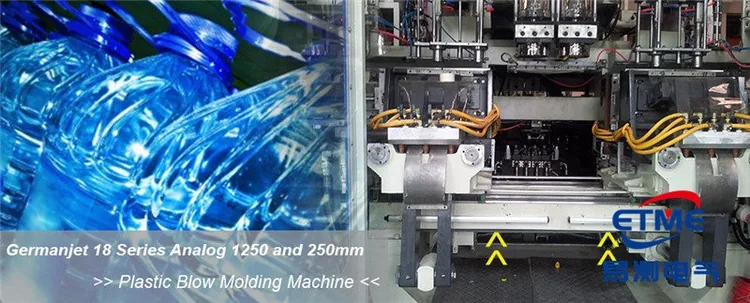
Mill Roll Gap Choice: Displacement Sensor on the Screw-Down Cylinder
A magnetostrictive displacement sensor for roll-gap control (AGC) on a metallurgical mill meets two distinct needs. The requirements can be summarised in two sentences: the screw-down-cylinder measuring point must be accurate and fast, because roll-gap error becomes strip-thickness error directly; ancillary mechanisms along the line must be long and durable, with loopers, coilers, side-guides, shears and similar often travelling several metres, for long periods among mill scale, cooling water and a strong electromagnetic environment. Magnetostrictive displacement sensors, with absolute-position output and a non-contact structure, can serve both needs, but the selection logic is entirely different.
What roll-gap control requires of position feedback
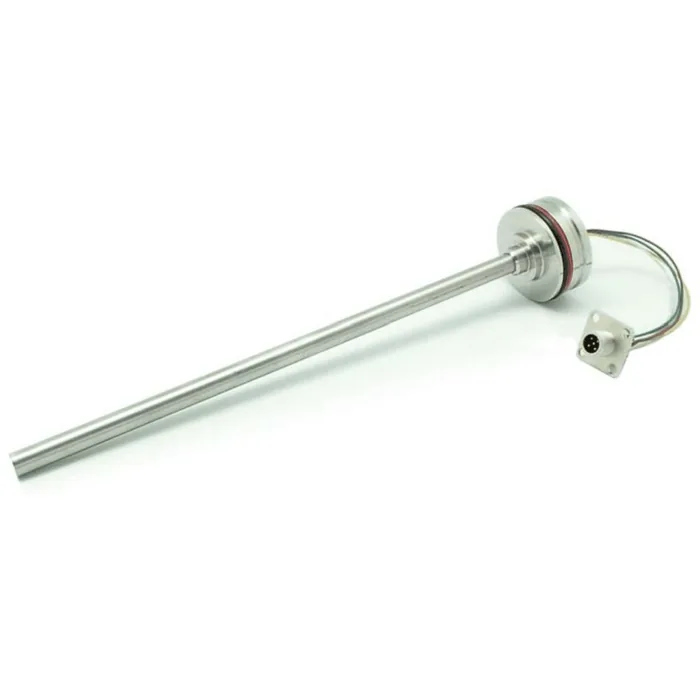
The core of hydraulic AGC is a screw-down-cylinder position loop: the controller commands a position from the target roll gap, the cylinder servo valve regulates, and the displacement sensor reports actual position. The quality of this loop is set by three figures — repeatability determines thickness consistency at the same roll-gap setpoint (can reach the order of ±0.002 mm); resolution determines the smallest adjustable increment, usually a 1–5 μm step on the AGC section; update rate must be faster than the position-loop control cycle, otherwise the regulator overshoots on stale data. Distinctions and common misreadings of the three figures are in The Three Accuracy Terms of Magnetostrictive Sensors: Resolution, Repeatability and Non-Linearity.
Long-stroke mechanisms: how to measure 2 m and above
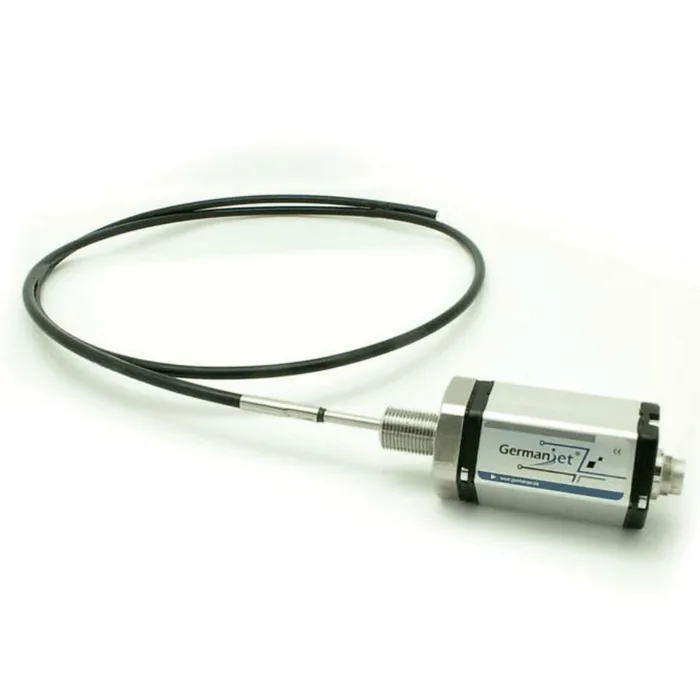
Loopers, coiler cars, side-guides, transfer machines and similar often travel several metres. Three points must be calculated in advance: first, non-linearity is a percentage of full scale, so 0.02% FS is ±0.8 mm on a 4 m range — a mathematical result of the range base, not a product downgrade; second, the update rate of a long range is relatively longer (about 0.5 ms to 5 ms depending on range and model), and high-speed mechanisms must check whether it meets the control cycle; third, a rigid rod needs intermediate support over a several-metre span, or a flexible-rod scheme can be used. Flexible long-stroke products include Series 19F flexible long-stroke; the overall long-stroke selection framework is in Why Choose Magnetostrictive Sensing for Hydraulic Cylinder Position Control.
Comparison of roll-gap and line long-stroke measuring points
| Measuring point | Stroke magnitude | Resolution step | Primary figure | Recommended form |
|---|---|---|---|---|
| AGC screw-down cylinder | Short stroke | 1–5 μm | Repeatability, update rate | In-cylinder |
| Roll-bending / roll-shifting cylinder | Short stroke | 5–10 μm | Repeatability | In-cylinder |
| Looper / coiler car | Metre-scale long stroke | 20–50 μm | Absolute non-linearity, contamination resistance | External / flexible long-stroke |
| Side-guide / transfer machine | Metre-scale long stroke | 50–100 μm | Protection class, vibration resistance | External / flexible long-stroke |
Environmental constraints of a mill site
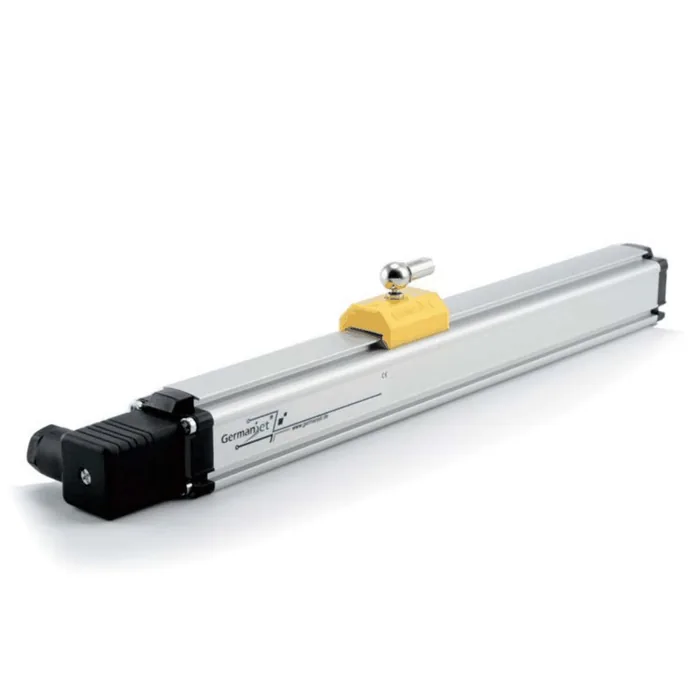
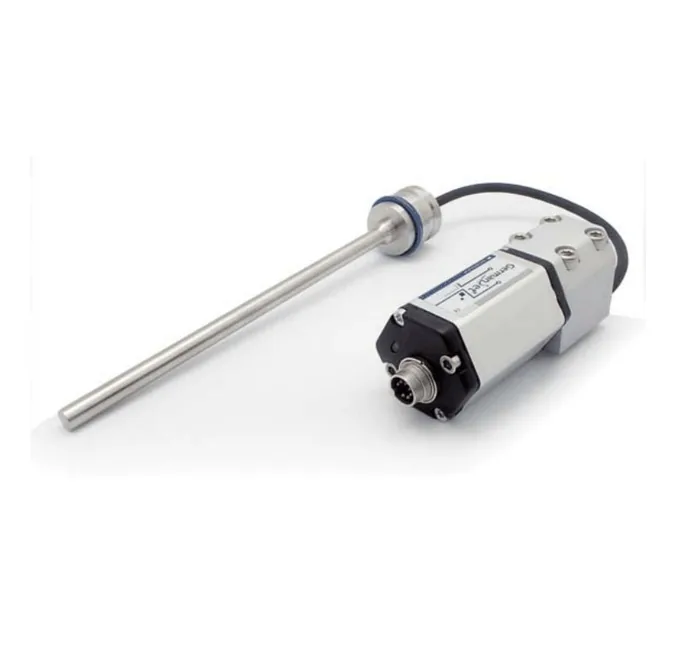
Environmental pressure on a mill line comes mainly from four sides: continuous spray of cooling water and emulsion (IP67 and above required; IP69K recommended in wash-down zones), mill-scale dust (magnetic dust especially must be kept from collecting between magnet and rod; magnetic dust sticks to the magnet ring and rod, so shield against it), strong electromagnetic fields from main drives and induction heating (EMC design and earthing are in EMC: Why Strong Magnetic Fields Disturb Measurement), and high ambient temperature near hot product (check the operating-temperature range; use a split electronics head if necessary). External mounting can use Series 18 external; wet and wash-down zones prefer Series 13 mobile hydraulics (IP69K, 25 g vibration / 100 g shock). High-frequency vibration measurement on the caster is a different problem — see Steel Continuous Casting: Mold Oscillation Position.
Interface and redundancy
Mill main control is mostly a large PLC/DCS; position signals commonly enter in three ways: analog 4-20 mA (simple wiring, good immunity), SSI (digital, deterministic timing, suited to a high-speed position loop), and Profibus/PROFINET/EtherCAT fieldbus (rich diagnostics, good multi-axis synchronisation). Screw-down cylinders on critical stands should be assessed for dual-channel redundancy to avoid a single-point mill stop; redundant design is in What Is Redundant Output? The Story Behind Dual-Channel Safety Design.
Practical tips for engineers
- Series 19F flexible types must be supported inside a straight or bent guide pipe of non-ferromagnetic material.
- With a 10 mm ID flange: pipe OD must be <10 mm and ID >8 mm; with a 12.7 mm ID flange: OD <12.7 mm and ID >8.5 mm.
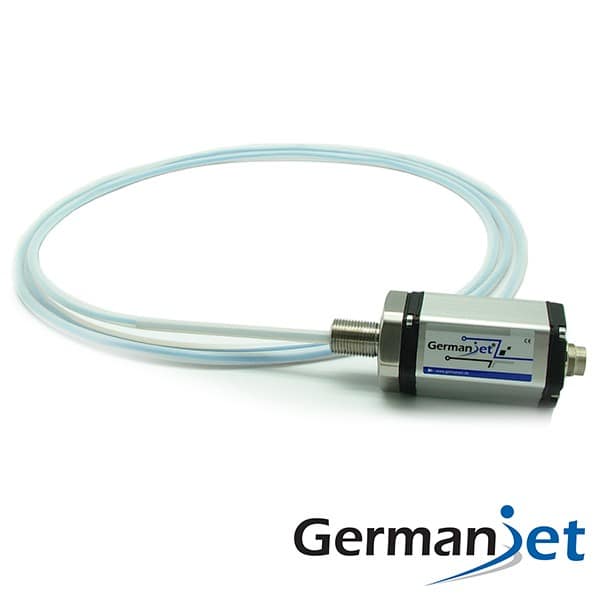
- Guide-pipe length: stroke + 150 mm when stroke <8000 mm; stroke + 230 mm when stroke >8000 mm. The flexible-rod jacket is PTFE-coated stainless steel and may be used in heavily contaminated environments.
Frequently Asked Questions
Q: Why must mill roll-gap use a long-stroke displacement sensor?
Roll-gap adjustment stroke often reaches several metres, which an ordinary short in-cylinder rod cannot cover. Series 19F flexible long rods are designed for extra-long strokes and are the only series covering this range.
Q: Must both sides of the roll gap be measured in synchronism?
Yes. The difference between the two sides reflects roll parallelism and directly affects transverse thickness tolerance. Monitor the difference with two sensors of the same type rather than looking at a single absolute value.
Q: How should protection be chosen in a rolling-emulsion environment?
Choose IP67 or above and route cables downward; wet zones can use Series 13 IP69K. The sensor is non-contact and oil-tolerant; the emphasis is on connector sealing and cable resistance to rolling emulsion.
Related Products
Related Applications
Multi-Industry Application Cases for Magnetostrictive Displacement Sensors
View Details
Series 18 Profile Magnetostrictive Displacement Sensor Application Cases
View Details
Series 19D Split-Type Process Displacement Sensor Application Cases
View Details