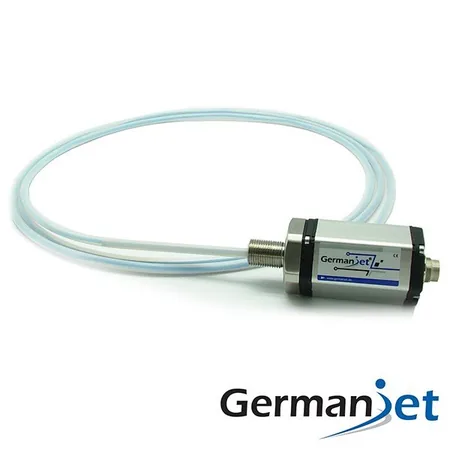
19D Split Magnetostrictive Displacement Sensor: Moving the Head Out of Heat and Tight Spaces
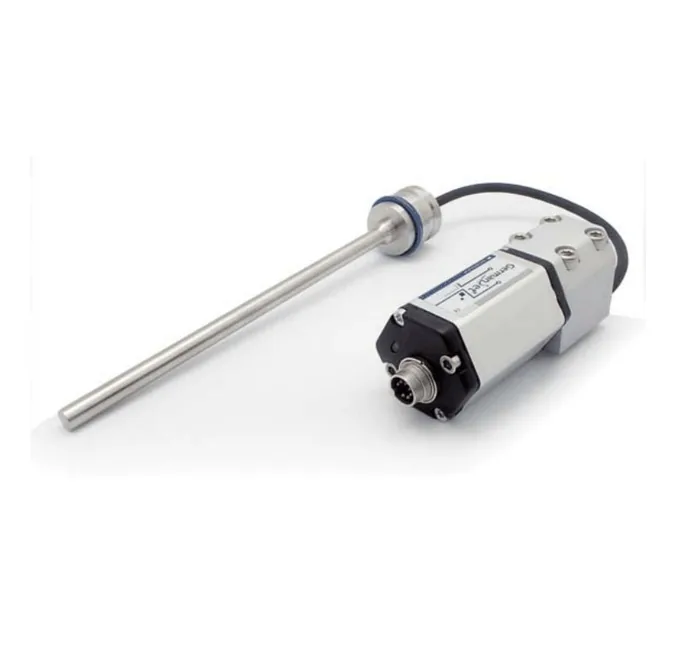
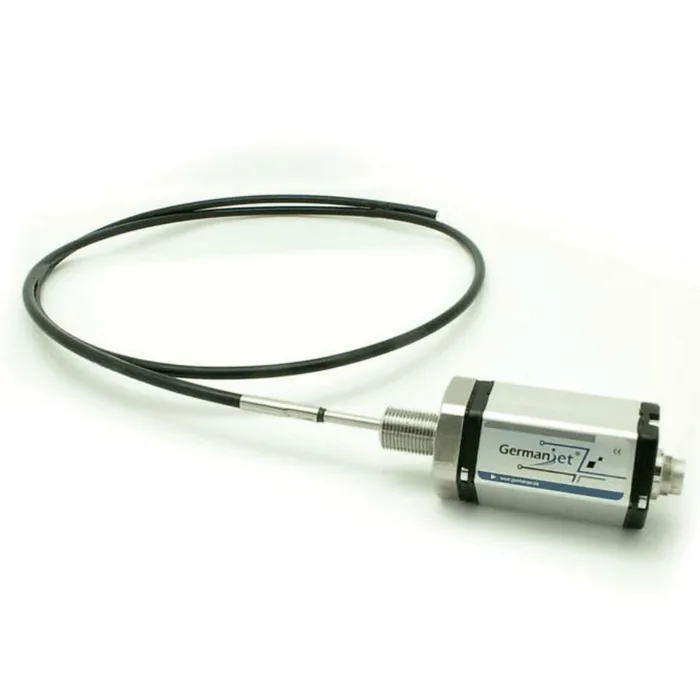
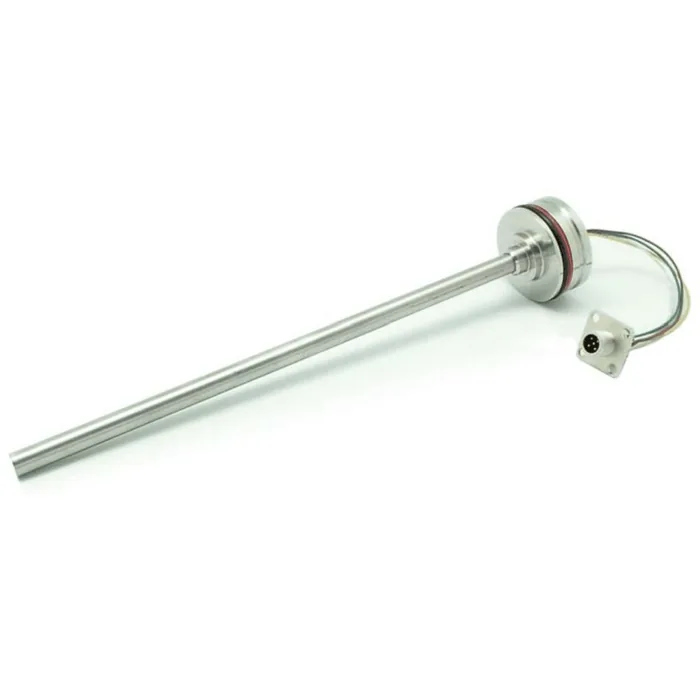
19D is the split type magnetostrictive displacement sensor in Germanjet Series 19: the electronics head and the sensing rod are separate, linked by a connecting cable. It solves a specific contradiction — the environment at the measuring point is more than the electronics can take, but the measurement must be made there. The most typical case is high-temperature duty: the sensing rod itself is mainly a stainless-steel tube and waveguide wire, with a temperature capability well above that of an electronics head containing semiconductor devices. Moving the electronics head to a position of acceptable temperature allows measurement to continue in an environment the rod can withstand. Besides high temperature, very tight installation space, strong radiant heat and restricted maintenance access are equally applicable.
Why high temperature burns the electronics head first
The temperature bottleneck of a magnetostrictive sensor is not the measuring principle but the electronic devices. The sensing-rod section is a metal tube, waveguide wire and damping assembly, with relatively generous temperature margin; the electronics head contains the pulse-generation circuit, high-speed timing circuit and output module. Junction-temperature limits of semiconductor devices are a hard constraint; long-term over-temperature causes parameter drift, a sharp drop in life, or failure. What is inside the electronics head is in What is inside the electronics head.
When ambient temperature exceeds the specification of an integral type, there are therefore three feasible routes: lower the ambient temperature (add insulation, ventilation, water cooling), change to a more temperature-capable integral model, or move the electronics head away. The first two are often limited by process and cost; the third is the split-type scheme. How to read operating temperature versus storage temperature is in Operating temperature vs. storage temperature; selection thinking for high-temperature environments is in Selecting for high-temperature environments.
Split type versus integral type
| Comparison | 19D split type | Integral (Series 12 / 13 / 16 / 17 etc.) |
|---|---|---|
| Construction | Electronics head and sensing rod separate, cable-connected | Electronics head and sensing rod as one piece |
| High-temperature suitability | Electronics head can be moved to a cooler zone | The whole unit is limited by the electronics-head temperature ceiling |
| Installation space | The measuring point need only accept the sensing rod | The measuring point must accept the complete body |
| Connection links | An extra connecting cable and connectors | No intermediate connection |
| Number of fault points | More (added connection interfaces) | Fewer |
| Interference immunity | The connecting section needs particular shielding | Relatively simple |
| Ease of maintenance | Electronics head can be serviced in a safe area | Must approach the measuring point |
| Selection criterion | Measuring-point environment exceeds what the electronics head can take | Ordinary applications within specification |
The point is in the last two rows: what the split type brings is feasibility and maintainability; the cost is an extra connection interface. Wherever an integral type will meet the need, a split type should not be chosen because it “looks more flexible” — every added connector is an added fault point.
Typical applications
Metallurgical and foundry ancillary equipment. Hydraulic mechanisms near continuous casters, rolling mills and reheating furnaces see ambient temperature and radiant heat far beyond what ordinary electronic devices can take; the electronics head must be moved out. Industry applications are in Mould-oscillation displacement on a steel continuous caster and Roll-gap control on a metallurgical mill.
Rubber vulcanising and hot-press forming. The mould zone is at high temperature for long periods, and the process requires displacement to work with temperature control; see Mould-close displacement and temperature-control coordination on a rubber vulcanising press.
High oil-temperature hydraulic systems. A cylinder-integrated sensor is immersed in hydraulic oil for long periods, so oil temperature is the working temperature. If system oil temperature is high and cooling capacity is limited, an integral cylinder-integrated scheme (such as Series 17; see Series 17 explained) may exceed the temperature specification; a split scheme is then an optional path.
Extremely tight installation space. Mechanical structures where the measuring point will only accept the sensing rod, not the electronics head: the split type is the only solution.
The connecting cable is the critical link of the split type
Whether a split type succeeds often depends on that middle length of cable. Three points must be controlled:
First, the cable itself must be temperature-capable. The electronics head has been moved, but a length of cable still remains in the high-temperature zone. Ordinary PVC-sheathed cable will harden and crack at high temperature and then lose insulation and shielding. The high-temperature section should use a temperature-capable sheathed cable; routing and selection are in Installing in high temperature: heat dissipation and cable selection.
Second, the shield must be continuous. The connecting section carries a low-level signal; if the shield is broken at a connector or not reliably bonded, immunity falls significantly. Shield-earthing principles are in Shielded cable: single-end versus both-end earthing; interference mechanisms are in EMC electromagnetic compatibility.
Third, length must not be changed at will. The split-type connecting cable is part of the signal chain; length is usually fixed to specification at the factory. Extending, cutting or substituting a non-matching cable on site may degrade the signal or invalidate calibration. If a different length is needed, state it at order.
Choosing where to put the electronics head
Once the electronics head has been moved, the new position must satisfy four conditions at once:
- Temperature within specification, and not on a rising path of hot air or on a surface in direct radiant heat;
- Acceptable vibration — do not, in order to avoid heat, mount it where vibration is worse; for strong vibration refer to the vibration-rating thinking of Series 13;
- Convenient to service — this is a side benefit of the split type and should be used deliberately when choosing the position;
- Sensible cable routing — avoid sharp bends, long parallel runs with power cables, and unprotected crossing of moving parts.
Also note: even if the electronics head is moved out of the high-temperature zone, the sensing rod is still working in a high-temperature environment, so speed-of-sound temperature drift is still present. The split type solves device reliability, not temperature drift; high-temperature duty should still consider temperature compensation or on-site calibration. The mechanism is in Speed-of-sound temperature drift and compensation.
Selection decision path
Judge in this order: (1) is measuring-point ambient temperature within the integral-type specification? If yes, choose integral; (2) if not, can temperature be brought down by insulation, ventilation or water cooling? If yes, still choose integral; (3) if not, and the sensing rod’s temperature capability is enough, choose the 19D split type; (4) if explosion protection is also required, the explosion-protection type must be satisfied first; see 17EX intrinsic safety explained.
Division of work among other Series 19 members: 19H is aimed at cylinder-integrated duty (see 19H explained), 19P is an external type (see 19P explained), 19F is flexible long-stroke (see 19F explained).
Practical tips for engineers
- Standard PUG cable diameter is 6 mm; minimum bend radius >24 mm — do not route below this radius.
- For fieldbus cables use shielded twisted pair (3×2×0.2 mm); a matching Fieldbus Terminator must be fitted at the end of the bus.
Frequently Asked Questions
Q: Why use a split-type displacement sensor in a high-temperature environment?
The temperature bottleneck of a magnetostrictive sensor is the electronic devices, not the measuring principle. The sensing rod is mainly a metal tube and waveguide wire, with relatively generous temperature margin; the electronics head contains semiconductor devices whose junction-temperature limit is a hard constraint. Moving the electronics head to a position of acceptable temperature allows measurement to continue in an environment the rod can withstand.
Q: Can the split-type connecting cable be extended on site?
No. The split-type connecting cable is part of the signal chain; length is usually fixed to specification at the factory. Extending, cutting or substituting a non-matching cable on site may degrade the signal or invalidate calibration. If a different length is needed, state it at order.
Q: Does using a split type mean temperature drift can be ignored?
It must still be considered. The split type solves reliability of the electronic devices; the sensing rod is still working in a high-temperature environment, so zero and span drift from the speed of sound in the waveguide wire changing with temperature is still present. High-temperature duty should still consider temperature compensation or on-site calibration after the machine has reached thermal steady state.
Q: When should a split type be chosen rather than an integral type?
Judge in order: if measuring-point ambient temperature is within the integral-type specification, choose integral; if it is outside specification but can be brought down by insulation, ventilation or water cooling, still choose integral; only if temperature cannot be reduced and the sensing rod’s temperature capability is enough should 19D split type be chosen. In addition, when installation space will only accept the sensing rod, not the electronics head, the split type is the only solution.
Related Products
Related Applications
Multi-Industry Application Cases for Magnetostrictive Displacement Sensors
View Details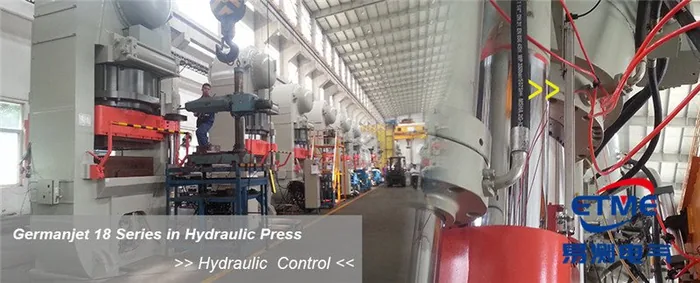
Series 18 Profile Magnetostrictive Displacement Sensor Application Cases
View Details
Series 19D Split-Type Process Displacement Sensor Application Cases
View Details