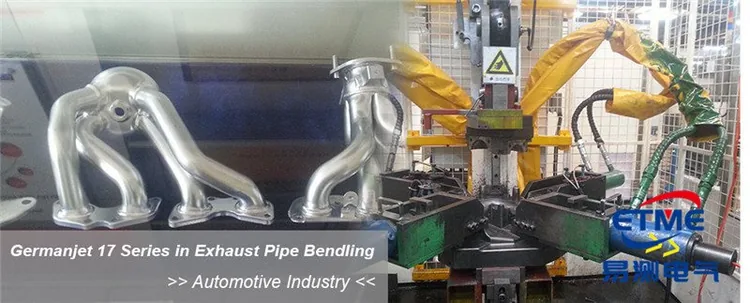
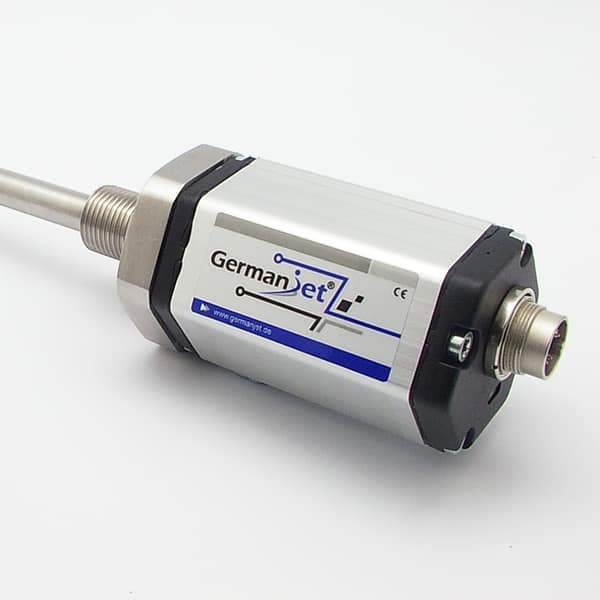
Magnetostrictive Displacement Sensor Series 13: IP69K, 25 g Vibration and 100 g Shock Mobile Duty
Series 13 is Germanjet’s reinforced magnetostrictive displacement sensor for mobile hydraulic equipment. Against general-purpose types, the core differences are three environmental ratings: protection up to IP69K (high-temperature, high-pressure water-jet wash-down), 25 g vibration resistance and 100 g shock resistance. The measuring principle and accuracy system are the same as the rest of the range — absolute position output, Series 13C resolution ±0.15 mm, repeatability <±25 μm; Series 13M non-linearity <±0.04% (depending on model and measuring range). What is reinforced is the mechanical structure and sealing, not the measuring chain. It is therefore suited to construction machinery, agricultural machinery, marine deck machinery and other applications where “the machine itself is moving and the environment is dirty”.
Three real constraints of mobile hydraulic duty
Stationary plant and mobile equipment subject sensors to entirely different tests. Displacement sensing on mobile hydraulics typically faces all of the following at once:
- Continuous vibration of the whole machine: diesel-engine excitation, travel shocks and hydraulic shocks superimposed — vibration is the normal state, not an occasional event;
- Transient shock loads: bucket strike, load drop and end-stop impact produce high-g shocks that are short in duration but high in amplitude;
- High-pressure hot-water wash-down and outdoor rain: agricultural and construction machines are commonly cleaned with high-pressure washers after a shift; ordinary IP67 devices will take in water under a close-range, high-temperature, high-pressure jet.
The IP69K, 25 g vibration and 100 g shock ratings of Series 13 are aimed squarely at these three constraints. Note that IP69K is not “one step above IP68”: it tests a close-range high-temperature, high-pressure water jet, whereas IP68 tests continuous immersion — two independent test items. The practical differences are set out in What IP65/67/68/69K actually mean in testing.
How to read 25 g vibration and 100 g shock
These two figures are often treated as one; their meanings are different:
25 g vibration resistance describes the ability of the sensor to keep working, with undistorted readings, under continuous sinusoidal or random vibration. It tests the fatigue life of internal solder joints, magnet-ring assembly and the cable exit — under long-term vibration the first failures are usually not the sensing element, but loose connectors and broken strands at the cable root.
100 g shock resistance describes the ability to survive a short, high-amplitude shock without damage and without a permanent zero offset. The damage mechanism is instantaneous inertial force, which can displace the waveguide-wire tensioning structure and appear as a fixed offset of the reading over the whole stroke after the shock.
Field rule of thumb: if vibration is a long-term background (as on travelling machines), look at the vibration rating; if hard-impact duty is present (piling, breaking, loading and unloading), look at the shock rating. When both are exceeded, simply “adding damping pads” will not solve it — damping pads change the natural frequency and may amplify broadband vibration in a particular band. Practical mounting measures are covered in Installation and commissioning in practice.
Series 13 versus general-purpose and cylinder-integrated types
| Comparison | Series 13 mobile hydraulic | Series 12 general-purpose | Series 16 / 17 cylinder-integrated |
|---|---|---|---|
| Protection class | Up to IP69K | Standard IP rating | Inside the cylinder, sealed by the cylinder |
| Vibration resistance | 25 g | Standard | Protected by the cylinder body |
| Shock resistance | 100 g | Standard | Protected by the cylinder body |
| Mounting form | In-cylinder integration, fitted into the cylinder-head space | External, independent bracket | Inserted into the cylinder bore |
| Cylinder modification required | No | No | Yes; piston-rod bore ≥12.7 mm |
| Typical equipment | Excavators, loaders, agricultural machines, marine machinery | Machine tools, test stands | Injection molding machines, die-casting machines, hydraulic presses |
| Replacement difficulty | Low; cylinder need not be stripped | Low | High; cylinder must be stripped |
Why mobile equipment usually chooses external rather than in-cylinder types
Cylinders on mobile hydraulic equipment are mostly standard parts, purchased in volume, and replaced frequently in after-sales service. Cylinder-integrated types require a deep bore in the piston rod (≥12.7 mm) and a mounting port in the cylinder base. Once the sensor fails, the whole cylinder must be stripped — an unacceptable downtime cost for machines working outdoors. The Series 13 mobile hydraulic type is a compact in-cylinder / head-space integration: it is not a Series 18 floating type or rail type external sensor, and it does not use the Series 16/17 deep piston-rod bore. That, rather than any accuracy advantage, is why it is widely used on construction machinery.
If the equipment uses a custom cylinder and the priority is to keep the sensor completely clear of external impact, compare the Series 16 cylinder-integrated type. The full trade-off between the two routes is set out in Comparing the whole external range and Comparing the whole cylinder-integrated range.
Output interface and electrical matching to the machine
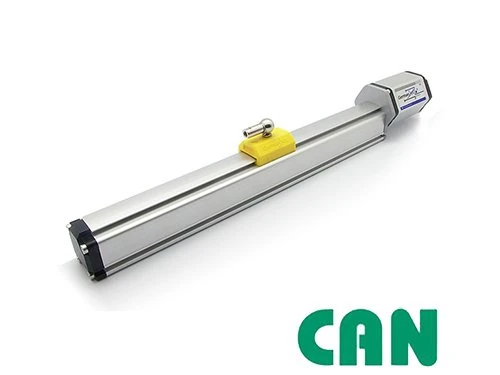
Controllers on mobile machines are typically mobile controllers and almost all support CAN. Series 13 is therefore often specified with CANopen output in mobile hydraulic applications, following the DSP406 encoder profile, so that several axes can share one bus and machine wiring is reduced. Configuration points are covered in Fieldbus practical guide; on the product side see the Series 194 CANopen.
On older machines that still use analog inputs, a 4-20 mA current-output configuration is available — a current loop tolerates long-cable voltage drop and electromagnetic interference better than a voltage output, and is more stable on mobile equipment with long harnesses and dense power wiring. The full analog-versus-fieldbus decision framework is in Analog or CANopen; wiring detail is in Series 191 analog wiring in practice.
Frequent issues in the field
Water-ingress alarm after wash-down. In most cases it is not the sensor body that has taken in water, but an M12 connector that was not fully tightened or a seal that has aged. IP69K is a whole-device rating; if the connector is not locked to specification, the protection class of the whole chain is set by the weakest link.
Readings jitter while travelling. First distinguish mechanical shake from electrical interference: if readings are stable at idle with the machine stopped and jitter only when travelling, vibration is usually being transmitted to the magnet-ring bracket; if jitter is already present at idle, check shield earthing and supply ripple. The troubleshooting sequence is in Fault finding.
Zero shift between winter and summer. Outdoor equipment can see temperature swings of tens of degrees Celsius. The speed of sound in the waveguide wire changes with temperature, producing zero and span drift — a normal physical effect. How to deal with it is covered in Speed-of-sound temperature drift and compensation.
Practical tips for engineers
- IP65 means a 6.3 mm nozzle spraying water from any direction causes no harmful effect; IP67 means no harmful ingress when immersed at 1 m water depth.
- Contact-based sensor-type sensors are typically only IP40/50, whereas non-contact magnetostrictive types can reach IP65 or even IP67 — for high-dust, high-humidity environments, choose a non-contact type.
Frequently Asked Questions
Q: How do IP69K and IP68 relate, and which is better?
They are independent test items, not successive grades. IP68 tests continuous immersion; IP69K tests a close-range high-temperature, high-pressure water jet. Mobile machines are commonly cleaned with high-pressure washers after a shift, which is an IP69K duty. Ordinary IP67 devices will take in water under a close-range high-pressure hot-water jet.
Q: What is the difference between 25 g vibration resistance and 100 g shock resistance?
25 g vibration resistance describes the ability to keep working, with undistorted readings, under continuous vibration, and tests the fatigue life of solder joints, assembly and the cable root. 100 g shock resistance describes the ability to survive a short, high-amplitude shock without damage and without a permanent zero offset. For long-term vibration look at the vibration rating; for hard-impact duty look at the shock rating.
Q: Why do mobile hydraulics often choose Series 13 rather than a Series 16/17 deep-bore in-cylinder type?
Mobile cylinders are mostly standard parts and are replaced often. Series 16/17 need a deep piston-rod bore (≥12.7 mm) and a modified cylinder base; a fault often means stripping the whole cylinder. Series 13 is a compact head-space integration with IP69K / 25 g / 100 g; it is not a Series 18 external floating type or rail type.
Q: Which output interface is Series 13 commonly specified with on mobile machines?
Mobile controllers almost all have a CAN port, so CANopen output following the DSP406 encoder profile is common; several axes can share one bus and the machine harness is reduced. Older machines that still use analog inputs can take 4-20 mA current output, which tolerates long-cable voltage drop and electromagnetic interference better than a voltage output.
Related Products
Related Applications

Multi-Industry Application Cases for Magnetostrictive Displacement Sensors
View Details
Series 12 General-Purpose Magnetostrictive Displacement Sensor Application Cases
View Details
Series 17 Hydraulic Cylinder Integrated Magnetostrictive Displacement Sensor Application Cases
View Details