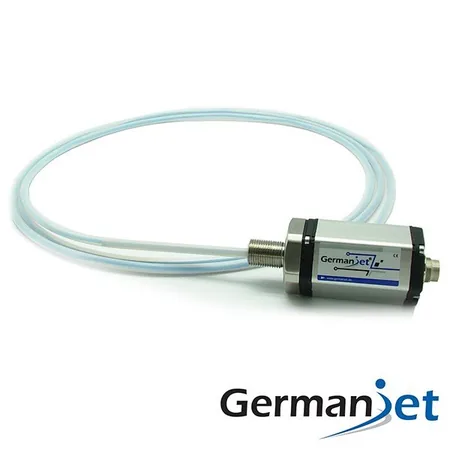
Picking an External Magnetostrictive Displacement Sensor: 13, 18, 19P or 19F
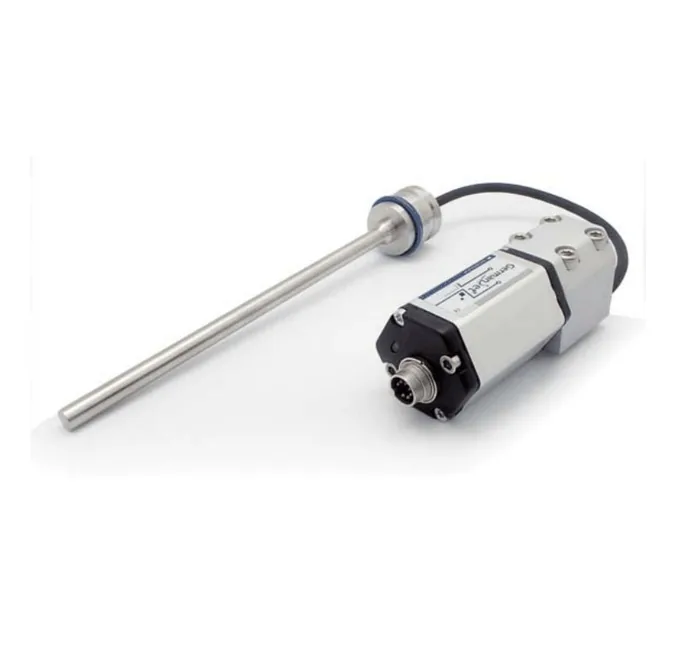
Select a magnetostrictive displacement sensor by first splitting cylinder-integrated from external mounting: the external types are 18, 19P and 19F. What the four share is that they do not change the mechanical body, do not take pressure, and replacement does not require stripping the cylinder. They share non-contact absolute position and no cylinder pressure; accuracy still follows the series catalogue (Series 18 analogue is infinite resolution / < ±0.02% FS, not a shared 1–100 μm row). The selection order is: first environmental class (whether mobile / wash-down / strong vibration), then stroke length (whether beyond the range of a rigid sensing rod), and finally platform unification and follower-structure matching. Comparing data sheets will not produce an answer; constraints are the decision basis.
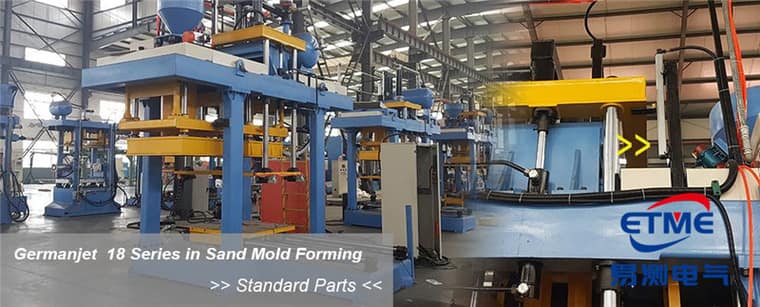
Product-form comparison
| Dimension | Series 13 mobile hydraulic | Series 18 dedicated external line | 19P (Series 19 platform) | 19F flexible long-stroke |
|---|---|---|---|---|
| Core positioning | Environmental reinforcement for mobile machinery | General external; follower schemes fully developed | Series 19 platform external form | The only solution for very long strokes |
| Protection class | Up to IP69K | Standard IP rating | Standard IP rating | Depending on model |
| Vibration / shock | 25 g / 100 g | Standard | Standard | Depends on routing and fixing |
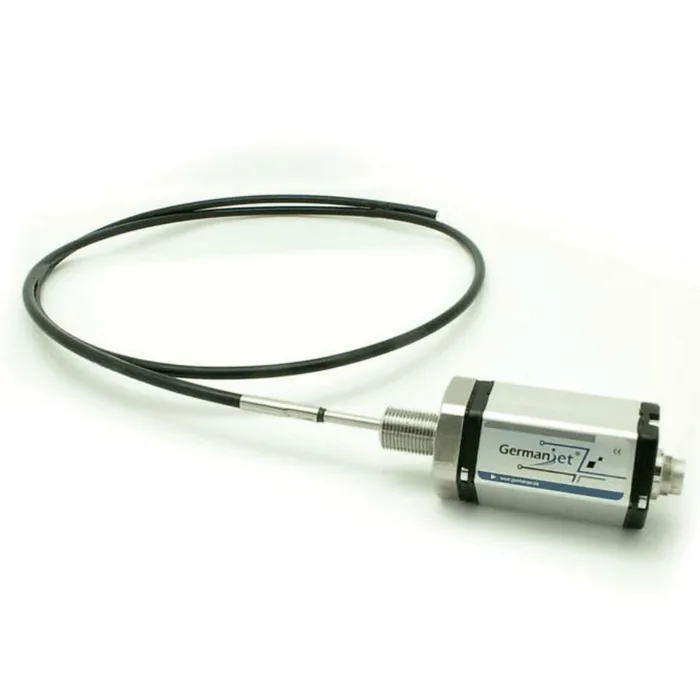
| Sensing-rod form | Rigid | Rigid | Rigid | Flexible, bendable |
| Stroke suitability | Ordinary stroke | Ordinary stroke | Ordinary stroke | Very long stroke |
| Path requirement | Straight | Straight | Straight | Non-straight routing possible |
| Follower structure | Matched to mobile duty | floating type / profile-mounted fully developed | Platform general scheme | Fixing along the path + magnet-ring follower |
| Transport and installation | Ordinary | Transported whole; length limited by access | As 18 | Can be coiled for transport; easy to position on site |
| Platform synergy | — | — | Can unify with 19H/19D/19F | Same origin as the Series 19 platform |
| Typical application | Excavators, loaders, agricultural machines, marine machinery | Machine tools, special-purpose machines, retrofit of existing plant | Several forms mixed on the machine | Gates, rolling mills, large lifts |
First-layer judgement: environmental class
This layer is the easiest to get wrong, and the easiest to cause early failure. The criterion is not “indoors or outdoors”, but three concrete questions:
- Does the machine itself move? Vibration on travelling machinery is a continuous background, not an occasional event;
- Is there high-pressure water wash-down? Construction and agricultural machines are commonly cleaned with high-pressure washers after a shift; ordinary IP67 devices will take in water under a close-range, high-temperature, high-pressure jet;
- Are shock loads present? Instantaneous g values from bucket strike, load drop and end-stop impact are far above ordinary vibration.
If any one of the three is “yes”, choose Series 13 (IP69K, 25 g vibration, 100 g shock). If all three are “no”, Series 18 or 19P is sufficient. Mobile, pressure-wash or shock duty on any one point calls for Series 13: those 25 g vibration, 100 g shock and IP69K ratings are structural, not restored by covers.
Do not try to make an ordinary external type do mobile duty by adding a guard: a guard brings heat-dissipation and trapped-water problems, and vibration and shock resistance are structural capabilities that a cover cannot supply. IP69K and IP68 are two independent test items, not successive grades; meanings are in What IP65/67/68/69K actually mean in testing; Series 13 reinforcement detail is in Series 13 mobile hydraulics explained; mounting points for vibrating environments are in Installing in vibration: locking and vibration resistance.
Second-layer judgement: stroke length
A rigid sensing rod has three physical bottlenecks on a long stroke: sag under self-weight grows quickly with length; transporting and positioning a whole rod is difficult; the installation path must be strictly straight and supported. When any one becomes an obstacle, turn to the flexible option 19F.
Conversely, if rigid will do, do not go flexible — a rigid scheme is simpler to install, has fewer fixing points and is lower in cost. The value of 19F is “it can be fitted and it can be brought in”, not better performance. Routing constraints of a flexible scheme (minimum bend radius, arrangement of fixing points, magnet-ring section still needing alignment) are in 19F flexible long-stroke explained; the overall long-stroke selection framework is in Selecting for long stroke (2 m and above).
A long stroke also needs accuracy-expectation management: non-linearity is % FS. The same 0.02% FS is about ±0.2 mm on 1000 mm and about ±0.8 mm on 4000 mm — a mathematical result of the measuring-range base. How to read the figures is in The three accuracy figures.
Third-layer judgement: Series 18 or 19P
Performance is the same; both are rigid external types. The difference is the product platform:
- Follower structure needs fine matching → Series 18. floating type and profile-mounted schemes are more fully developed: the floating type is compact and low-cost, suiting well-aligned short to medium strokes; the profile-mounted type has coaxiality guaranteed by its own rail, with strong resistance to lateral offset, suiting long strokes or mechanisms with assembly offset. See Series 18 external explained.
- Several forms mixed on the machine, platform unification wanted → 19P. Same platform as 19H cylinder-integrated and 19D split; spares, cables, configuration and maintenance procedures can be merged. See 19P external explained.
Two shared risks of the external type
Whichever is chosen, external-mounting problems almost all sit on the mechanical side; changing the sensor will not solve them.
Misalignment. Motion axis of the measured mechanism not parallel to the sensing-rod axis → magnet-ring eccentricity → progressive deviation over a local section of stroke; in severe cases the follower takes a side load, and long-term wear can end in seizure. The remedy is a floating link at the connection (ball joint, universal joint, flexible connector) that transmits only axial displacement. Methods are in External mounting: how to fix the bracket and rail type so they stay stable; magnet-ring-side points are in Five magnet-ring installation pitfalls.
Bracket resonance. Regular reading jitter in operation, normal when stopped, with jitter frequency tracking machine speed, can essentially be diagnosed as bracket resonance. The principle is “short, straight and stiff”: keep the bracket as short as possible, fix it directly to the rigid main structure, and avoid thin-plate cantilevers. General installation points are in Installation and commissioning in practice; the troubleshooting order for abnormal readings is in Common fault finding.
On both risks the fix is the same: a ball joint at the moving joint passes only axial motion, and brackets stay short, straight and rigid.
When a cylinder-integrated type should be used instead
An external type is not always better. The following cases suit cylinder-integrated better: new-machine design with a customisable cylinder, insufficient external space, on-site risk of impact or foreign objects, a requirement that the sensor be completely free of external influence. The cost of a cylinder-integrated type is that the piston rod must be bored (≥12.7 mm), it must take pressure (by series: Series 16/16R is 350 bar working / 530 bar peak, Series 17/17EX is 350/600 bar, Series 19 in-cylinder is 300/600 bar), and replacement means depressurising and stripping the cylinder. Horizontal selection of the five cylinder-integrated types is in Comparing the whole cylinder-integrated range: how to choose among 16/16R/17/17EX/19H.
Once the mounting form is fixed, the interface is another independent dimension; the decision path is in Analog vs. digital across the whole range; the trade-off among fieldbus protocols is in Comparing the whole fieldbus range.
Practical tips for engineers
- Series 19F flexible types must be supported inside a straight or bent guide tube of non-ferrous material.
- With a 10 mm ID flange: guide-tube OD must be <10 mm, ID >8 mm; with a 12.7 mm ID flange: OD <12.7 mm, ID >8.5 mm.
- Guide-tube length: stroke <8000 mm → stroke + 150 mm; stroke >8000 mm → stroke + 230 mm. The flexible-rod sheath is Teflon-coated stainless steel and can be used in heavily contaminated environments.
Frequently Asked Questions
Q: How should an external displacement sensor be selected quickly?
Judge in three layers. First layer: environmental class — whether the machine moves, whether there is high-pressure wash-down, whether shock loads are present; if any is yes, choose Series 13. Second layer: stroke length; if it is beyond a reasonable range for a rigid sensing rod, choose the flexible 19F. Third layer: the trade-off between Series 18 and 19P — follower structure needing fine matching, choose 18; several forms mixed on the machine and platform unification wanted, choose 19P.
Q: Can an ordinary external type plus a guard replace Series 13?
No. A guard brings heat-dissipation and trapped-water problems, and 25 g vibration and 100 g shock resistance are structural capabilities that a cover cannot supply. IP69K is aimed at close-range high-temperature, high-pressure water-jet wash-down; it and IP68 continuous immersion are two independent test items, not successive grades.
Q: What usually causes reading deviation and jitter on an external type?
Deviation is mostly magnet-ring eccentricity from misalignment, appearing as a progressive deviation over a local section of stroke; the remedy is a floating link such as a ball joint or universal joint at the connection. Jitter is mostly bracket resonance; the diagnostic is jitter in operation, normal when stopped, with jitter frequency tracking machine speed; the remedy is a short, straight, stiff bracket fixed directly to the rigid main structure.
Q: When should a cylinder-integrated type be used instead?
A cylinder-integrated type is more suitable when it is a new-machine design with a customisable cylinder, external space is insufficient, there is on-site risk of impact or foreign objects, or the sensor must be completely free of external influence. The cost is a piston-rod bore ≥12.7 mm (Ø10 rod), pressure rating by series: Series 16/16R is 350 bar working / 530 bar peak, Series 17/17EX is 350/600 bar, Series 19 in-cylinder is 300/600 bar, and replacement that means depressurising, draining and stripping the cylinder.
Related Products
Related Applications
Multi-Industry Application Cases for Magnetostrictive Displacement Sensors
View Details
Series 18 Profile Magnetostrictive Displacement Sensor Application Cases
View Details
Series 19D Split-Type Process Displacement Sensor Application Cases
View Details