Agricultural Field Duty: In-Cylinder Sensor on Header and Seeder
A magnetostrictive displacement sensor on agricultural machinery follows header height and seeding depth in the field. Survivability and maintenance-free come first, accuracy second, as autonomous driving and precision farming spread. Typical measuring points include header height and reel position on a harvester, contour-following mechanisms and down-force adjustment on a seeder, boom lift and levelling, and tractor rear-hitch position. All of these mechanisms work in the field — mud, straw debris, dust, rain and washdown, severe jolting, and long seasonal storage.
Functional role of displacement measuring points on agricultural machines
Header-height feedback is used for contour following: the header is held at a set height above the ground as the terrain undulates, reducing uneven stubble and soil-entry damage. Down-force and contour-stroke feedback on a seeder are used to keep sowing depth consistent, which directly affects emergence rate. Boom-lift and levelling feedback are used to maintain spray height, which affects droplet-deposition uniformity. The shared character of all three is that the control objective is “following”, not “precise positioning”, so 20-100 μm resolution suffices and response and reliability matter more; the emphasis should be on response and reliability.
Four constraints of the field environment
First, high-pressure washdown: after the working season the whole machine is washed with a high-pressure water jet. Ordinary-rated connectors take in water easily; IP69K is recommended at washdown locations (for measured differences between ratings see what IP65/67/68/69K really mean). Second, jolting and shock: field-surface excitation is strong; vibration and shock ratings should cover the actual duty (for example of the order of 25 g vibration / 100 g shock). Third, straw wrapping and debris: an exposed rod is easily scored by wrapping material; in-cylinder mounting is preferred. Fourth, wide temperature and long storage: winter storage temperatures are low; the distinction between operating temperature and storage temperature must be checked (see operating temperature vs. storage temperature).
Measuring-point schemes
| Measuring point | Control objective | Recommended form | Protection recommendation | Resolution grade |
|---|---|---|---|---|
| Header-lift cylinder | Contour-height following | In-cylinder | IP69K | 50-100 μm |
| Reel-position cylinder | Fore-aft / height adjustment | In-cylinder | IP67 or better | 50-100 μm |
| Seeder contour / down-force mechanism | Sowing-depth consistency | In-cylinder or profile type with cover | IP67/IP69K | 20-50 μm |
| Boom lift and levelling | Spray height | In-cylinder | IP69K (chemical corrosion) | 50-100 μm |
Why in-cylinder is preferred
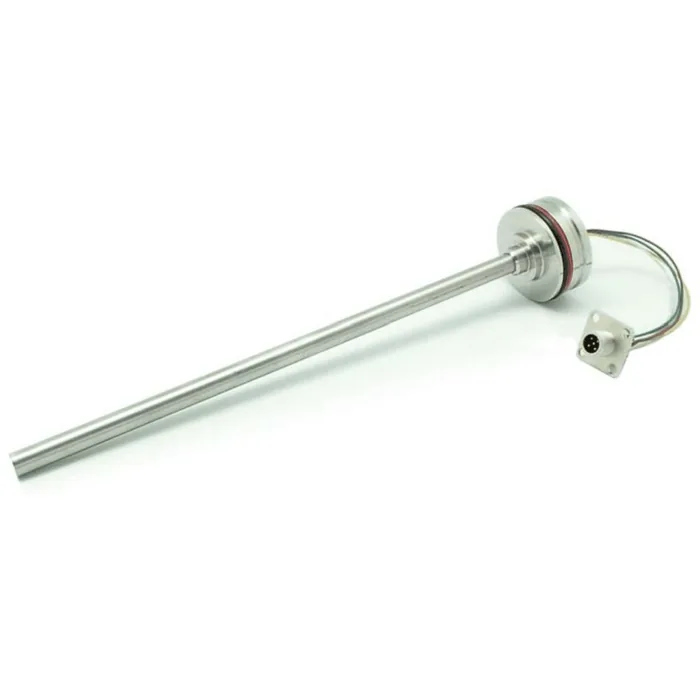
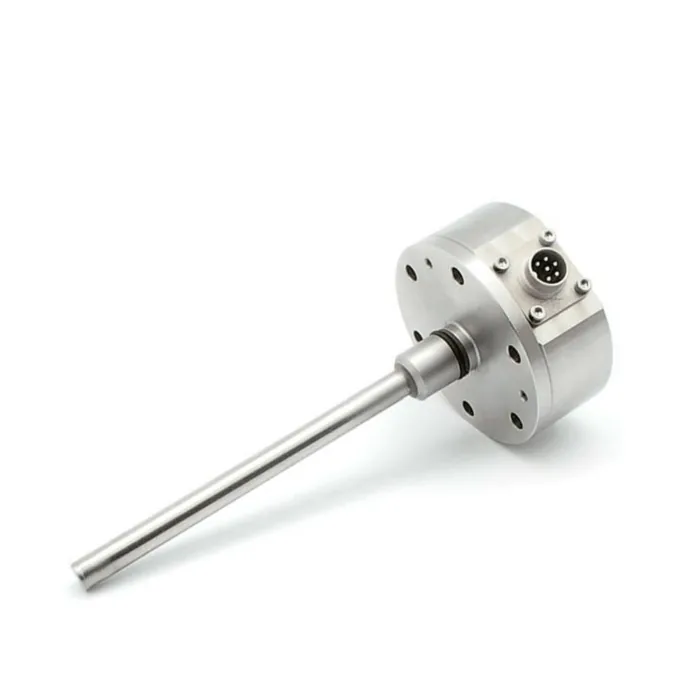
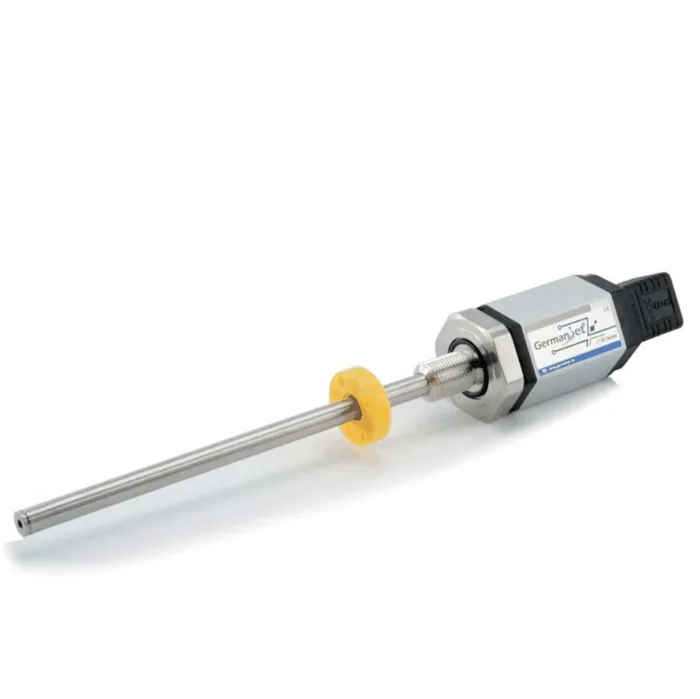
An in-cylinder magnetostrictive displacement sensor suits agricultural cylinders, which are mostly medium- to low-pressure systems. In-cylinder mounting places the rod entirely inside a deep bore in the piston rod, avoiding the three risks of straw wrapping, mud envelopment and knocks, and adding no external installation space. The implementation prerequisite is that the piston rod can take a deep bore (minimum bore generally ≥12.7 mm) and meet the pressure rating (by series: Series 16/16R is 350 bar working / 530 bar peak, Series 17/17EX is 350/600 bar, Series 19 in-cylinder is 300/600 bar; agricultural machines are usually well below this). For in-cylinder products see Series 16 in-cylinder. The exposed electronics head relates to whole-machine mobile duty; see Series 13 mobile hydraulic. General points for a hydraulic closed loop are given in hydraulic cylinder position-control schemes; shared experience with construction machinery is in construction-machinery cylinder position schemes.
Whole-machine CAN network and operational data
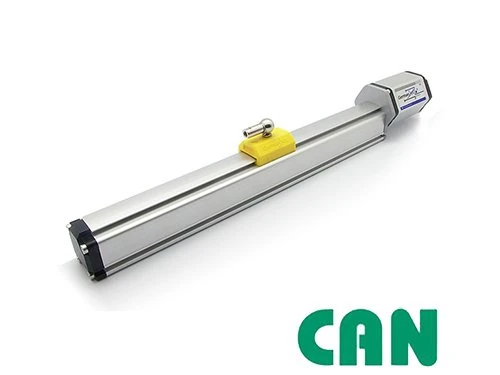
Agricultural machines commonly use a CAN bus architecture. Specifying a CANopen (DSP406 profile) displacement sensor lets it hang directly on the vehicle network, reducing wiring and carrying diagnostic information. See Series 194 CANopen and the networking notes in the practical fieldbus guide. Once position data are aligned with worked area, speed and GNSS position, operational-quality reports such as sowing-depth distribution and header-height distribution can be generated — the foundation data of precision farming. Magnet selection and mounting details (remanence, temperature coefficient, anti-loosening) are given in selecting the permanent magnet (position magnet).
Practical tips for engineers
- For in-cylinder mounting, piston-rod bore lower limit is ≥12.7 mm (Ø10 rod). Series 17 also has a Ø13 mm through-hole + M18×1.5 on the cylinder cap; Series 16 uses Ø18G7. Do not mix pressure ratings: Series 16/16R is 350 bar working / 530 bar peak, Series 17/17EX is 350/600 bar, Series 19 in-cylinder is 300/600 bar.
- The sensor rod inside the cylinder should be protected against wear.
- Series 19 in-cylinder types are rated 300 bar, 600 bar peak; use these figures for selection and pressure testing.
Frequently Asked Questions
Q: What are the difficulties of displacement measurement on agricultural machinery?
Outdoor dust, vibration and large temperature swings require dust protection, vibration resistance and a wide operating-temperature range. Series 13 mobile hydraulic is a suitable choice.
Q: Is seeding rate controlled by displacement?
Furrow and press depth are determined by cylinder position. Displacement feedback keeps sowing depth consistent, which affects evenness of emergence.
Q: Is homing needed after a power loss when moving between fields?
An absolute-position sensor needs no homing: after a transfer, mechanism position is known on power-up, reducing set-up time.
Related Products
Related Applications
Multi-Industry Application Cases for Magnetostrictive Displacement Sensors
View Details
Series 16 Hydraulic Rod Magnetostrictive Displacement Sensor Application Cases
View Details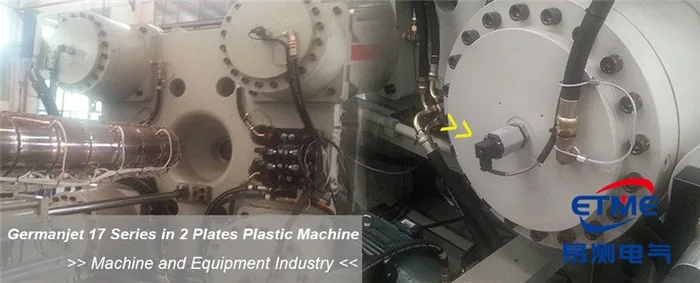
Series 17 Hydraulic Cylinder Integrated Magnetostrictive Displacement Sensor Application Cases
View Details