Magnetostrictive Displacement Sensor Series 17 vs Series 16: Integrated Interface and Pressure Differences
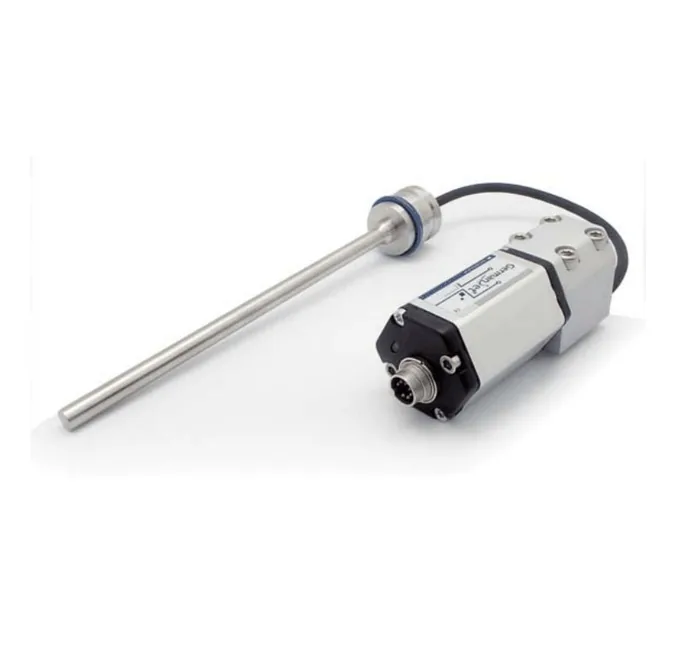
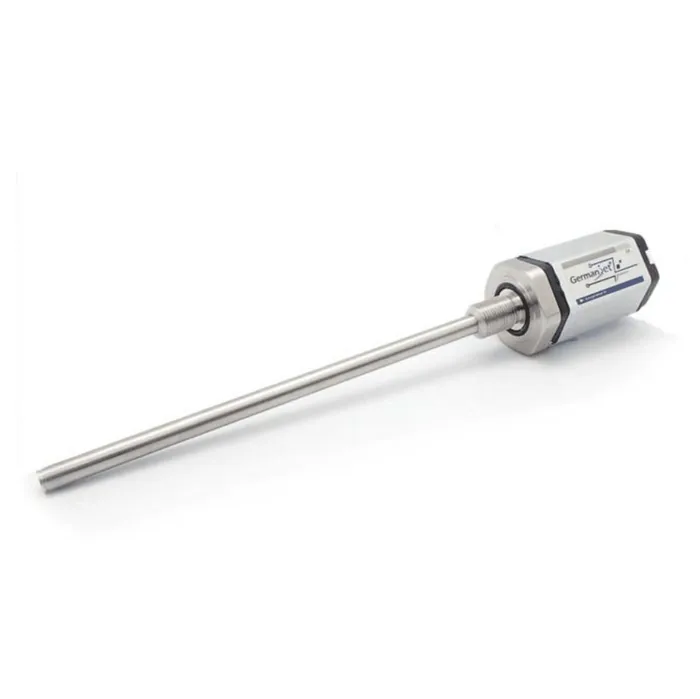
Series 17 is Germanjet’s magnetostrictive displacement sensor for hydraulic cylinders. In the electronics housing and stainless-steel pressure tube are separable: the pressure tube stays in the cylinder while the electronics module can be removed for calibration. It shares the measuring principle of the likewise in-cylinder Series 16, but analogue accuracy and the cylinder-cap interface are not the same set of figures: Series 17 analogue resolution is infinite (controller A/D), non-linearity < ±0.02% FS (min. ±90 μm), 350 bar working / 600 bar peak, cap M18×1.5 with Ø13 mm through-hole; Series 16 analogue is 16-bit D/A, 350/530 bar, cap Ø18G7. Piston-rod bore is ≥12.7 mm (Ø10 rod) on both. The key selection judgement is “whether the cylinder can be customised to the sensor interface”, not a comparison of a single accuracy row.
Defining integrated versus cylinder-integrated
The two terms are often mixed in the field. The intended meanings here are:
- Cylinder-integrated emphasises that the sensing rod is inside the cylinder and takes cylinder pressure — a mounting-position concept relative to “external”;
- Integrated emphasises that the sensor is designed in as a constituent part of the cylinder; the mounting interface, sealing and cable routing are already fixed at the cylinder-design stage.
Series 17 is therefore both in-cylinder and integrated; Series 16 is in-cylinder, with a relatively looser degree of integration. What actually affects the engineering decision is this sentence: Series 17 requires the cylinder to be designed to the sensor interface; Series 16 has a wider adaptation surface.
Core differences between Series 17 and Series 16
| Comparison | Series 17 integrated | Series 16 cylinder-integrated |
|---|---|---|
| Integration form | Electronics housing separable from the pressure tube; hex flange on the cylinder cap | Flat electronics housing, in-cylinder mounting |
| Cylinder design requirement | Interface must be reserved at the cylinder-design stage | Can be adapted by machining an already frozen cylinder |
| Machine appearance and space | High integration, least external protrusion | Depends on mounting form |
| Pressure rating | 350 bar working / 600 bar peak | 350 bar working / 530 bar peak |
| Piston-rod bore / cap | ≥12.7 mm; cap M18×1.5, Ø13 mm through-hole | ≥12.7 mm; cap Ø18G7 |
| Analogue measuring performance | Infinite resolution (controller A/D); repeatability < ±0.001% FS; non-linearity < ±0.02% FS (min. ±90 μm) | 16-bit D/A 0.0015% (min. 1 μm); repeatability < ±0.001% FS (min. ±2.5 μm); non-linearity < ±0.01% FS (min. ±40 μm) |
| Ease of replacement | Electronics housing can be swapped; pressure tube stays in the cylinder | Changing the sensor usually means opening the cap seal |
| Typical adoption stage | New-machine design, OEM volume supply | New-machine design and adaptation of existing cylinders |
The measuring principle is the same; the analogue accuracy wording is not: Series 17 analogue resolution is infinite, non-linearity < ±0.02% FS (min. ±90 μm); Series 16 analogue is 16-bit D/A, non-linearity < ±0.01% FS (min. ±40 μm). Selection still turns on the mechanical interface and pressure rating — do not write both sets of figures on one row. Bore and pressure-rating detail for Series 16 is in Series 16 explained.
Mounting rule: screws that hold the magnet must be non-magnetic (e.g. stainless steel). If the cylinder body is magnetic, add a non-magnetic washer, or the field is shunted — the magnet is not detected or the reading drifts.
When Series 17 should be chosen
OEM volume supply. The machine builder produces the same model in volume, and the cylinder is made in-house or is a long-term dedicated custom part. Writing the mounting interface of the Series 17 hydraulic cylinder integrated type into the cylinder drawing, and forming it once on the assembly line, is more economical and more consistent than adapting each machine.
Extremely tight machine layout. The integrated type has the least external protrusion and can free appreciable layout space on compact frames and close-packed multi-cylinder machines.
High protection and no external maintenance. The sensor is fully hidden in the cylinder; there is no exposed electronics head to be struck or washed, and field maintenance is lowest.
High-accuracy servo-hydraulic pressing. Integrated mounting removes the mechanical links of an external bracket, avoiding the error chain of bracket deflection and resonance, which helps a μm-level closed loop. Overall configuration for high-accuracy duty is in Selecting for high-accuracy applications.
When Series 17 should not be chosen
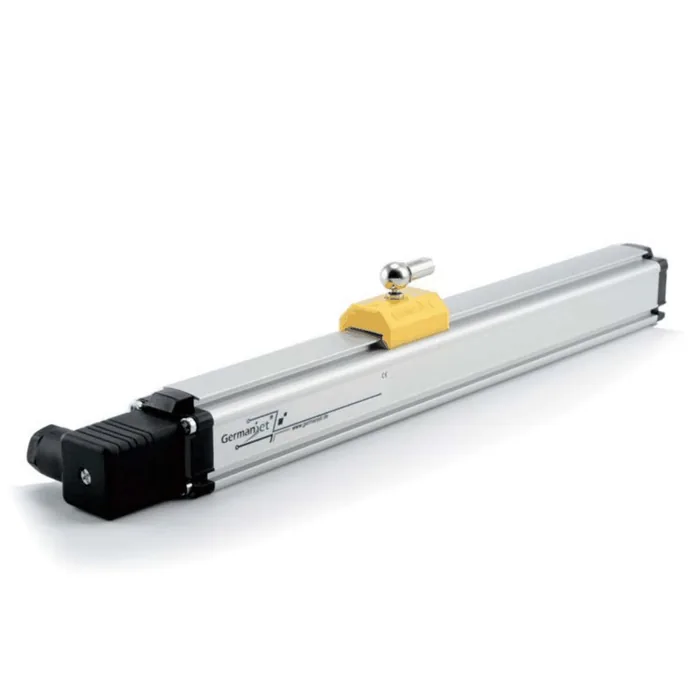
- Retrofit of existing plant. If the existing cylinder interface cannot be changed, forcing an integrated type means changing the cylinder and the cost runs away; evaluate the Series 18 external type or Series 13. The reasoning is in Comparing the whole external range.
- Duty that needs the whole sensor pulled often. Withdrawing the pressure tube still means depressurising, draining and opening the cylinder. Swapping only the electronics housing leaves the tube in place — that is Series 17’s maintenance advantage over Series 16 — but a full change is still not as fast as swapping an external type.
- Explosive-gas atmospheres. The intrinsically safe 17EX must be used; an ordinary type, however highly integrated, must not enter a hazardous area. Explosion-protection basics are in Intrinsic safety, flameproof and dust explosion protection distinguished.
- Dual-channel redundancy required. Safety-related position detection should use the Series 16R redundant type; see Series 16R explained.
Installation and commissioning points
The mechanical tolerance chain of integrated mounting is shorter, but the demand on cylinder-base mounting-face quality is higher. Insufficient sealing-face flatness causes oil seepage; coaxiality error of the mounting thread or flange makes the rod enter the bore eccentric, and the error accumulates over a long stroke. Deep-hole machining requirements are in Bore machining requirements for cylinder-integrated sensors.
On the electrical side it is the same as other series: the output is absolute position, available at power-up, with no homing required. The mechanism is in Absolute versus incremental position. Zero calibration is done once after installation and then remains stable; the method is in Installation and commissioning in practice.
Oil temperature is an extra variable for the integrated type: the sensor is immersed in hydraulic oil for long periods, so oil temperature is its working temperature. On continuously high oil temperature, check the temperature specification and allow for reading change from speed-of-sound temperature drift; the mechanism is in Speed-of-sound temperature drift and compensation. If oil temperature is outside the normal range, evaluate a split design such as the Series 19D split type, with the electronics head separated from the sensing rod; see Series 19D split type explained.
Relation to Series 19H
The 19H in Series 19 is likewise aimed at in-cylinder duty and overlaps Series 17 in application range. The differences and trade-offs are compared item by item in Series 19H cylinder-integrated explained. To see every in-cylinder option at once, see Comparing the whole cylinder-integrated range.
Practical tips for engineers
- For in-cylinder mounting, piston-rod bore lower limit is ≥12.7 mm (Ø10 rod). Series 17 also has a Ø13 mm through-hole + M18×1.5 on the cylinder cap; Series 16 uses Ø18G7. Do not mix pressure ratings: Series 16/16R is 350 bar working / 530 bar peak, Series 17/17EX is 350/600 bar, Series 19 in-cylinder is 300/600 bar.
- The sensing rod inside the cylinder should be protected against wear.
- Series 19 cylinder-integrated types are rated 300 bar, 600 bar peak; use these figures for selection and pressure testing.
Frequently Asked Questions
Q: Where exactly do Series 17 and Series 16 differ?
The measuring principle is the same, but analogue figures and the cylinder-cap interface differ. Series 17 analogue resolution is infinite (controller A/D), non-linearity < ±0.02% FS (min. ±90 μm), 350/600 bar, cap M18×1.5. Series 16 analogue is 16-bit D/A, 350/530 bar, cap Ø18G7. Piston-rod bore is ≥12.7 mm on both. The core difference in selection is still integration form: Series 17 needs the interface reserved at the cylinder-design stage; Series 16 has a wider adaptation surface.
Q: When should the Series 17 integrated type be chosen?
It suits OEM volume supply with a customisable cylinder, extremely tight machine layout, no external maintenance, and high-accuracy servo-hydraulic pressing. Integrated mounting removes the external-bracket links and avoids the error chain of bracket deflection and resonance.
Q: Can Series 17 be used on a retrofit of existing plant?
Usually not. If the existing cylinder interface cannot be changed, choosing an integrated type means changing the cylinder and the conversion cost runs away. Retrofits should first evaluate external options such as Series 18 or Series 13, which add displacement sensing without touching the mechanical body.
Q: Does oil temperature affect measurement when an integrated type is mounted in a hydraulic cylinder?
Yes. The sensor is immersed in hydraulic oil for long periods, so oil temperature is its working temperature. Continuously high oil temperature requires a check of the temperature specification, and allowance for zero and span drift as the speed of sound in the waveguide wire changes with temperature. If oil temperature is outside the normal range, evaluate the Series 19D split type with the electronics head separated from the sensing rod.
Q: Is Series 17 analogue resolution 16-bit?
No. In Series 17 analogue resolution is listed as infinite, depending on the controller A/D; non-linearity is < ±0.02% FS (min. ±90 μm). Series 16 analogue is the 16-bit D/A, 0.0015% (min. 1 μm), non-linearity < ±0.01% FS (min. ±40 μm). Do not mix the two sets of figures.
Related Products
Related Applications
Multi-Industry Application Cases for Magnetostrictive Displacement Sensors
View Details
Series 17 Hydraulic Cylinder Integrated Magnetostrictive Displacement Sensor Application Cases
View Details
Series 18 Profile Magnetostrictive Displacement Sensor Application Cases
View Details