Magnetostrictive vs. Encoder: How to Choose for Linear Position Detection
Note: Germanjet supplies only magnetostrictive linear displacement / position sensors; descriptions of other displacement-measurement technologies below are for technical comparison only.
Choosing magnetostrictive or an encoder for linear position detection is not a matter of “which is more accurate”, but of two items: whether the measuring chain goes through a mechanical conversion and whether homing is required. A rotary encoder measures angle; to obtain linear position it must convert through a leadscrew, rack-and-pinion or sprocket. Backlash, pitch error, elastic deflection and slip are all added into the measurement result. Magnetostrictive measures the absolute position of the magnet ring directly along the motion axis; there is no mechanical conversion in the measuring chain. A linear scale also measures directly, but its tolerance of oil, dust and shock is limited. This article compares the two on four dimensions: measuring chain, position reference, environmental endurance and installation. The overall selection framework is in Magnetostrictive vs. LVDT vs. potentiometer.
Measuring-chain difference: direct measurement versus converted measurement
When a rotary encoder is used to measure linear position, what is actually measured is the angle of the motor shaft or leadscrew shaft; linear position is inferred from “angle × pitch / reduction ratio”. Error sources on that chain include: coupling torsional backlash, accumulated leadscrew pitch error, nut reversal backlash, rack meshing backlash, thermal expansion of transmission parts, and slip and elastic lag under hydraulic or belt drive. These errors are especially obvious at the instant of reversal, appearing as reversal dead band.
A magnetostrictive displacement sensor fixes the magnet ring on the moving part (piston, rail type, cross-beam) and measures the distance of that point from the fixed end, independent of the drive method. A hydraulic cylinder, which has no usable rotary shaft, cannot take a rotary encoder directly and can only add a mechanical conversion such as a rack — which is why hydraulic position control commonly uses magnetostrictive sensing. Industry background is in Why choose magnetostrictive sensing for hydraulic cylinder position control.
Position reference: absolute output versus incremental counting
Magnetostrictive outputs absolute position: position is set by the physical location of the magnet ring. After power-down and power-up, the electronics head measures travel time once more and obtains the correct reading; homing is not required, nor is a reference-point switch. An incremental encoder records a pulse accumulation; the reference is lost on power-down, and homing must be executed at power-up. An absolute encoder can solve absolute position within one revolution, but multi-turn counting still depends on a battery or a mechanical gearbox, and a check is needed after a long shutdown. The full explanation of this mechanism difference is in Absolute versus incremental position: why magnetostrictive does not lose zero on power-down.
The practical engineering effect: when a multi-axis machine recovers from power-down, an absolute-position scheme can independently confirm the current position of each axis at once, without homing axis by axis in an interlocked sequence. That saves a complete motion beat and also avoids the risk of mechanical interference during homing.
Environmental endurance and protection
An encoder’s code disc (optical type) and bearings are precision parts that fear oil mist, dust, condensate and shock; a magnetic encoder has better dirt tolerance, but limited immunity to strong magnetic-field interference. A magnetostrictive sensing rod is a stainless-steel tube structure; the electronics head can be made to IP65 / IP67 / IP68 / IP69K in several grades. The Series 13 mobile hydraulic type is rated 25 g vibration, 100 g shock, suiting construction machinery, metallurgy and other applications where vibration and wash-down coexist. What protection classes actually mean in testing is in IP65/67/68/69K are not a numbers game.
Also note that magnetostrictive sensing itself depends on a magnetic field. If high-current busbars, electromagnets or permanent-magnet chucks are near the mounting position, interference and magnet-ring demagnetisation risk must be assessed; related content is in EMC electromagnetic compatibility: why a strong magnetic field interferes with measurement.
Comparison of the two schemes
| Dimension | Magnetostrictive displacement sensor | Rotary encoder + mechanical conversion | Linear scale |
|---|---|---|---|
| Measured quantity | Linear position, direct measurement | Angle, converted to linear | Linear position, direct measurement |
| Transmission error enters the measurement | No | Yes (backlash, pitch, slip) | No |
| Position reference | Absolute; not lost on power-down | Incremental needs homing; absolute multi-turn depends on battery/gearbox | Absolute or incremental, depending on model |
| Typical resolution | 1 / 2 / 5 / 10 / 20 / 50 / 100 μm optional | Converted from line count and pitch, depending on model | Can reach sub-micrometre, depending on model |
| Repeatability | Of the order of ±0.002 mm | Limited by reversal backlash | High, depending on installation stiffness |
| Environmental endurance | IP65–IP69K, vibration- and shock-resistant | Fears oil and dust; bearings are wearing parts | Sensitive to oil, swarf and condensate |
| Cylinder-integrated | Can be cylinder-integrated; pressure rating by series: Series 16/16R is 350 bar working / 530 bar peak, Series 17/17EX is 350/600 bar, Series 19 in-cylinder is 300/600 bar | No | No |
| Long-stroke suitability | Good, including flexible long-stroke models | Good (long-stroke leadscrews limited by critical speed) | Limited by scale length and mounting datum |
| Output interface | 4-20 mA / 0-10 V / SSI / CANopen / Profibus / EtherCAT / PROFINET | ABZ incremental / SSI / fieldbus | TTL / 1 Vpp / SSI / fieldbus |
| Typical application | Hydraulic cylinders, presses, metallurgy, mobile machinery | Servo leadscrews, machine-tool feed, where a rotary shaft is available | Machine tools, precision tables (clean and protectable) |
Selection-criterion checklist
- Does the actuator have a usable rotary shaft: hydraulic cylinders, pneumatic cylinders and linear motors do not — a rotary-encoder scheme is ruled out directly;
- Does the transmission chain have backlash or elasticity: reversal dead band of rack, chain, belt or long-leadscrew drives cannot be removed by the encoder itself; the linear quantity must be measured directly;
- Can homing be accepted: the homing motion of large presses, gates and multi-axis synchronised equipment is costly and risky; choose the absolute magnetostrictive displacement sensor that does not lose zero on power off;
- Site environment: where there is oil mist, water wash-down, dust or shock, prefer magnetostrictive; where it is clean and sub-micrometre is needed, consider a linear scale;
- Interface and refresh rate: when matching a servo cycle is required, confirm the update rate. Magnetostrictive update rate varies with measuring range and falls on a long range; matching methods are in How to match response time / refresh rate to the control cycle;
- Stroke and installation space: how to calculate stroke allowance, dead zones and installation size is in Selection calculation in practice: how to work out stroke, installation space and output.
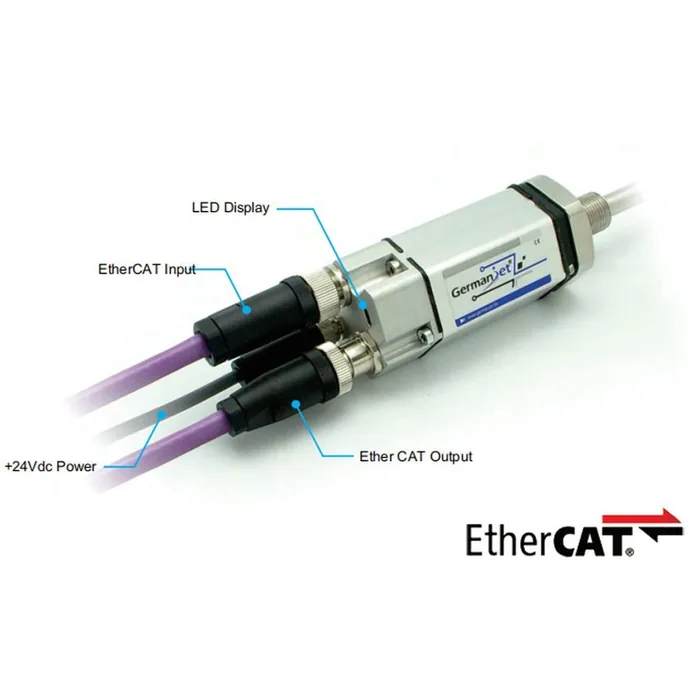
On interface selection, if the original system already has an SSI channel, the Series 192 SSI digital interface can substitute an encoder SSI input; if it is an EtherCAT servo architecture, the Series 197 EtherCAT supports distributed-clock (DC) synchronisation, so that it can share one real-time bus with the servo axes.
Frequently Asked Questions
Q: Can a rotary encoder plus a leadscrew replace a linear displacement sensor?
It can be used, but backlash, pitch error, elastic deflection and slip of the transmission chain all enter the measurement result, appearing as reversal dead band at the instant of reversal. A hydraulic cylinder, which has no rotary shaft, cannot take a rotary encoder directly.
Q: How can one judge whether an encoder scheme is accurate enough?
Do a reversal-backlash test: run forward to a point and record the reading, then reverse past it and return to the same point; the difference between the two readings is the dead band introduced by the transmission chain. If that value is already close to the control-accuracy requirement, the linear quantity must be measured directly instead.
Q: Can an absolute encoder also avoid homing after power-down?
Within one revolution, yes, but multi-turn counting usually depends on a battery or a mechanical gearbox, and a check is needed after a long shutdown. Magnetostrictive position is set by the physical location of the magnet ring and does not depend on electronic counting; at power-up, measuring travel time once more gives the correct reading.
Q: Can magnetostrictive substitute an encoder SSI input?
Yes, but data-bit length, encoding format (Gray code or binary) and clock frequency must be checked. A mismatched bit length will read a value that looks plausible but is offset as a whole.
Related Products
Related Applications
Series 19D Split-Type Process Displacement Sensor Application Cases
View Details
Series 19H Cylinder-Integrated Process Displacement Sensor Application Cases
View Details
Series 19P External Rod Process Displacement Sensor Application Cases
View Details