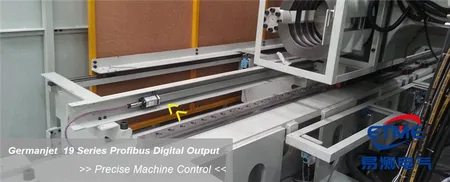
Magnetostrictive Displacement Sensor Series 199: PROFINET RT, IRT and Device Names
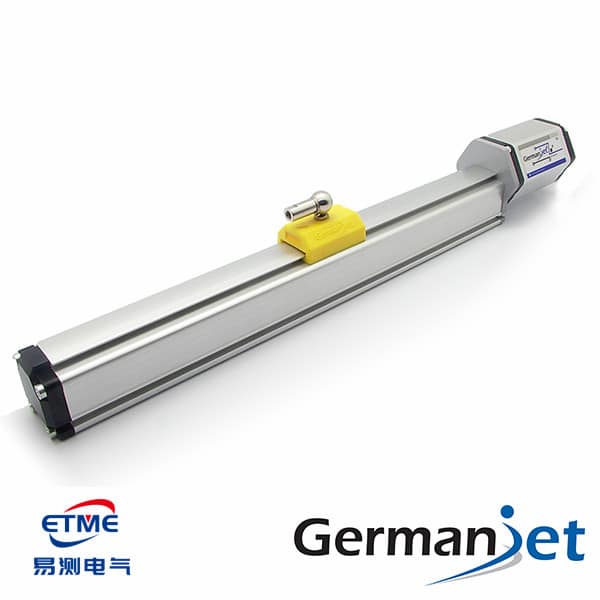
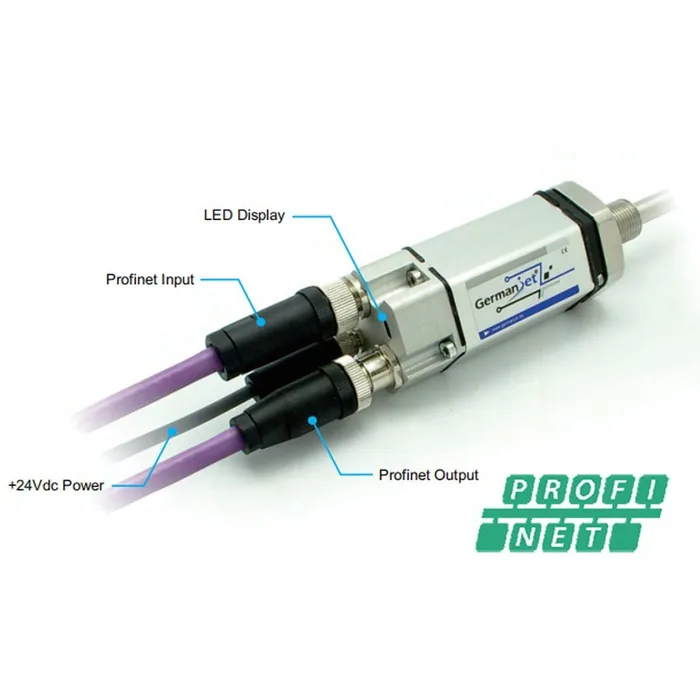
The 199PROFINET series is Germanjet’s PROFINET fieldbus magnetostrictive displacement sensor, aimed at industrial-Ethernet sites built mainly on Siemens control systems. PROFINET has three real-time classes: non-real-time (NRT), real-time (RT) and isochronous real-time (IRT). IRT reserves fixed time slots for cyclic data through a pre-planned communication schedule, achieving highly deterministic synchronised transmission, suited to coordinated multi-axis motion. Measuring performance of 199PROFINET matches the rest of the range — absolute position output, resolution steps 1–100 μm, repeatability of the order of ±0.002 mm, typical non-linearity <0.02% FS.
The essential difference between RT and IRT
| Item | RT real-time | IRT isochronous real-time |
|---|---|---|
| Scheduling | Priority tagging; transmission is seized by priority | Pre-planned time slots; cyclic data exclusively occupy reserved bandwidth |
| Determinism | Fair, but jitter exists | High; jitter is strictly limited |
| Topology requirement | Relatively loose | Must match the planned topology in the engineering configuration |
| Hardware requirement | Standard PROFINET device | Device and switch must support IRT |
| Configuration effort | Medium | High; topology planning and sync-domain configuration required |
| Typical use | General process data, status monitoring | Multi-axis coordination, high-dynamic position closed loop |
The selection criterion is clear: if strict multi-axis synchronisation is not needed, use RT; use IRT only when it is needed. IRT brings determinism and also constraints — topology must be fixed and match the configuration; plugging into a different port may report a topology error. That is the most common IRT field cause of “it stopped working after we changed the wiring”. Basic concepts of IRT and device names are in PROFINET introduction: IRT and device-name assignment.
Device-name assignment: the PROFINET entry threshold
Unlike other Ethernet protocols that address by IP, PROFINET identifies devices at run time by device name; the IP address is assigned and downloaded by the controller at start-up. The engineering meaning of this mechanism is:
- A new device going live must first be assigned a device name, which must match the name in the configuration exactly (including case and separator rules), or the controller cannot find it;
- When replacing a device it is enough to write the device name into the new device; the configuration need not be changed — this is the PROFINET design for easier maintenance, provided the site knows the original device name;
- A duplicated device name causes an identification clash, as fatal as an IP clash.
In practice the device name should match the electrical-drawing tag (for example named by station or axis number) and a label should be fitted on the device. Going live on a “scanned default name” alone makes later maintenance very confused.
GSDML and the configuration flow
The description file for a PROFINET device is GSDML (XML format), with stronger descriptive capability than a Profibus GSD. A typical configuration flow: import GSDML → add the device in hardware configuration → assign device name and IP → configure modules and I/O data → (if needed) plan topology and sync domain → download and start.
Three easy mistakes:
First, GSDML version does not match firmware. The symptom is missing module options or a parameter error after the configuration is downloaded.
Second, I/O data length does not match reality. The byte count of the position value, and whether a status word is included, must match the configuration, or the data that are read will be misaligned.
Third, IRT topology does not match the actual wiring. After topology is planned, any port swap triggers a topology diagnostic alarm. A wiring change must be accompanied by a configuration change. PROFINET diagnostics and topology identification are in PROFINET diagnostics and the truth about topology.
What IRT isochronous synchronisation means for displacement measurement
The value of IRT appears in multi-axis systems: position acquisition and control output of the axes are placed in fixed time slots on the same time base, so the multi-axis data the controller receives represent the system state at the same instant. Without synchronisation, axis data are scattered at different instants within the cycle; in high-dynamic motion the inter-axis deviation that is then calculated already contains error, and synchronised-control accuracy is limited.
The same physical boundary applies: bus synchronisation cannot remove the sensor’s own measuring delay. The magnetostrictive update rate depends on torsion-wave travel time; the longer the measuring range, the slower it is — typically about 0.5 ms to 5 ms, depending on measuring range. A multi-axis synchronised system should therefore as far as possible choose sensors of similar measuring range, and confirm that the bus cycle is not shorter than the sensor update rate — a cycle set shorter than the update rate will only repeatedly read the same value. Matching methods are in How to match response time / refresh rate to the control cycle; multi-axis configuration is in Selecting for multi-axis synchronisation.
Where 199PROFINET is suitable
New Siemens-system lines. The controller is an S7-1200/1500, the network backbone is PROFINET, the sensor joins directly, no gateway is needed, and engineer familiarity is high.
Lines that need to fuse with the upper IT network. PROFINET is based on standard Ethernet, so it is convenient to share a segment with MES and data-acquisition systems or to interconnect through a switch, suiting digital-conversion projects.
High diagnostic demand. PROFINET supports rich diagnostic alarms and topology identification, locating to a specific port; fault-finding efficiency is higher than with a conventional fieldbus.
Lines upgrading from Profibus. When an existing Profibus network (see Series 195 Profibus explained) migrates to Ethernet, PROFINET is the smoothest path within the same system.
Choosing against EtherCAT
| Dimension | PROFINET (199PROFINET) | EtherCAT (197 / 198) |
|---|---|---|
| Ecosystem | Mainly Siemens systems | Beckhoff systems and a wide range of third-party masters |
| Description file | GSDML | ESI (XML) |
| Device addressing | Device name + controller-assigned IP | Physical position (series order) |
| Synchronisation | IRT time-slot reservation | DC distributed clocks |
| Network hardware | IRT-capable switch required | Slaves forward themselves; no switch needed |
| Topology flexibility | Star/tree supported; must be fixed under IRT | Mainly linear series |
| Reason to choose | Consistent with the existing Siemens control system | Shortest cycle and strongest real-time performance |
The decision principle is not which protocol is more advanced, but follow the master system. Whatever the master is, that is what the sensor should be; adding a gateway across systems only adds a fault point. On the EtherCAT side see Series 197 EtherCAT explained and Series 198 single M12 explained; the full trade-off among the four fieldbuses is in Comparing the whole fieldbus range. Product pages: 199PROFINET series, Series 197 EtherCAT, Series 194 CANopen. General fieldbus wiring points are in Fieldbus practical guide.
Practical tips for engineers
- The Series 19 analog programming tool can set the zero and end values anywhere within the nominal factory stroke range.
- The Series 19 Profibus simulator can check sensor functions, read magnet-ring positions and diagnostic data, and change the slave address.
Frequently Asked Questions
Q: How should PROFINET RT and IRT be chosen?
If strict multi-axis synchronisation is not needed, use RT; use IRT only when it is needed. IRT reserves bandwidth for cyclic data through pre-planned time slots, with high determinism and low jitter, but the device and switch must support IRT, and the actual wiring topology must match the planned topology in the configuration. Plugging into a different port will report a topology error.
Q: What is a PROFINET device name for, and why not use IP?
PROFINET identifies devices at run time by device name; IP is assigned and downloaded by the controller at start-up. The benefit is that replacing a device only requires writing the original device name into the new device; the configuration need not be changed. The premise is that the device name matches the configuration exactly and the site knows the original name, so the device name should match the electrical-drawing tag and a label should be fitted.
Q: What are common PROFINET configuration errors?
Three classes: GSDML version does not match device firmware, appearing as missing module options or a parameter error after download; I/O data length does not match reality, so the data that are read are misaligned; IRT planned topology does not match the actual wiring, triggering a topology diagnostic alarm. After a wiring change the configuration must be changed in step.
Q: Does IRT isochronous synchronisation improve displacement-measurement accuracy?
IRT improves the time consistency of multi-axis data, not the measuring accuracy of a single sensor. It places acquisition and output of the axes in fixed time slots on the same time base, so that axis data do not represent different instants. The sensor’s own measuring delay still exists, and the bus cycle should not be shorter than the sensor update rate.
Related Products
Related Applications
Series 19D Split-Type Process Displacement Sensor Application Cases
View Details
Series 19F Flexible Process Displacement Sensor Application Cases
View Details
Series 19H Cylinder-Integrated Process Displacement Sensor Application Cases
View Details