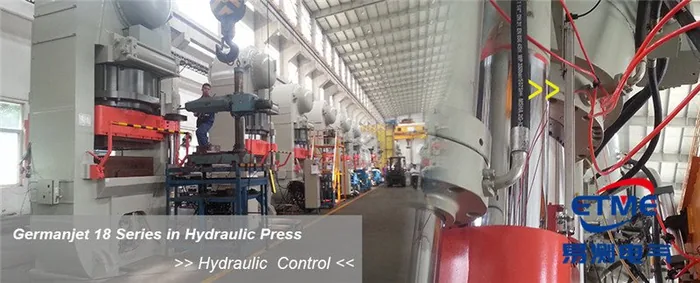
Servo Press Accuracy Loop: In-Cylinder Displacement Sensor on the Slide
A magnetostrictive displacement sensor on a servo hydraulic press closes the slide loop, so pressing accuracy is essentially the accuracy of the slide position loop: a pump-controlled servo system regulates flow to a position command, the main-cylinder displacement sensor reports actual position, and the pressing end point, hold position and speed-switch points are all judged from this one feedback. To achieve micrometre-level pressing the sensor must satisfy three points at once — repeatability of the order of ±0.002 mm, a 1–2 μm resolution step, and an update rate faster than the position-loop control cycle. If any of the three is missing, the closed loop shows end-point overshoot, hold jitter or batch-to-batch scatter of pressing depth.
Three tasks of position feedback in the position loop
The first is end-point positioning: the in-position criterion is taken from the position reading, so repeatability of the position feedback equals consistency of pressing depth. The second is speed-curve shaping: the switch points of fast-down, working feed, slow pressing and return are triggered by position; a jumping feedback lets the switch point drift and leaves a speed-step mark on the workpiece surface. The third is four-corner levelling: a large-platen press has one displacement channel at each corner; the controller compares the four readings and controls each corner cylinder so that the slide stays level. Levelling accuracy is limited by consistency among the four sensors, not by the rated accuracy of one — handling of this multi-axis consistency is in The Three Accuracy Terms of Magnetostrictive Sensors: Resolution, Repeatability and Non-Linearity.
Why high-accuracy pressing prefers the in-cylinder type
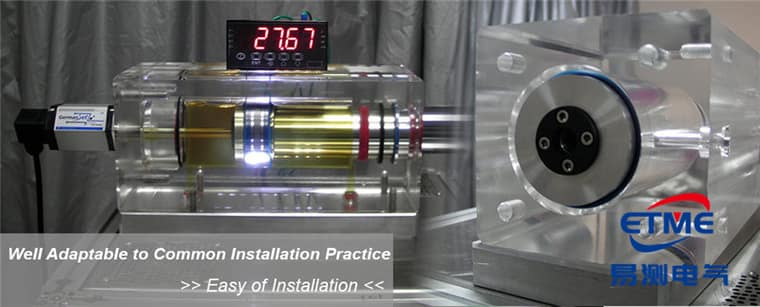
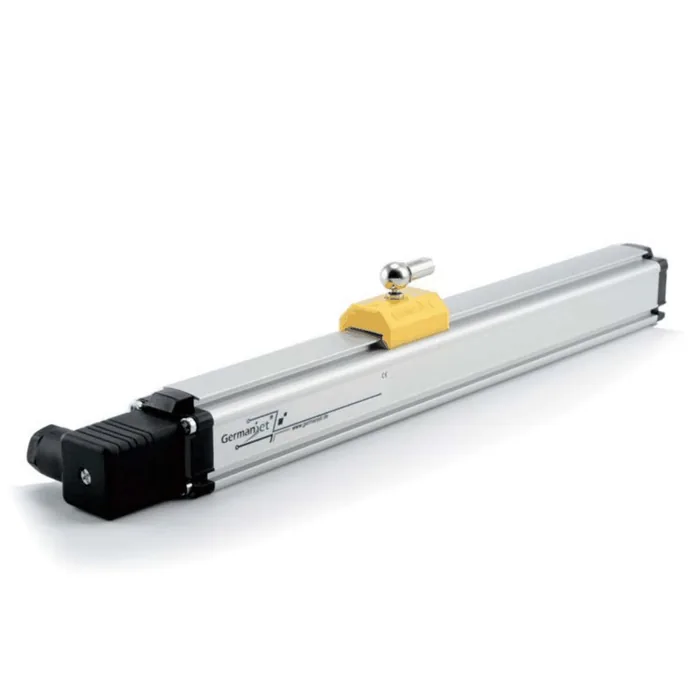
Displacement measurement of the press main-cylinder stroke can be done in two ways: in-cylinder (the rod in a deep piston-rod bore) and external (the body fixed on the machine frame, the magnet following the slide). High-accuracy pressing recommends the in-cylinder type because the measuring chain is shorter — it measures piston position relative to the barrel directly, without slide-guide backlash, frame elastic deflection or bracket thermal deflection in between; an external type puts all of those errors into the measuring chain. The premise of the in-cylinder type is that the piston rod can be deep-bored (minimum bore generally ≥12.7 mm) and that the pressure rating covers system pressure (by series: Series 16/16R is 350 bar working / 530 bar peak, Series 17/17EX is 350/600 bar, Series 19 in-cylinder is 300/600 bar). Integrated products are in Series 17 hydraulic-cylinder integrated, in-cylinder in Series 16 cylinder-integrated, and dual-channel duty with a high safety requirement in Series 16R redundant in-cylinder.
Pressing-accuracy need versus configuration
| Accuracy need | Resolution step | Recommended mounting | Recommended interface | Key check |
|---|---|---|---|---|
| ±0.1 mm class (general press-fitting) | 10–20 μm | External or in-cylinder | 4-20 mA | Range and non-linearity conversion |
| ±0.01 mm class (precision pressing) | 2–5 μm | In-cylinder | SSI / fieldbus | Repeatability, update rate |
| μm class (high-accuracy forming) | 1–2 μm | In-cylinder, short range | EtherCAT (DC synchronisation) | Non-linearity (<0.02% FS) converted on range; thermal drift |
| Four-corner levelling | 2–5 μm | Four in-cylinder channels, same model and batch | Fieldbus synchronous sampling | Inter-channel consistency and synchronism |
Matching update rate to the control cycle
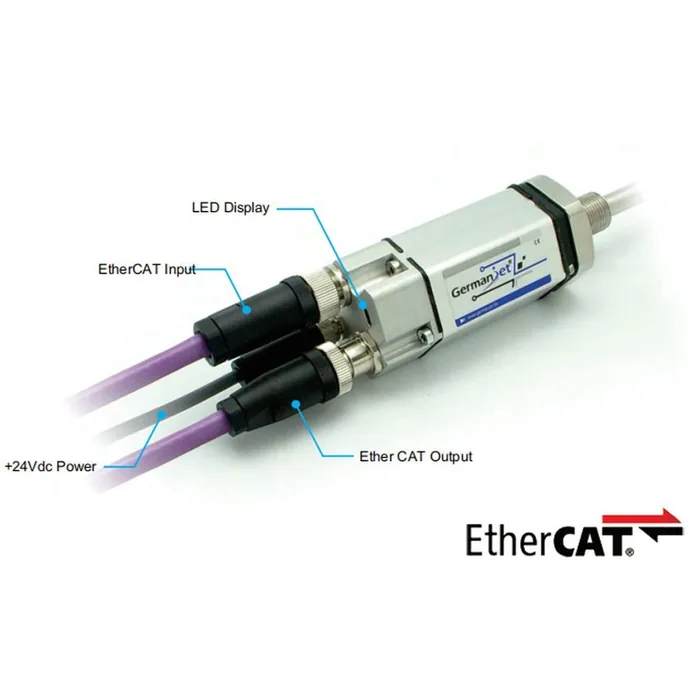
The position-loop control cycle is usually of millisecond order; sensor update rate varies with range (about 0.5 ms to 5 ms depending on model and range). If the update rate is slower than the control cycle, the regulator reuses the same position value between updates, equivalent to inserting pure lag, seen as a small end-point oscillation or a “nudge” after pressing in; a refresh slower than the loop causes end-of-stroke settle jitter, and EtherCAT distributed clock is preferred for four-corner levelling. Four-corner levelling is more sensitive to synchronism: the four channels must be sampled at the same instant. Analog scanning channel by channel introduces inter-channel time offset; then prefer an EtherCAT model that supports distributed clocks (Series 197 EtherCAT). Configuration is in How to Connect Magnetostrictive Displacement Sensors to a Fieldbus. Matching principles are in Matching Response Time and Refresh Rate to the Control Cycle.
Thermal drift and calibration: a step that precision pressing cannot skip
In continuous production oil temperature rises and the cylinder, frame and sensor expand together. Sonic-velocity thermal drift on the sensor side can be eased by internal compensation of the model (the principle is in Do Sensors Need Warm-Up? Self-Heating, Thermal Equilibrium and the Real Magnitude of Temperature Effects), but mechanical thermal deflection cannot be compensated by the sensor and must be handled in the process: either calibrate after the machine is hot, or apply a position correction in the controller from oil temperature. After installation a full-stroke calibration should be done, recording reading versus true-value deviation at several datum points; the method is in Factory Calibration and Linearisation. The overall hydraulic closed-loop background is in Why Choose Magnetostrictive Sensing for Hydraulic Cylinder Position Control; differences of forging impact duty are in Position Feedback for Forging Hammer Rams.
Engineering application notes
- A 6600-tonne two-platen injection molding machine used a Series 19 7600 mm-stroke CANBus scheme for full-stroke clamp-position feedback.
- Die-casting clamp speed can reach 10 m/s; choose a digital-interface model with a sufficiently fast response.
- Steel-mill roll-gap control has used Series 19 with SSI output; woodworking formers and packaging machines (IP67 environments) are often fitted with Series 17/18.
Frequently Asked Questions
Q: What resolution should a servo hydraulic press use?
Precision pressing should use a 1–10 μm step; finer steps help trim the hold position, but non-linearity and repeatability must be met at the same time, otherwise the result is only a precise error.
Q: How does repeatability affect pressing quality?
It directly determines consistency of pressing depth from shot to shot. Repeatability of typically ±0.002 mm is the reliable guarantee that the closed loop returns to the target position.
Q: How can displacement be used for overload protection?
Compare slide position in real time with the target curve and reduce load or emergency-stop on deviation; with absolute position retained on power loss, there is no need to re-home after a mould change.
Related Products
Related Applications
Multi-Industry Application Cases for Magnetostrictive Displacement Sensors
View Details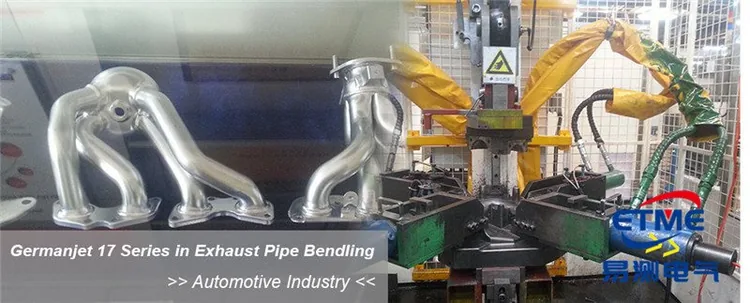
Series 16 Hydraulic Rod Magnetostrictive Displacement Sensor Application Cases
View Details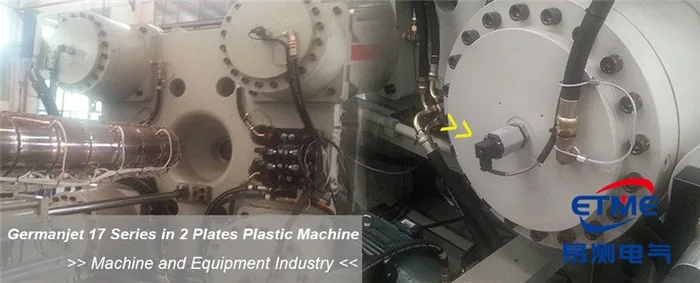
Series 17 Hydraulic Cylinder Integrated Magnetostrictive Displacement Sensor Application Cases
View Details