
Acceptance of a Magnetostrictive Displacement Sensor: Arrival Checks and a 10/50/90 Percent Round-Trip Test
Acceptance of a magnetostrictive displacement sensor runs on arrival and again after install; the arrival check stops you mounting a wrong or damaged unit. The value of acceptance testing is to stop problems before production starts. Effective acceptance has two levels: incoming acceptance confirms that the right goods arrived and that there is no transit damage; installed acceptance confirms that, once fitted, the measurement is accurate and stable. The most common mistake is a single-point check — a pass at one point does not represent a pass over the full stroke. This article gives the check items at both levels, the three-point round-trip method and the principles for setting criteria. For the meaning of accuracy figures, see the three accuracy terms; for the calibration method, see zero calibration step by step.
1. Incoming acceptance: five checks
| Check item | What to verify | Consequence of a fail |
|---|---|---|
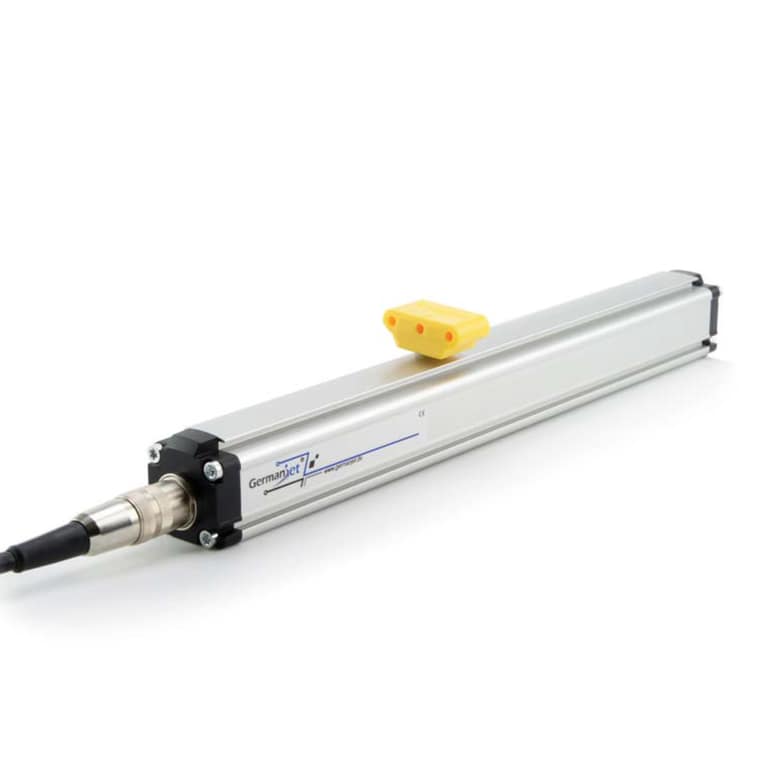
| Model and specification | Nameplate model, range, output form and connector match the order | Will not fit or will not connect; see spare parts replacement |
| Resolution step | Is the ordered step (one of 1/2/5/10/20/50/100 μm) | Reading step size does not match the control need |
| Appearance and mechanics | Rod straight with no bend, flange threads intact, connector undamaged | Transit damage appears after installation as a local jump |
| Accessories | Position magnet, seals, connector and documentation complete | No magnet means no test; see no-output troubleshooting |
| Special requirements | Pressure rating by series (16: 350/530, 17: 350/600, 19 in-cylinder: 300/600), protection class and explosion-protection documents match | Compliance risk; see hazardous-area installation |
On arrival, run a bench power-up test: move a test magnet along the full rod and confirm that the reading is continuous, monotonic and free of jumps. This step can find transit damage before installation, at very low cost. The method is in use a test magnet to verify in 5 minutes. Note that a bench test can only judge "does it work, does it jump", not accuracy.
2. Installed acceptance: the three-point round-trip test
Execute this after installation, wiring and calibration. It is the core of acceptance.
- Select three positions at 10%, 50% and 90% of the range (avoid the dead zones at both ends; see measurement dead zones);
- From zero, reach the three points in the forward direction; after each point has settled, record the sensor reading and the measured mechanical position;
- Continue to the end of the stroke, then return in the reverse direction and record again at the same three points;
- Repeat the round trip several times to form a data set;
- Compute two figures: the indication error at each point (reading minus measured value) and the forward–reverse reading difference at the same point.
Drive to 10, 50 and 90 percent in both directions; a reading that only agrees one way means backlash or mounting slip, not a failed sensor. Principle for setting criteria: indication error should be referred to the non-linearity figure (typically <0.02%FS) converted for this range — the same 0.02%FS is about ±0.02 mm on a 100 mm range and about ±0.8 mm on a 4000 mm range; the absolute error on a long range is naturally larger, which is set by the range base. The forward–reverse difference should be referred to repeatability (of the order of ±0.002 mm), but recognise that this value comes from laboratory conditions and will degrade on site with mechanical backlash, vibration and temperature drift. Leave a reasonable margin for the actual duty.
3. Additional static and dynamic items
- Static stability: hold the machine at a position for a period and watch whether the reading drifts. Drift points to temperature drift, an unstable supply or interference; see the signal-jump troubleshooting flow;
- Interference-duty test: start and stop inverters, solenoid valves and high-power loads as in actual duty, and watch reading fluctuation. This item is the most often skipped, yet it is the main source of faults after production starts; see on-site EMC remediation reviewed;
- Power-loss recovery test: power down and up again, and confirm that the reading returns immediately to the correct value. Magnetostrictive output is absolute position and needs no homing (see absolute vs. incremental). If the reading is wrong after power-up, the calibration parameters were not saved;
- Dynamic following test: cycle at the actual running speed and confirm that the update rate meets the control-cycle requirement; see response time and the control cycle;
- Fieldbus extra: record the error-frame count and drop-out count over a period as a baseline; see fieldbus data loss.
4. What the acceptance record should keep
Acceptance without a record is as if it were not done. Keep at least five items: model and serial number, calibration parameters (raw zero / raw full-scale / measured stroke), the three-point round-trip data table, observations from the static and interference-duty tests, and the acceptance date and personnel. This record is extremely valuable in later troubleshooting — any judgement that "it has recently become inaccurate" needs a baseline of "it was accurate then" for comparison. The analysis method for reading errors is in tracking down reading errors. Multi-axis machines should also record the inter-axis-difference baseline; see synchronizing multiple sensors.
5. Common acceptance pitfalls
- Testing only one point: agreement near zero does not mean agreement over the full stroke; that is how a proportional error is missed;
- Forward only: without reverse, mechanical backlash and a loose magnet are not found;
- Accepting cold, producing hot: accepting before hydraulic-oil temperature has stabilised lets the zero "run away" after production starts; see installing in high temperatures;
- Using an unreliable reference: measuring a long range with a tape, the reference itself may have a larger error than the sensor;
- All interference sources stopped during acceptance: stability measured in a quiet environment says nothing about stability in production.
Product-side note: cylinder-integrated types (Series 16 cylinder-integrated, Series 17 hydraulic-cylinder integrated) should also include a system pressure-hold test to confirm there is no leakage; external types (Series 18 external, Series 13 mobile hydraulics) should additionally confirm that the bracket does not deflect under full load; see external installation.
Frequently Asked Questions
Q: Why can acceptance not test only one point?
A pass at one point does not represent a pass over the full stroke. When agreement near zero is good, a proportional error from a wrong span coefficient is completely invisible; forward only, without reverse, does not find mechanical backlash or a loose magnet. The specified method is a forward and reverse round trip at 10%, 50% and 90%, repeated over several cycles.
Q: Can the interference-duty test be omitted?
It should not be omitted. Stability measured in a quiet environment says nothing about stability in production. A large share of post-production faults comes from interference when inverters, solenoid valves and high-power loads start and stop. During acceptance, start and stop those devices as in actual duty, watch reading fluctuation and record a baseline.
Q: What should the power-loss recovery test look for?
After power down and up, the correct position value should be read immediately, with no homing. If the reading is wrong after power-up, the calibration parameters were not truly saved. A common case on fieldbus types is writing a zero offset online without executing the store command. Finding this at acceptance costs far less than finding it after production starts.
Q: What should the acceptance record keep at a minimum?
At least five items: model and serial number; calibration parameters (raw zero, raw full-scale, measured stroke); the three-point round-trip data table; observations from the static and interference-duty tests; and the acceptance date and personnel. Any later judgement that the reading is inaccurate needs a baseline of an originally passing record for comparison.
Related Products
Related Applications
Multi-Industry Application Cases for Magnetostrictive Displacement Sensors
View Details
Series 16 Hydraulic Rod Magnetostrictive Displacement Sensor Application Cases
View Details
Series 17 Hydraulic Cylinder Integrated Magnetostrictive Displacement Sensor Application Cases
View Details