
Port Crane Spreader Position: Salt Air, Sway, Power Loss
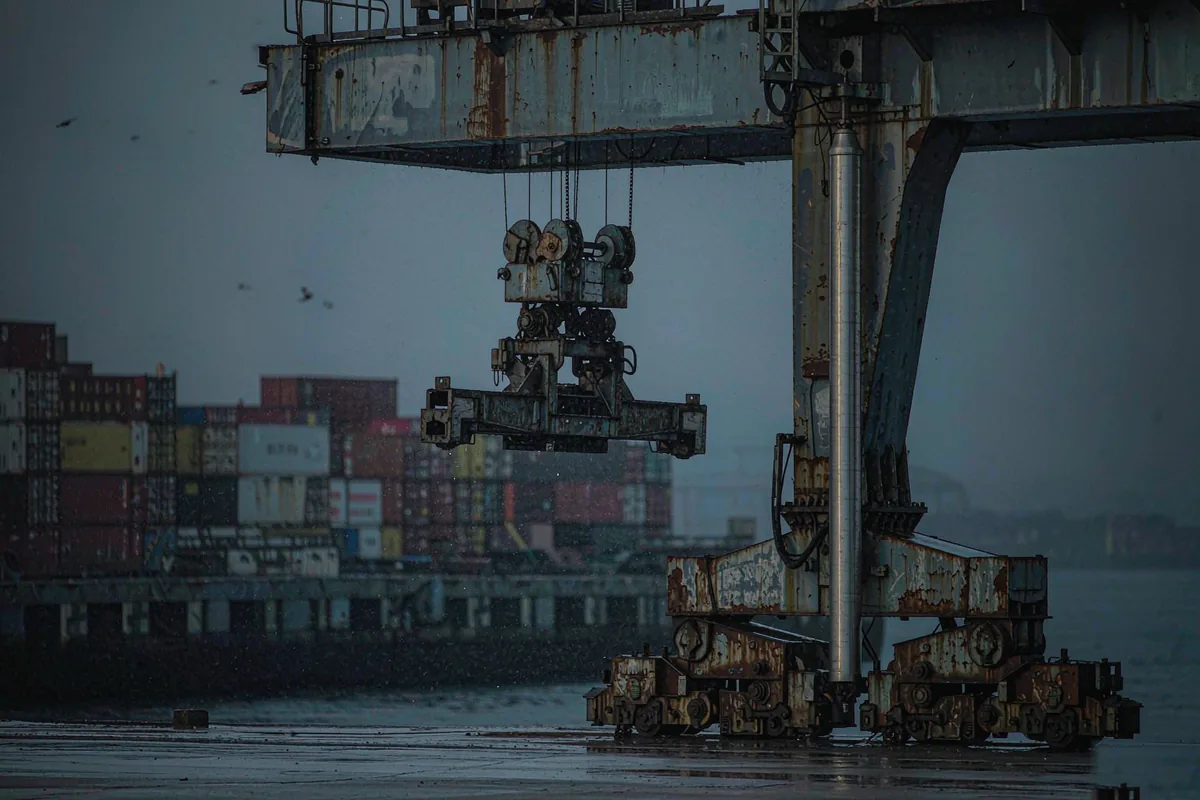
What stops a position measurement project on port equipment is rarely accuracy. Hoist height is covered well enough by encoders and limits; the points that need a real continuous value are the luffing cylinder, grab opening and spreader tilt. The hard part is the environment: salt air, day-night temperature swing, constant sway from wind load, and the need to know immediately where the spreader sits after a power cut.
Four Points That Need a Continuous Value
- Luffing cylinder stroke.Sets boom angle and working radius. On hydraulic luffing gantries and ship loaders this is the main measuring point, with strokes of several metres.
- Grab opening.A hydraulic grab opens and closes on a cylinder; opening decides how much is picked up and whether the bucket empties cleanly.
- Spreader tilt and telescope.Tilt angle and telescopic beam position are short-stroke, high-repeatability measurements.
- Gantry and trolley travel.From tens to hundreds of metres; encoders with correction points are the right tool, not a magnetostrictive displacement sensor.
The dividing line is the same as anywhere: continuous value, closed loop, position known after power loss — use it. Counting or arrival only — encoder and limit switch are cheaper.
After a Power Cut You Must Know Where the Spreader Is
Port machines get moved, isolated and shut down between shifts constantly. If the system does not know hoist height when power returns, the choices are a forced homing cycle (slow and risky) or manual confirmation before releasing interlocks. This is where absolute position pays for itself:no zero is lost, the value is readable on power-up, and there is no homing move.
The same logic holds at pump stations and gates, see pump station cylinder reads original opening after power loss; long-stroke gate hoist practice is in long-stroke gate hoist.
What Salt Air and Temperature Swing Demand of Sealing
Corrosion at the coast is not uniform — connectors, weld seams and bolted gaps go first. Three things matter in selection:
- Probe material and housing treatment.Pick probe and housing for the corrosion requirement; do not move an indoor model onto a quay. At least IP67, and where washdown or spray hits directly, read it as IP69K.
- Connector sealing.M12 is easier here than DIN styles: tighten it properly and it seals. But the O-ring is a wear item on a replacement cycle, not a fit-once part. See choosing a sealed connector.
- Breathing from day-night cycling.Temperature difference pushes air in and out through the weakest seal, carrying moisture with it. Pointing cable entries down and adding a drip loop beats raising the IP number.
Long Stroke and Sway: The Connection Matters More Than the Sensor
Luffing cylinders have long strokes and rarely sit where you would like, so two problems have to be solved together:
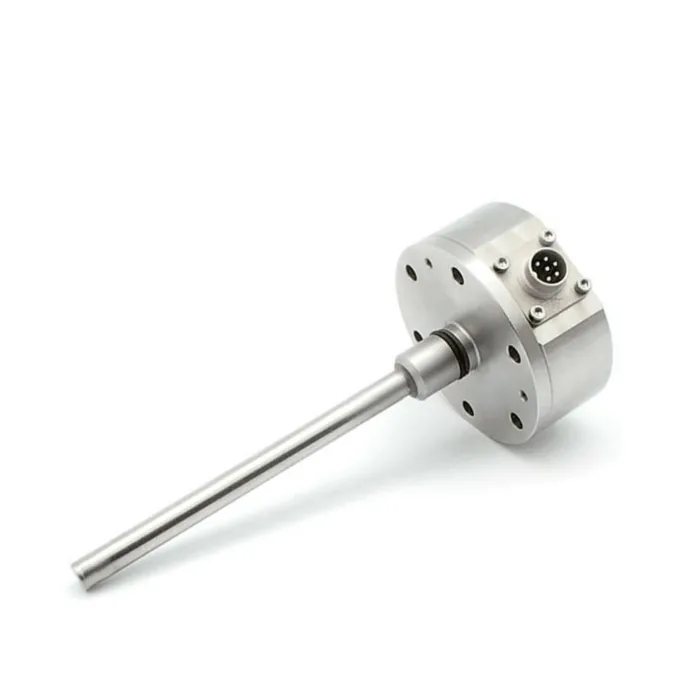
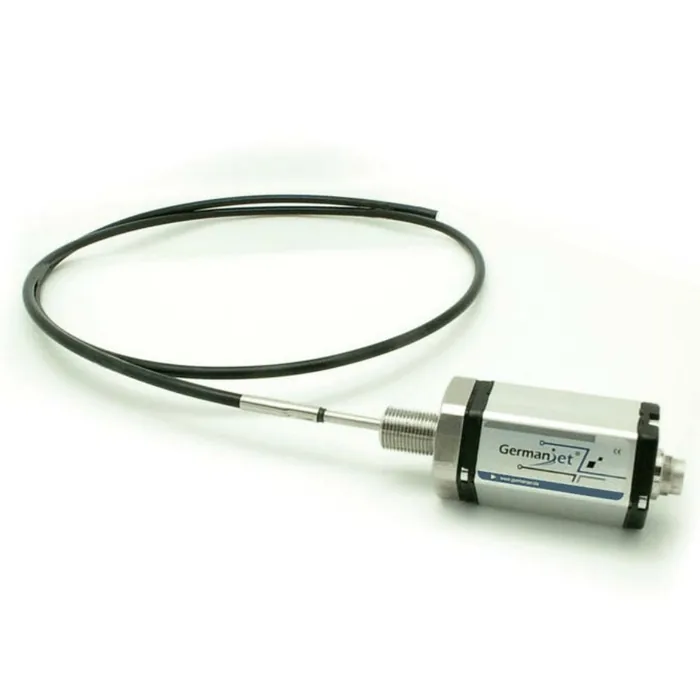
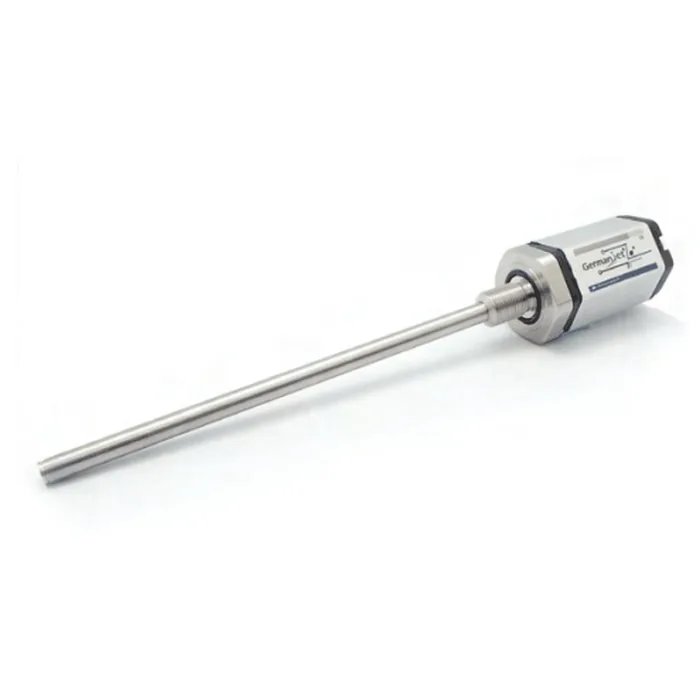
- Long stroke.An in-cylinder design keeps the probe inside the barrel and removes most of the geometry problem — Series 16 in-cylinder. Where the barrel cannot be bored and the stroke is very long, Series 19F flexible uses a bendable probe routed along the machine.
- Sway and misalignment.Wind load keeps the boom moving slightly, so the probe-to-magnet connection must absorb angular deviation; a rigid link feeds all the side load into the probe. On floating mounts and parallelism see building a stable mounting bracket, and installation and commissioning for the full procedure.
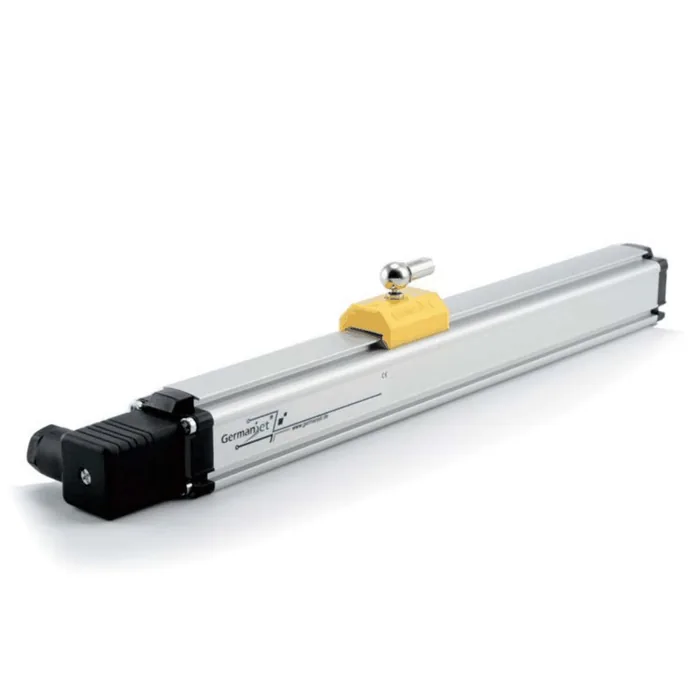
External types are common on retrofits: no barrel work, at the cost of separate mechanical protection — Series 18 external. On long horizontal runs the probe sags at mid-span and that has to be dealt with first, see horizontal mounting and probe sag; dead zones at both ends still have to be deducted, see effective stroke and dead zone.
Choosing Output and Protocol
Port control systems are replaced slowly, so one machine often carries both an old PLC and a new network. Output choice has to respect that reality.
- Single-point retrofit, old system untouched: analogue is simplest — Series 19 analogue.
- Absolute position without touching the protocol stack: SSI — Series 19 SSI, and mind cable length against clock rate, see SSI cable length and clock.
- New build or fully networked machine: CANopen, EtherCAT or PROFINET, following the master — see choosing a bus from the PLC hardware.
Three Things Easily Missed on Site
- Lightning and surge.A quay is a high-lightning area and a long cable is an antenna. Surge protection on signal lines plus single-end shield earthing does more than a higher IP rating.
- VFD and shore power interference.Large drives sit right next to the equipment; separate the routing and avoid long parallel runs with power cable. Reasoning and troubleshooting in EMC and strong magnetic fields.
- Short maintenance windows.Downtime is expensive at a terminal, so price in how fast a part can be changed: connector type, access space and spares commonality all turn into downtime hours.
Ship steering gear and hatch cover cylinders see similar conditions, see ship steering gear and hatch cover cylinders; walk the five selection steps before fixing a part number, see five-step selection.
Frequently Asked Questions
Q: Why not measure luffing travel with an encoder?
An encoder measures motor or drum rotation, with rope, sheaves and accumulated error in between, and it needs periodic re-referencing. A luffing cylinder directly reflects boom angle, so absolute measurement on the cylinder is simpler and needs no homing after a power cut.
Q: What IP rating is needed at the coast?
At least IP67; where washdown or direct spray occurs, read it as IP69K. But the rating only describes a housing test condition — O-ring ageing and cable entry orientation usually decide real service life more than the number.
Q: Is position lost after a power cut?
A magnetostrictive sensor measures the physical position of the magnet, so it knows where the magnet is with no power applied and reads on power-up without homing. What can be lost is configuration such as bus parameters, which depends on being written to non-volatile memory. Two different things.
Q: Does continuous sway from wind load affect the reading?
Yes, but the effect is mechanical. Sway generates side load between probe and magnet, and a rigid link feeds that load into the probe, causing wear and occasional dropouts over time. A floating connection that absorbs angular deviation is the real fix, not electrical filtering.
Related Products
Related Applications
Series 16 Hydraulic Rod Magnetostrictive Displacement Sensor Application Cases
View Details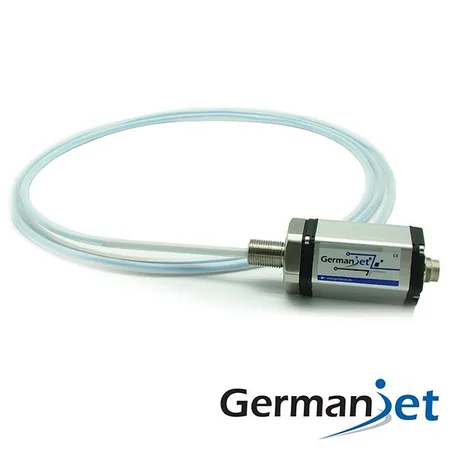
Series 19F Flexible Process Displacement Sensor Application Cases
View Details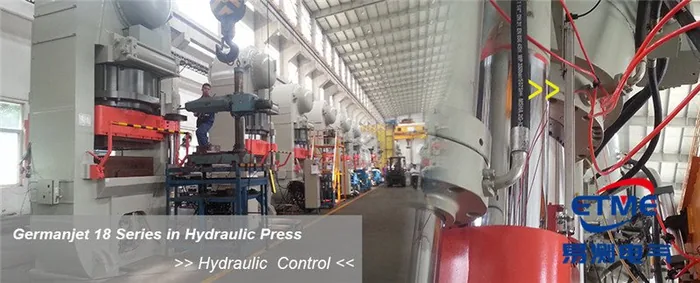
Series 18 Profile Magnetostrictive Displacement Sensor Application Cases
View DetailsWhatever the question above, it comes back to the same device.magnetostrictive displacement sensorThe product range lists every series by stroke, mounting style and output interface, which is the quickest way into a selection.
← Back to News